
The Tank Looks Simple Until You Stand Too Close to It
I sat down with Mike and Bobby to talk about LP gas, and within about thirty seconds the first myth got dragged into the light. Most people call it “liquefied propane,” because that is the word they know from the backyard grill, the camp stove, or the forklift parked behind the big box store. Bobby was quick to swat that down. LP is liquefied petroleum gas, not just propane, and that distinction matters because what we treat as one familiar fuel is often a blend. Propane may be the star of the show, but butane and propylene can be in the mix depending on the intended use, climate, and performance needs.
That sounds academic until you remember what we are really talking about: a flammable gas stored as a pressurized liquid, moving through neighborhoods, warehouses, farms, mechanical rooms, and loading docks every day. The public sees a white tank and thinks “grill.” Responders see a white tank and should immediately start thinking about expansion ratios, relief devices, fill density, ignition potential, and whether the problem in front of them is a vapor-fed event or a liquid-fed one.
Even the smell most people associate with propane is a lie, though a useful one. LP gas in its natural state is odorless. The warning odor is added during manufacture, most commonly with ethyl mercaptan, because the human nose can pick it up at vanishingly small concentrations. Mike and Bobby recalled a call in Manhattan where a tiny amount of mercaptan had been released inside a building, and the odor carried for blocks. That story landed because every hazmat tech knows the weird split between chemistry and psychology on these runs. A trace odor can trigger panic across an entire neighborhood. At the same time, the familiarity of that odor can lull people into treating it casually, as if “smells like gas” is a nuisance call instead of the opening line to a fatal incident.
White Paint, Bullet Shapes, and the Physics Nobody Sees
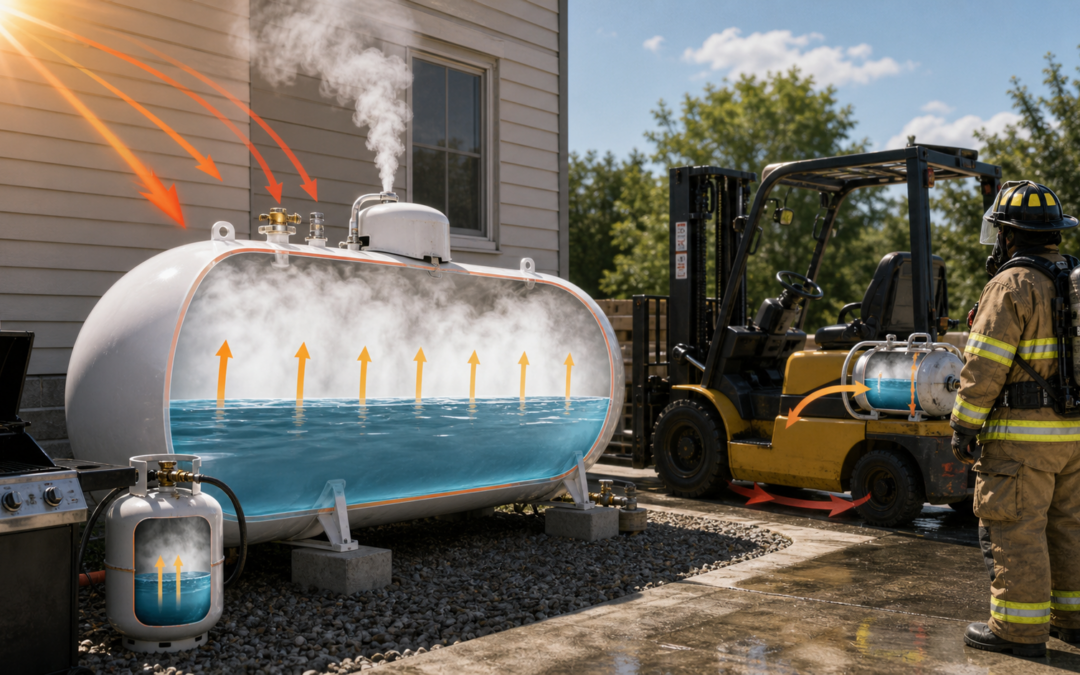
One of the smartest points Mike made was also one of the simplest: the tank is usually white for a reason. That color is not cosmetic. It reflects heat, and with LP products heat is everything. Stored product temperature drives expansion. Expansion drives pressure. Pressure drives the entire hazard profile.
That is why larger stationary tanks are typically horizontal, rounded at the ends, and built to manage internal pressure while minimizing heat gain. Residential and commercial tanks under ASME construction standards can range from the familiar backyard cylinder all the way up to large bulk installations. In some settings, especially where space is tight, vertical installations appear because the footprint matters. But the tactical question is not whether the tank is vertical or horizontal. The tactical question is always the same: what is the shell temperature doing, what is the product doing inside, and how much room is left for that product to move before the system starts protecting itself or failing.
Mike kept coming back to the industry habit of rating these containers in water capacity. That sounds like a paperwork detail until you understand why it exists. Water is predictable, easy to measure, and does not behave like LP. Propane and other LP blends expand dramatically with temperature. Water capacity gives everyone a stable reference point for container size, while the actual safe fill amount must account for product expansion. That is why the 80 percent fill rule matters so much under NFPA 58 practice. The empty space is not wasted space. It is life-saving space.
Bobby’s version was blunter, and probably more memorable. The guy at the fill station who “helps you out” by topping off a cylinder is not doing you a favor. He is setting the conditions for a pressure problem in your yard. Once an overfilled cylinder heats in the sun, the liquid expands, the headspace disappears, and the container can force liquid against the pressure relief device. That changes the release profile from an annoying whiff of vapor to a dangerous discharge that can rapidly escalate if an ignition source is nearby. This is where the hazmat lesson and the human lesson intersect. Most LP incidents do not begin with exotic failures. They begin with ordinary people trying to be helpful, efficient, or cheap.
Fill Stations: Where the Chemistry Meets Human Error
If there was one place in our conversation where the risk picture sharpened, it was the fill station. Mike called it out plainly: this is where human interaction with the system is constant, and that means the chance for error goes up. Connections are made and broken manually. Cylinders are handled, swapped, inspected, and sometimes overfilled. The hazard is not just the product. The hazard is the product plus routine plus complacency.
That is why some dense urban environments have sharply restricted where propane filling operations can occur. The fuel itself is common, but the act of transferring it introduces enough opportunity for failure that jurisdictions treat those sites very carefully. And they should. Every responder has seen the consequences of poor cylinder handling, damaged threads, bad seals, worn valves, or someone deciding the rules are flexible because they have “done it this way for years.”
What struck me most in talking with Mike and Bobby was how often LP emergencies are born in the gap between what the code expects and what the public actually does. Codes assume training, maintenance, proper outage, and intact equipment. Real life adds sun exposure, neglected cylinders, backyard storage, improvised refills, and the eternal confidence of the guy who swears he knows what he is doing.
Forklifts Change the Fight
The conversation took a sharp turn when we moved from residential and bulk storage into motor fuel cylinders, the tanks commonly seen on forklifts and similar equipment. This is where a responder can get hurt fast if they read the container wrong.
A grill cylinder usually feeds vapor. A forklift cylinder often feeds liquid. That one difference changes the fire behavior, the valve arrangement, and the urgency of your size-up. The service valve, fill valve, pressure relief device, and level indications may all be clustered on the tank, and the orientation of the cylinder matters because the system is designed around how that liquid is drawn off in service. Bobby and Mike emphasized a critical field lesson: do not waste precious time assuming that a small cylinder means a small problem. A liquid-fed LP fire can outrun your expectations.
They also made an important point about construction. Many larger stationary tanks fall under ASME design standards, but motor fuel cylinders have their own characteristics and vulnerabilities. In fire conditions, metal strength loss may become the real clock, not the relief setting. Responders love relief devices because they give us a sense that the container has a built-in warning system. But that confidence can become a trap. If the shell is degrading, the tank may fail before the situation unfolds the way we expect. The difference between a controlled release and a violent failure is often measured in minutes, heat exposure, and whether anyone recognized early enough that they were dealing with a liquid-fueled cylinder.
That is why Bobby’s advice, buried under the jokes, was so solid: identify the valves, understand the cylinder orientation, and when in doubt treat motor fuel cylinders as liquid service. On a noisy, smoky scene, you may not get a second chance to interpret the hardware.
The Hidden Propane Problem Inside Buildings
Most civilians think of LP outdoors: patio grills, home heating tanks, maybe a camper setup. But Mike pushed the conversation indoors, where LP becomes easier to miss and, in some ways, more dangerous. Forklifts in warehouses. Ceiling-mounted heaters in large occupancies. Standby generators waiting months for the moment they are suddenly needed. Refrigeration equipment using R-290, which is propane marketed as refrigerant.
That last point should get every responder’s attention. A flammable refrigerant inside a cooling system does not announce itself with the familiar mercaptan odor. No smell means no easy warning. The leak may reveal itself only when the concentration reaches an ignitable range and finds a source. That changes detection, evacuation, and entry decisions. It also changes the mental model. Too many people still hear “refrigeration unit” and think only in terms of pressure, frost, or mechanical failure. Some of those systems are carrying hydrocarbon fuel.
Mike noted another problem with standby equipment: infrequent use. Systems that sit idle are often the ones that fail when they finally cycle on. Seals dry out. Connections loosen. Small defects wait quietly until the day flow begins and vibration returns. The incident is not caused by the emergency power demand itself; it is caused by all the neglected time before it.
The Little Cylinders People Don’t Respect
By the time we got to one-pound camping cylinders, both Mike and Bobby sounded more irritated than amused. These tiny disposable containers get abused because they look harmless. They are tossed into trucks, rolled around in toolboxes, left in the sun, and, worst of all, refilled by people using aftermarket kits and bad judgment.
This is where responder frustration is justified. The public tends to reserve its fear for the giant tank in the field while ignoring the damaged disposable cylinder in the garage. But the small cylinder has all the same fundamentals: pressurized flammable product, mechanical connection points, and the potential for overfill or valve damage. The difference is that people respect it less.
And that disrespect is a recurring theme in every LP incident profile. Whether it is a 1-pound camping bottle, a 20-pound grill cylinder, a forklift tank, or a 1,000-gallon residential vessel, the story is usually the same. The chemistry behaves exactly as expected. The container behaves exactly as designed. Then a human being cuts a corner, ignores a warning, overfills a tank, stores it badly, misidentifies the valve, or assumes familiar means safe.
That is the real lesson Mike and Bobby drove home. LP is common, but it is never casual. The white tank in the yard, the cylinder on the forklift, and the refrigerant in the machine room all demand the same thing from us: respect the product, know the container, and never let routine talk you out of a proper size-up. If you train firefighters, drill this until they can recognize the setup in the dark. If you run calls, slow the scene down before the scene speeds you up. And if you work around propane every day, stop treating ordinary handling errors like part of the job. They are not. They are the beginning of the next fire.