Freezing Point: The Hidden Hazards of Cryogenics in Everyday Life
When I first sat down with Bobby Salvesen and Mike Monaco, I thought I understood cold. You know, winter frost, ice on the pavement, a chilly breeze. But by the end of our conversation, I realized I had no real grasp on what “cold” could do when it’s liquefied and concentrated. Cryogenics isn’t just a science- it’s a hazard, often hiding in plain sight, waiting to be mishandled.
“Technically, anything below minus 130 degrees Fahrenheit is considered cryogenic,” Mike explained, leaning back in his chair, eyes lighting up. But then he laughed, “Or, you know… just really cold shit.” The bluntness of it didn’t take away from the gravity of the warning: for first responders, an emergency involving cryogenic materials is nothing to underestimate. Even something “merely cold,” like a leaking propane tank at minus 40 degrees, can cause serious tissue damage if skin comes into contact with it. Labels and technicalities mean little when your body is in direct contact with extreme temperatures. The lesson was clear: cold emergencies demand the same vigilance whether or not the material qualifies as “cryogenic” by definition.
When Cold Becomes a Burn
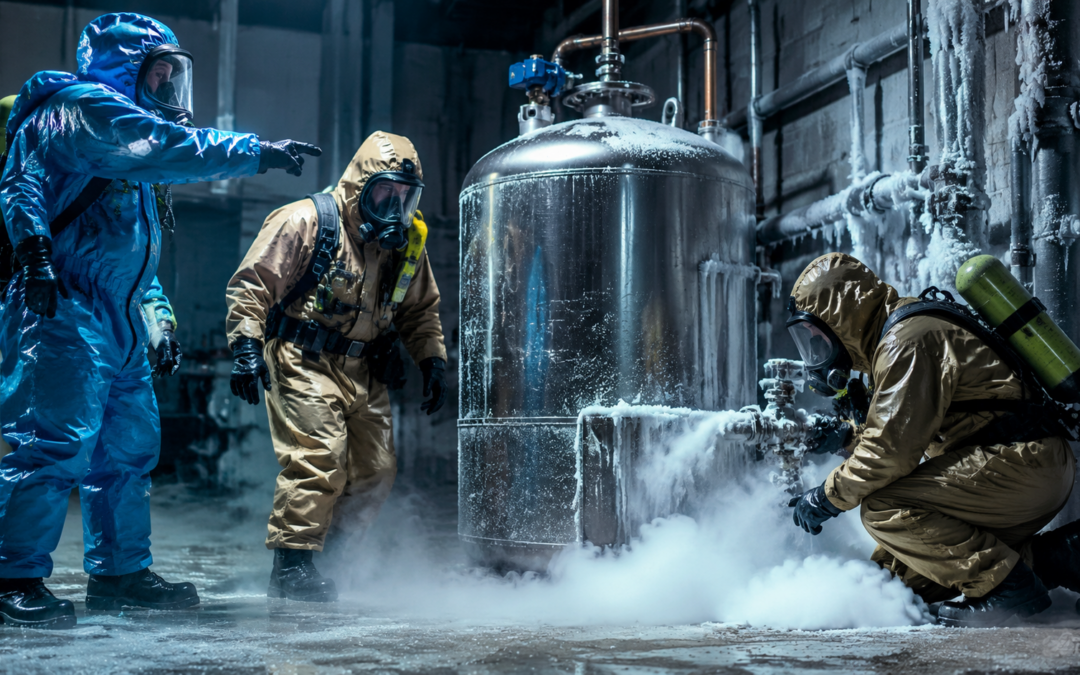
It’s easy to think of burns as a product of fire. But Mike and Bobby insisted I expand my perspective. “Thermal burns,” Mike clarified, “aren’t exclusive to heat. Cells burst from freezing the same way they do from boiling. The water inside crystallizes, expands, and ruptures the tissue.” Seconds matter. A brief touch of liquid nitrogen can irreparably damage skin. The danger extends beyond direct contact: any object exposed to cryogenic liquids will pluck heat from the surrounding environment, freezing anything it touches. Moisture on your hands or skin can bond to these objects, prolonging heat transfer and intensifying injury, just like sticking your tongue to a frozen flagpole, a cautionary tale from childhood experiments we all recognize but rarely internalize.
Mike framed it in thermodynamics: “Cold doesn’t exist, it’s just the absence of heat. Energy flows from high to low. The molecules in your hand vibrate; when they encounter a cryogenic object, that energy rushes out. That’s conduction. That’s why we respect it.” Physics isn’t abstract here; it’s survival.
The Multiplier Effect: Concentrated Danger
Beyond tissue damage, cryogenics poses a second, less intuitive hazard: the sheer concentration of energy in a minuscule volume. Liquefying gases reduces their volume by roughly 800 times, packing into one liter what would otherwise occupy 800 liters. This is more than a fun fact-it’s a tactical nightmare. As Bobby pointed out, “One tiny tank of liquid nitrogen or oxygen can displace the air in a confined space. That’s not just theoretical, it’s life-threatening.” Asphyxiation, oxygen-enriched atmospheres, and the hyperreactivity of flammable materials are all amplified in ways most people never anticipate.
Liquid oxygen, in particular, transforms the familiar fire triangle into a lethal force multiplier. Oxygen itself doesn’t burn, but it fuels combustion. Metals, plastics, and even normally nonflammable materials ignite with astonishing ease when oxygen concentration spikes. “A firefighter once got contaminated with liquid oxygen on his bunker gear,” Bobby recounted. “The areas where it touched literally burst into flames. That’s how dangerous it can get.” Even a seemingly inert environment, like a blacktop roadway, can become shock-sensitive, ready to react violently at the slightest spark.
Cryogenics in the Everyday
You don’t have to wander into a research lab to encounter these materials. In fact, they’re astonishingly common. Any place serving beverages at scale, think soda fountains, breweries, or fast-food chains, relies on cryogenic CO₂ for carbonation. McDonald’s, for example, uses industrial CO₂ tanks, sometimes called “McDoers.” These tanks are often stored in unconventional spots-basements, closets-where ventilation is poor, magnifying the risk of asphyxiation if leaks occur. Over the past decade, numerous incidents nationwide, including a notable one in Phoenix, have tragically demonstrated how lethal these setups can be.
It’s not just beverages. Cryogenics powers a surprising range of operations: hospital oxygen systems, nitrogen baths for spa treatments, and even experimental cooling therapies. Bobby recounted visiting a Manhattan office offering nitrogen vapor sessions. The tanks were on wheels, feeding tubes into small rooms where participants stood immersed in vapor at minus 200 degrees Fahrenheit for minutes at a time. One woman, tragically, succumbed to the hazards. Even with a “straw” for breathing, the risk was immense.
Human Factors: Where Accidents Happen
Bobby and Mike stressed that much of the danger is not the material itself but the way humans interact with it. Valves, hoses, tank swaps, refills- these are moments when operator error can turn a controlled hazard into a disaster. “You have to ask: How does it get in? How does it get out? Who’s handling it? That’s where the accidents happen,” Mike said. In emergency response, understanding human interaction with cryogenic systems is as critical as knowing the physics behind them.
It’s not paranoia, it’s preparation. Even in industries with safety protocols, the proliferation of cryogenic tanks in unventilated areas, combined with the complexity of handling, creates conditions ripe for error. The potential consequences: frostbite, burns, asphyxiation, and fires demand both technical respect and situational awareness.
Lessons for Responders and the Public
Walking away from that conversation, one thing became starkly clear: cryogenics is omnipresent yet underestimated. For emergency responders, awareness of the physical properties of these materials, their concentration effects, and human interaction points is non-negotiable. For the public, it’s about understanding that “cold” isn’t harmless. A tank in a corner of a fast-food kitchen, a nitrogen spa, or a hospital storage room is not just another appliance; it’s a compressed potential for catastrophe.
Bobby’s final advice was simple yet powerful: go see for yourself. Ask questions. Understand what’s stored, how it’s handled, and who interacts with it. Because when cryogenics is involved, ignorance isn’t just a gap in knowledge, it’s a hazard in itself.
The world of emergency response is littered with lessons learned the hard way. Cryogenics reminds us that sometimes the most dangerous elements aren’t visible, aren’t loud, and don’t roar; they’re silent, invisible, and frozen in place, waiting for one misstep to unleash their power.