Cryogenics Stop Being Exotic the Moment They Show Up in a Living Room
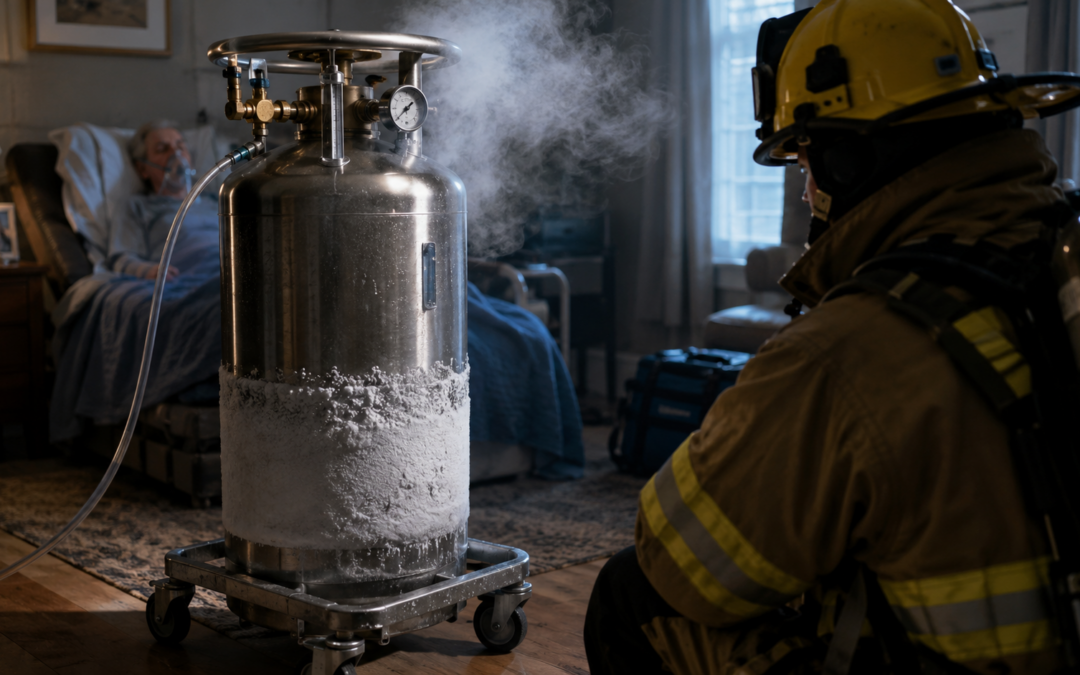
Cryogenics usually get filed in the public imagination under the same mental category as rockets, research labs, and industrial plants wrapped in vapor. That is part of the problem. The real danger is not that these materials are rare or mysterious. They are increasingly common in places people experience as ordinary. Hospitals use cryogenic systems in imaging, tissue preservation, and medical support equipment. Portable oxygen systems are now common in homes. What looks like a patient-care convenience can also be a highly energized pressure system sitting in a structure that was never designed around oxygen enrichment, cryogenic handling, or specialized emergency response.
That shift matters because ordinary settings encourage ordinary assumptions. A dewar beside a recliner does not trigger the same mental alarms as a tank in an industrial yard. A medical delivery truck does not feel like a hazmat problem. A piece of patient-support equipment does not read like a fire behavior multiplier. But the chemistry does not care what the room is used for. A cryogenic liquid still absorbs heat. Pressure still builds. Relief devices still cycle. Oxygen still changes the way other materials burn.
Liquid oxygen is the sharpest example of that disconnect. It is familiar enough to be underestimated and dangerous enough to punish that mistake brutally. Oxygen is not a fuel, but in enriched atmospheres it accelerates combustion so aggressively that ordinary materials stop behaving the way responders expect them to. Something that would normally char, smolder, or self-extinguish can burn with startling speed. The practical takeaway is ugly and simple: once the atmosphere changes, the margin for error collapses.
That is why oxygen-enrichment demonstrations hit so hard when they are done properly. Put protective gear under a modest flame, let the fire begin to fade, then increase the oxygen concentration around it. What looked resistant just moments earlier can disappear in seconds. That is not a gimmick. It is the fastest way to kill the myth that protective clothing and normal fireground instincts still behave the same way in an oxygen-rich environment. They do not.
A Cryogenic Tank Is Just a Thermos Until You Forget the Physics
The simplest description of a dewar is still the best one: it is a thermos. That comparison works because the design principle is the same. An inner vessel holds the product. An outer shell surrounds it. Between the two is a vacuum, sometimes aided by insulation, all intended to reduce heat transfer into the contents. The vacuum matters because without molecules in that space, there is very little available to conduct heat inward. The whole container is built to delay warming.
But “delay” is the important word. Cryogenic storage is never a victory over physics. It is a controlled holding action. Ambient heat is always trying to get in. The liquid is always trying to absorb that heat. The product is always edging toward phase change. That means every cryogenic tank is, at bottom, a pressure vessel. It may still look the same from the outside, but it is never static inside.
That is also why these systems intimidate people up close. From a distance, they can resemble common compressed-gas setups. Up close, the multiple valves, gauges, stems, reliefs, and branches announce that this is something more complex. The danger is not just mechanical confusion. It is the urge to simplify what should not be simplified. A responder who sees “just another tank” is already behind the problem.
The visual clutter atop a cryogenic container is not decorative. Each branch exists because the tank does more than merely store cold liquid. One branch may indicate the liquid level. Another may reflect pressure in the headspace. One path may vent vapor. Another may move liquid. Another may help build usable internal pressure by routing the product through a circuit where it can absorb heat and vaporize in a controlled way. Treating all of those functions as interchangeable is how operators and responders get into trouble.
Oxygen Enrichment Changes the Whole Fireground
The greatest hazard in a medical oxygen setting is often not the dramatic cold contact people first imagine. It is the invisible atmospheric change that accompanies the leakage or release of oxygen. That is the hazard many crews still underestimate because oxygen is so familiar. In homes, hospitals, and care facilities, the environment is already full of available fuel: bedding, clothing, plastics, vinyl, paper goods, upholstery, wall coverings, packaging, and dust. Add oxygen enrichment to that setting, and the fire problem becomes something else entirely.
The danger is not theoretical. In oxygen-enriched atmospheres, ignition thresholds drop and flame spread increases. Materials that normally resist ignition can become eager participants. A fire involving an oxygen-rich area can move with a speed and violence that makes normal room-and-contents behavior look tame. That is why these incidents can turn deadly before anyone on scene fully understands why the fire is behaving so aggressively.
The home setting makes the problem worse because it invites emotional shortcuts. People see medical equipment and instinctively assign it a lower risk category. But a portable oxygen dewar in a private residence may concentrate oxidizer hazard in a space with poor ventilation, no industrial safeguards, multiple ignition sources, and people who are physically unable to self-rescue. The fact that the system exists for compassionate reasons does not reduce the hazard. It often increases the stakes.
Pressure Relief Is Not a Malfunction. It Is a Warning in Motion.
Cryogenic systems make the most sense when understood in terms of pressure. Heat leaks in. Liquid absorbs energy and boils. Vapor accumulates. Headspace pressure changes. Relief devices open and close. Venting alters the balance. Pressure-building features intentionally create gas to keep the tank operating within its designed service range. What looks like a container is really a controlled thermodynamic process.
That is why intermittent venting or “burping” from a relief device cannot automatically be treated as failure. In many cases, it is exactly what normal operation looks like. Some heat ingress is inevitable. Pressure has to go somewhere. The relief device exists because the tank was designed with that reality in mind. A system that occasionally exhales may be working exactly as intended.
The dangerous instinct is to see discharge and decide the problem is the discharge itself. It is not. The relief device is often the only reason the tank has not become something worse. A burst disc or relief path opening is not an annoyance to be silenced. It is a safety measure responding to a pressure condition. Trying to plug it, block it, or mechanically override it is the kind of improvisation that turns a manageable event into a catastrophic one.
Even the sight of ice forming at a relief outlet can mislead people. In hot, humid conditions, a release may create temporary icing. To an inexperienced eye, that looks like a new failure layered onto the first one. In reality, it may just be the physical consequence of the release itself. That does not mean it should be ignored. It means it should be interpreted. The correct question is not “How do I stop this from venting?” The correct question is “Why is the system venting, and is that behavior normal for the condition it is in?”
The Most Important Valve Is the One You Misidentify
Cryogenic equipment does not forgive casual valve work. The liquid level indicator tells one story. The headspace pressure gauge tells another. A vent valve connected to the vapor space serves a different purpose than a liquid withdrawal path piped from the bottom of the inner vessel. High-pressure configurations add more complexity, including gas service and pressure-building arrangements. These systems are not difficult because they are exotic. They are difficult because they demand accurate reading under stress.
That is the sort of task emergency scenes are bad at producing. Stress makes people grab for visual shortcuts. A handle looks like a handle. A branch looks like a branch. A tank looks like a tank. But in cryogenics, the distinction between vapor control, liquid movement, and pressure generation matters more than the appearance of the hardware. The safest approach is not swagger. It is reading the tags, understanding the function, and refusing to operate from memory when the system in front of you has its own specifics.
This matters even more during transfer or filling operations. Cryogenic liquid trapped between two closed points in a hose or small section of tubing can warm, expand, and create intense overpressure in very little space. That kind of mistake feels minor right up until it produces a violent failure. The fact that the line is small does not make the consequence small. A little trapped cryogenic liquid can quickly become a serious explosion hazard.
That is why proper sequencing, purging, and maintaining an open path during transfer are not fussy habits. They are survival habits. The people who work these systems professionally appear methodical for a reason. They know the line does not have to be long, and the liquid does not have to be plentiful, for pressure to become the dominant problem.
Cryogenics Exposes the Weakest Habit in Fire Culture
The hardest truth in this subject is not technical. It is cultural. Firefighters are trained to move, improvise, and solve. Cryogenic incidents demand a different reflex. They demand interpretation before intervention. They demand patience around equipment that looks manageable. They demand respect for atmospheric hazards that may not be visible. Most of all, they demand humility from responders who are used to believing that turnout gear and confidence will bridge the gap between familiarity and actual competence.
That habit is dangerous here. Structural PPE does not magically become cryogenic protection because the wearer is brave. It does not protect the way people imagine against extreme cold, cryogenic splash, embrittlement effects, or the fire behavior changes that come with oxygen enrichment. Yet because liquid nitrogen and medical oxygen systems have become so common, responders often drift into casual behavior around them. Familiarity erodes caution. A common product gets treated like a harmless one.
That drift shows up in scene interpretation, too. Frozen valves may be normal in some operating conditions and concerning in others. Frost on the lower area of a tank can be part of the expected function. Frost or cold higher up on the shell may indicate a loss of vacuum and heat transfer where there should be little to no heat transfer. A venting relief may be routine pressure management or the early sign of a larger failure. None of those clues mean much unless someone on scene has the discipline to read them in context.
The Room Becomes Part of the Hazard
Cryogenic incidents are not confined to the tank itself. The surrounding space matters just as much. A leaking product can displace oxygen in an enclosed area, creating an asphyxiation hazard. A leaking oxygen system can enrich the atmosphere and create a fire problem. Both of those conditions can develop in spaces that feel safe because they are familiar: a stairwell, an apartment bedroom, an elevator, a treatment room, a vehicle compartment.
That is why movement and handling matter so much. Push these containers; do not pull them into yourself. Keep people out of enclosed spaces with them. Do not ride in an elevator alongside one. Send it separately and control the area around it. Those instructions sound simple, but they rest on a serious premise: the product may be changing the room before anyone realizes it.
This is what makes cryogenics such a dangerous blind spot for ordinary emergency response. The scenes often look calm. The equipment often looks familiar. The setting often feels low-threat because it is medical, domestic, or routine. Meanwhile, the actual hazard may involve pressure, oxygen displacement, oxygen enrichment, contact injury, transfer failure, and accelerated fire behavior simultaneously. That is too many failure modes to leave to improvisation.
Cryogenic containers do not need to look dramatic to be dangerous. They only need to be misunderstood. That is the real problem for most departments. These systems are showing up in places crews think they already understand, and that confidence is exactly what gets people hurt. Train on portable dewars, relief behavior, pressure-building systems, shell frost interpretation, and home oxygen hazards until the equipment stops looking “medical” and starts looking like what it really is: a thermodynamic pressure system sitting in a fuel-rich environment. Then teach crews to slow down, read the tank, respect the relief devices, stop trusting turnout gear to solve a chemistry problem, and treat that harmless-looking thermos in the corner like the hazard it has always been.