
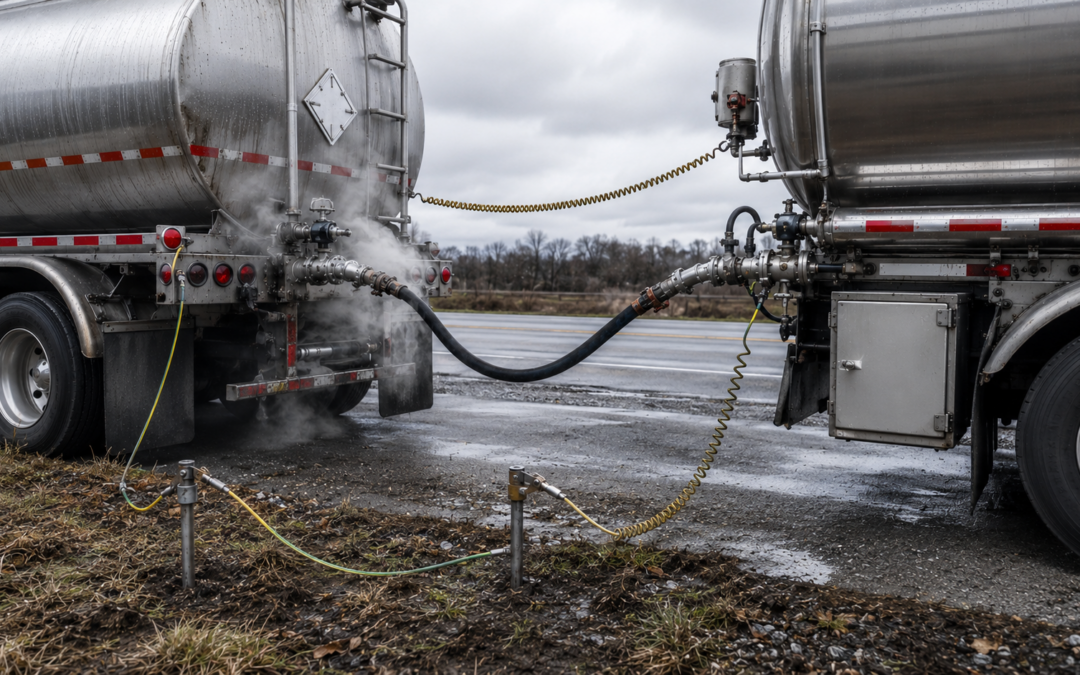
Grounding, Bonding, and the Spark You Never See
We have a bad habit in hazmat of teaching critical tasks as rituals. Clip this here. Drive that rod there. Connect this cable before transfer. The steps get memorized, the boxes get checked, and the deeper reason behind the action gets lost somewhere between the classroom and the scene. Grounding and bonding suffer from that problem more than most topics. We train the how. We repeat the why in a sentence or two. But we rarely slow down enough to explain what electricity is actually doing, why static builds up, and how a tiny, invisible discharge can turn a controlled transfer into a fire.
That was the value of this discussion. It was not just about where to put the clamp. It was about understanding the unseen force that sits quietly on a tank shell, a poly drum, or a moving stream of product until it suddenly finds a path.
Starting with the Basics
To understand grounding and bonding, we have to start with the simplest terms. An insulator is something that does not readily transmit electricity. Think about the ceramic hardware on power poles or the plastic sheathing around an electrical wire. Those materials exist to keep current from moving where it should not. A conductor is the opposite. It allows electricity to move. Copper is the obvious example, but conductors are not limited to wires. A tank, a tool, a metal fitting, or any other conductive surface can become part of that pathway.
That is where many responders get tripped up, especially when the conversation turns to water. Most people grow up hearing that water conducts electricity, full stop. In reality, pure water is a poor conductor. What makes water conductive are the dissolved impurities in it-salts, minerals, electrolytes, and other contaminants that allow electrons to move. That distinction matters later because, in grounding work, we sometimes deliberately add water and salt to soil to improve conductivity. If you do not understand the difference between pure water and contaminated water, the tactic may sound contradictory. It is not. It is applied chemistry.
Static electricity is often treated like a side note, the little zap you get from a doorknob in winter. In hazmat, it deserves a lot more respect than that. Static is energy trapped on the surface of a nonconductive material. If the charge were on a conductive object, it would usually dissipate. But when it forms on an insulated surface, it can stay there and build.
That buildup is what creates a static charge. In simple terms, it is an imbalance of electrical charges on or within a surface. The charge remains until it is given a route to travel. Once that route appears, the charge moves, and that movement is the discharge. The same basic physics behind the small spark from your finger to a metal doorknob is at work in a lightning strike. The size is different. The science is the same.
That comparison matters because it forces us to stop thinking of static as harmless just because it is usually small. A static event does not need to be dramatic to be dangerous. In a hazmat transfer, it only has to be hot enough to ignite a flammable vapor cloud.
Grounding, Bonding, and the Hidden Danger in Transfer
Nobody needs a three-year lecture on electrical theory to understand why grounding and bonding matter, but we do need a working grasp of the fundamentals. The easiest way to picture it is the same way firefighters understand water movement.
Voltage is pressure. It is the electrical push, the difference in potential that drives movement. Amperage is flow. It is the amount of electrical current moving through a pathway, similar to gallons per minute. Resistance is the restriction that slows movement, much like friction loss in a hose. The higher the resistance, the harder it is for electrons to move. The lower the resistance, the more easily and quickly they flow.
That simple framework is enough to understand the hazard. When there is a difference in electrical potential between two objects, electrons want to equalize it. If resistance is low and a pathway opens, that equalization can happen very quickly. If the discharge occurs in the wrong atmosphere, that tiny event becomes an ignition source.
This is one of the most important points in the entire discussion. We say “grounding and bonding” so often that many responders end up treating them as a single action. They are related, but they are not identical.
Grounding is the connection of a system to earth. The purpose is to bring the electrical potential of the object toward zero. If a tank, pipe, or other piece of equipment can safely send excess charge into the earth, then the chance of a dangerous discharge drops. That is the goal: reduce the potential so there is less opportunity for a spark.
Bonding is different. Bonding connects two conductive objects together so they share the same electrical potential. It does not necessarily bring either object to zero. It equalizes them. If tank A and tank B are at different potentials, electrons may jump the gap when a path becomes available. Bonding reduces that difference so the two objects are not looking to equalize through a spark.
One drains the system toward the earth. The other makes sure the connected parts of the operation are at the same level. Both matter. Both solve a different version of the same problem.
Where the Ignition Risk Really Lives
This is where the theory becomes operational. During transfer operations, static electricity can build up simply because material is moving. Liquids flowing through hoses, vapors moving through systems, and even solids in motion can generate charge. That is not rare. That is the normal condition of product transfer.
Now picture the real-world scenario: a damaged tank is leaking, vapors are present, and responders are trying to recover or transfer product before conditions worsen. Somewhere in that atmosphere, there may already be a flammable range. The transfer itself begins to create an unequal charge on the damaged container, the receiving container, and the equipment connecting them. If those differences are not controlled, a discharge can occur.
That discharge may be tiny. It may be almost invisible. It may still be enough to ignite the vapor space. And once that happens, the entire incident changes. The transfer stops. The product may continue to be released. Fire becomes part of the problem. The timeline stretches. The risk to personnel increases. What should have been a controlled mitigation effort becomes a much more dangerous event.
That is why grounding and bonding are not optional habits. They are ignition control measures.
One of the most useful reminders in this discussion was that nonconductive does not mean irrelevant. A poly drum, for example, may not conduct electricity like steel, but it can still hold a static charge on its surface. In that sense, it behaves like stored energy waiting for an opportunity to move.
That is why plastic containers and other insulated materials cannot be ignored during product handling. People often assume the danger is only in metal tanks and metal tools because they look like “electrical” objects. In reality, the charge can develop on the nonconductive surfaces as well. The moment a pathway appears to something with a different potential, the system tries to equalize.
A few times in the discussion, that point came through especially clearly, and it is the sort of thing worth emphasizing. The danger is not always in what looks energized. The danger is often in what looks inert until the instant it is not.
Building the Grounding Field
Another term that deserves more attention in training is relaxation. In this context, relaxation time is the time required for the charge to dissipate. Sometimes that happens almost instantly. Sometimes it takes longer than people expect.
That matters because responders are vulnerable to the illusion of safety. Nothing is visibly happening. The transfer has slowed or stopped. The container looks stable. The operation feels quiet. But static does not care about our sense of closure. Charge may still be present. Conditions may still allow equalization. The hazard may still be waiting for a path.
This is one of those areas where experience can either help you or betray you. The seasoned responder knows that invisible hazards rarely announce themselves. The overconfident responder assumes that because a spark did not happen immediately, it is no longer likely. That kind of thinking gets people hurt.
In the classroom, grounding sometimes sounds absurdly simple: drive a rod into the earth, and you are done. In actual scenes, it is rarely that easy. Creating an effective grounding field may require multiple rods, improved soil contact, and active efforts to reduce resistance.
In practice, responders may aim for a resistance of less than 10 ohms, though some training programs and operational guidance accept a range up to 25 ohms, depending on the circumstances. Either way, that target is not always easy to hit. Soil conditions matter. Moisture matters. Surface area matters. Composition matters.
That is why crews may wet the soil, add salt, and use multiple three-foot rods to improve conductivity. Water increases contact with the soil. Salt adds impurities that help conductivity. More rods create more surface area for the system to connect with the earth. None of that is superstition. It is simply applying the same electrical principles we talked about earlier.
Adapting the Technique Without Losing the Principle
The challenge, of course, is that the textbook version of the ground is rarely the ground we actually get. Soft soil is one thing. Rock, asphalt, compacted roadway, or dry western terrain is another. In those places, the idea of driving rods straight down like tent stakes can become unrealistic fast.
That is where practical field adaptation matters. Laying rods horizontally, wetting the area, covering them, and building conductivity across the surface can be a workable solution when vertical placement is ineffective. On roadway operations, especially, that kind of flexibility can be the difference between creating a useful grounding field and just performing the motions of one.
That was one of the strongest takeaways from the discussion. The real professional does not just memorize the technique. The real professional understands the principle well enough to adapt the technique without abandoning the goal.
That is what grounding and bonding should be for every hazmat team: not a ritual, but a controlled answer to an invisible threat. We are not clipping cables and pounding rods because somebody once wrote it in a manual. We are managing differences in electrical potential in an environment where product movement, vapor release, and ignition risk often exist at the same time.
The hazard is often hiding in the gap. The gap between the two containers at different potentials. The gap between a charged surface and a conductor. The gap between what a responder was taught to do and what that responder actually understands.
If we want better technicians, we need to teach beyond the checklist. We need to make sure people know what static is, how charge builds up, why bonding equalizes, why grounding drains, and why a seemingly insignificant spark can still change the entire scene. Train that way, drill that way, and insist on that level of understanding before the next transfer operation puts invisible energy and flammable vapor in the same piece of real estate.
Because the spark that starts the fire is usually the one nobody thought was still there.