The Science of the the Plan
I used to think hazmat size-up started when the rig stopped moving.
That is the comfortable answer. It gives us a clean starting line. Wheels stop, doors open, binoculars come up, and the scene begins to reveal itself. But the more Bobby and Mike worked through the APIE system, the more obvious it became that this answer is too late.
The scene starts long before arrival.
APIE is not an SOP. It is not a checklist pretending to be a strategy. It is a thought process. Analyze, Plan, Implement, Evaluate. That sounds simple enough on paper, but the real value is not in memorizing the words. The value lies in understanding that hazmat response must be broken down into manageable pieces because the incident rarely arrives as a single complete picture.
Mike framed it the simplest way possible: how do you eat an elephant?
One bite at a time.
That is really what this system is. It takes a call that can feel massive, technical, confusing, and full of unknowns, and forces us to slow down enough to take the next useful bite.
The Puzzle Starts With the First Piece
Hazmat incidents do not usually present themselves clearly. They arrive like a jigsaw puzzle dumped onto a table. Some pieces are obvious. Some are missing. Some look like they belong until you try to connect them to something else.
That is why the Analyze phase matters so much.
The first information may come from dispatch, but that does not make it complete. It may not even make it accurate. A caller says they smell gas. What does that mean? Gasoline? Natural gas? Propane? Sewer gas? A chemical odor from a process line? The words are not the incident. They are only one piece of the puzzle, and that piece came through someone else’s lens.
That lens matters.
A firefighter, police officer, plant manager, truck driver, passerby, dispatcher, and hazmat technician may all describe the same scene differently. Not because anyone is lying, but because they are filtering the event through their experience. By the time that information gets relayed from the caller to the dispatcher, from the dispatcher to another dispatcher, from the dispatcher to the first-due officer, and then from that officer to the hazmat team, there are multiple points where details can be lost, simplified, or unintentionally distorted.
So the first job is not to believe everything. It is time to start sorting.
Is there a product name? Is there a container type? Are there victims? Are people symptomatic? Is there smoke? Is there a release? Is there a fire? Does the reported information match what the first units are actually seeing?
That last question may be the most important one.
If a person has a chemical burn after a liquid is spilled on them and the reported product is gasoline, something does not add up. Gasoline may irritate the skin, but a true corrosive burn points the mind elsewhere. That mismatch is not an inconvenience. It is intelligence.
In hazmat, the pieces that do not fit often tell us as much as the pieces that do.
Distance Buys Thinking Time
One of the most useful parts of the APIE discussion was how much emphasis Bobby and Mike placed on distance.
Not distance as avoidance. Distance as information space.
The longer response times hazmat teams often face can feel like a disadvantage, but they are also an opportunity. While en route, we can start building the macro picture. What kind of occupancy is involved? Residential, commercial, industrial? What is around it? Are there storm drains, waterways, attached exposures, roadways, rail lines, or nearby populations? Are weather conditions helping us or working against us?
This is where the analysis starts to become operational.
A residential call may suggest smaller quantities, but that does not mean lower risk. A commercial occupancy may be more concerning because it can hold enough product to hurt people while still being operated by people who may not truly understand the chemical behavior. Industrial facilities may have larger quantities and better documentation, but also more complex systems, more process hazards, and more ways for products to interact.
None of these categories gives the whole answer. They simply help us organize the puzzle.
As we get closer, the senses become part of the analysis, but only if they are used intelligently. Eyes first. From a distance. Binoculars, monoculars, cameras, and good positioning can gather a huge amount of information before anyone gets close enough to become part of the problem.
If you smell something, that is not a cue to investigate harder. It is a cue that you may already be in the wrong place. If you taste something, the scene has already communicated something serious about your position.
Hearing matters too. A hissing cylinder, escaping pressure, a relief device lifting, or product movement inside a container can all shape the early picture. The goal is not to be brave enough to get close. The goal is to be disciplined enough to gather useful information without giving the chemical access to you.
The Container Is the First Witness
One line from the conversation should be written on every hazmat board: Hazmat is only hazmat once it has escaped its container.
That does not mean the material is harmless. It means the container is the first control system. If the product is still inside and the container is intact, the problem is different than a release, a fire, or a container showing signs of failure.
So we start with the container.
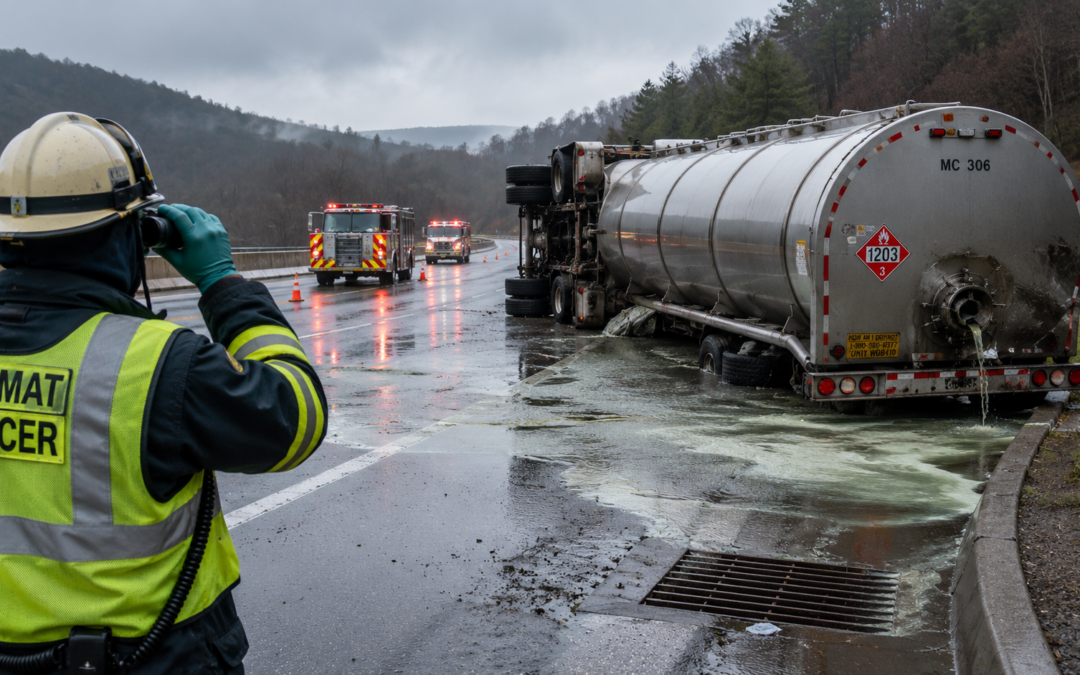
In transportation, that means vehicle type, container shape, size, condition, placards, labels, shipping papers, and the story the damage is telling. A saddle tank leak is not the same as a tractor-trailer split open across the highway. An overturned gasoline tanker resting intact in brush is not the same as a gouged, torn, heated tank that looks like it is minutes away from failure.
Shipping papers help, but they are not magic.
For highway transportation, the bill of lading is expected to be with the driver, usually in the cab or driver-side door area. On rail, the consist, or waybill, is typically with the train crew. On vessels, the dangerous cargo manifest is kept with the captain or on the bridge. On aircraft, hazardous materials documentation is associated with the pilot or flight crew.
But Bobby made the point clearly: nobody should expect the driver to step out like a movie character and present the bill of lading like the glowing briefcase from Pulp Fiction.
Information has to be found, confirmed, and compared against the physical scene.
Placards can help, but they can also mislead. They can be missing, damaged, outdated, incorrect, or even flipped around by someone with no understanding of the consequences. An NFPA 704 diamond at a fixed facility can give important hazard categories for health, flammability, instability, and special hazards, but it does not identify the product by name. It tells us there is a hazard profile. It does not solve the incident.
That is why the container, the markings, the occupancy, the paperwork, and the observed behavior all have to be read together.
One piece alone is not enough.
Chemical Properties Drive Tactical Reality
Once we start identifying the product or even narrowing the product family, the incident changes. Now the analysis moves from “what am I looking at?” to “how will this material behave?”
The first question is the state of matter.
Solids are usually easier because they tend to stay where they are. They must be addressed, but they do not usually reach across distance on their own. Gases are different. Gases come looking for us. They move, spread, collect, displace oxygen, ignite, or poison depending on their properties. Liquids sit in the uncomfortable middle. They can pool, flow, soak, react, and produce vapors that create a second problem on top of the first.
From there, toxicity starts to shape the operation.
IDLH values matter because they provide a numerical threshold for immediate danger to life or health. Carbon monoxide has an IDLH of 1,200 ppm. Hydrogen cyanide is much lower, typically around 50 ppm. That difference matters because it changes how we interpret readings, PPE, rescue decisions, and exposure risk.
Other numbers matter too. The permissible exposure limit, time-weighted average, and short-term exposure limit each provide different windows into worker exposure. They are not interchangeable. They answer different questions. One may tell us what is acceptable over the course of a workday. Another may tell us what is dangerous for minutes. The responder has to know which number they are using and why.
Then, the vapor pressure starts to explain the reach.
A material with low vapor pressure does not readily leave the liquid phase. A material with high vapor pressure is much more willing to enter the air and find us. That difference changes isolation, metering, PPE, entry posture, and urgency.
Vapor density tells us where to look. Acetylene is lighter than air, so we expect it to rise. Carbon dioxide is heavier than air, so we expect it to collect near the floor. That does not mean we ignore the unexpected, but it does give us a starting expectation for monitoring.
pH indicates whether acids or bases are involved in the skin, eye, respiratory, PPE, rescue, and decon problems. Flammability indicates whether the vapor concentration is within the range between the lower and upper explosive limits. Flash point, fire point, and autoignition temperature tell us how temperature and ignition risk are changing the field.
That last one can sneak up on responders.
If a flammable liquid in a container has been heated to or near its autoignition temperature, the absence of flame does not mean the absence of danger. It may only mean the atmosphere inside the container does not yet have the oxygen it needs. Open a dome cover or introduce air, and the responder may create the missing condition.
That is not trivia. That is tactics.
Every Action Creates a Consequence
The deeper we got into the APIE discussion, the more the Analyze phase started to feel less like information gathering and more like consequence prediction.
Solubility is a perfect example.
In hazmat, we often care about how a material interacts with water because water is one of the most common tools we bring to the scene. But water is not neutral just because it is familiar. If a product dissolves into water, runoff may become part of the hazard. If it does not dissolve, water may move the product without controlling it. If water reacts with the product, the operation may get worse because we used the wrong tool for the wrong behavior.
A fog stream used for vapor control may be useful in one incident and a mistake in another. Dropping a vapor into a solution may create a corrosive liquid problem on the ground. Trying to scrub a gas that has limited solubility may give us less control than we think.
The same is true with instability.
The yellow section of the NFPA 704 diamond points to reactivity or instability concerns, but the real issue is what that instability means when exposed to heat, shock, contamination, water, air, or other chemicals. Oxidizers can intensify combustion and react violently with incompatible materials. Polymerization can generate heat and pressure, causing container failure as molecules realign into larger structures. Radioactive materials require time, distance, shielding, respiratory protection, and a deliberate slowdown of the entire operation.
The scene is not just asking, “What is this?”
It is asking, “What will happen if we do that?”
Stress Is Not Just Human, It Is Structural
Container stress may be the most practical bridge between the physical scene and the tactical decision.
Mike broke it into three categories: thermal, mechanical, and chemical.
Thermal stress is heat or cold acting on the container. Heat can raise internal pressure, weaken materials, damage welds, soften plastics, or move a product closer to dangerous temperature thresholds. Cold can make plastics brittle, compromise metals, affect seals, and in some cases, create pressure changes or vacuum effects.
Mechanical stress is the blunt reality of transportation and handling. Forklifts through drums. Rollovers. Punctures. Gouges. Tears. Abrasions. Containers striking other containers. Highway incidents are full of mechanical stories, and the damage pattern often tells us what the next failure might be.
Chemical stress is the quiet one. It happens when the wrong product is in the wrong container, when contamination enters the system, or when incompatible chemicals come into contact. A corrosive in the wrong metal drum. An organic material contaminated by something that does not belong there. A reaction is building pressure inside a container that looked fine a few minutes earlier.
That is where the General Hazardous Materials Behavior Model becomes useful. The container is not just a shell. It is part of the incident’s behavior. If we understand how the container is being stressed, we can better predict breach, release, dispersion, harm, and tactical options.
And that is the heart of the Analyze phase.
We are not collecting facts to sound smart on the radio. We are collecting facts so we can make fewer guesses.
APIE begins with analysis because every plan is only as good as the picture it was built from. The trick is accepting that the picture will never be complete. There will always be missing pieces. There will always be bad information, late information, and information filtered through someone else’s understanding.
The job is to keep sorting anyway.
Because the first bite of the elephant is not the entry. It is not plugged. It is not metering. It is not picking PPE.
The first bite is learning what kind of elephant you are actually dealing with.
Keep training your eyes, your ears, and your decision-making process before the scene forces you to use them under pressure.