Radiation Is Not Rare. We Just Pretend It Is.
Radiation has always been one of those weird corners of hazmat that gets treated like either the end of the world or not worth talking about at all. There never seems to be an in-between. For a lot of responders, radiation means dirty bombs, terrorism, and mushroom clouds. For others, it is just another meter buried in a compartment somewhere, checked once a year and never touched again. Either way, the result is usually the same: very little real-world training, very little confidence, and a whole lot of assumptions.
That is a problem, because radiation is not nearly as rare as we like to tell ourselves.
The truth is, most of the radiation incidents happening in this country have nothing to do with terrorism. They are not elaborate plots or catastrophic reactor failures. They are far less dramatic and far more likely. They are lost industrial gauges, contaminated scrap, mishandled medical isotopes, transportation thefts, and materials that simply fell through the cracks. They are the kind of incidents that show up looking like normal calls until the meter tells you otherwise.
That is what makes radiation dangerous in the hazmat world. Not because it is everywhere in massive quantities, but because it hides in plain sight and most of us are not looking for it.
The Stuff That Goes Missing More Than You Think
One of the biggest wake-up calls in radiation response is realizing how often radioactive material goes unaccounted for. Depending on whose numbers you look at, radioactive sources are lost, stolen, or illegally dumped somewhere in the United States almost every day. The Nuclear Regulatory Commission NRC tracks some of it. The International Atomic Energy Agency IAEA tracks more of it globally. Since the early 1990s, thousands of incidents have been documented.
That number should make every hazmat team stop for a second. Because when most people hear “missing radioactive source,” they picture somebody smuggling uranium across a border in a movie. That is almost never what it is. More often, it is somebody tossing out a gauge they were not supposed to throw away, a shipment that got stolen off a truck, or a piece of contaminated equipment ending up where it should not be.
That matters because it changes where the risk lives. Radiation is not just sitting behind security fences at power plants. It is moving through roads, job sites, hospitals, rail yards, and scrap facilities every single day. That means your next radiation call is far more likely to be accidental than intentional, and that makes it easier to miss.
Radiation Lives In More Places Than You Think
A lot of responders still tie radiation directly to nuclear power, but that is only one slice of the pie. Industry runs on radioactive material. Hospitals use it for imaging and treatment. Construction companies use it in density gauges. Industrial radiographers use it to inspect welds and steel. Manufacturing facilities use sealed sources for a wide range of measurements and process control.
It is built into the infrastructure around us. That means it is constantly moving, constantly being handled, and constantly creating opportunities for mistakes. And mistakes with radiation are not always obvious.
A truck carrying a sealed source crashes on the highway. A construction trailer catches fire. A scrapyard starts getting elevated readings. A hospital throws out waste that was not processed correctly. None of those sound like classic radiation calls, but all of them can become one.
That is where the operational mindset has to shift. Under the Occupational Safety and Health Administration OSHA 29 CFR 1910.120 and the National Fire Protection Association NFPA 470, we are expected to identify hazards before we commit. That includes radiation. The standard does not care if your department “doesn’t really do radiation.” If it is in your district, you do now.
The Troxler Gauge Will Humble You Fast
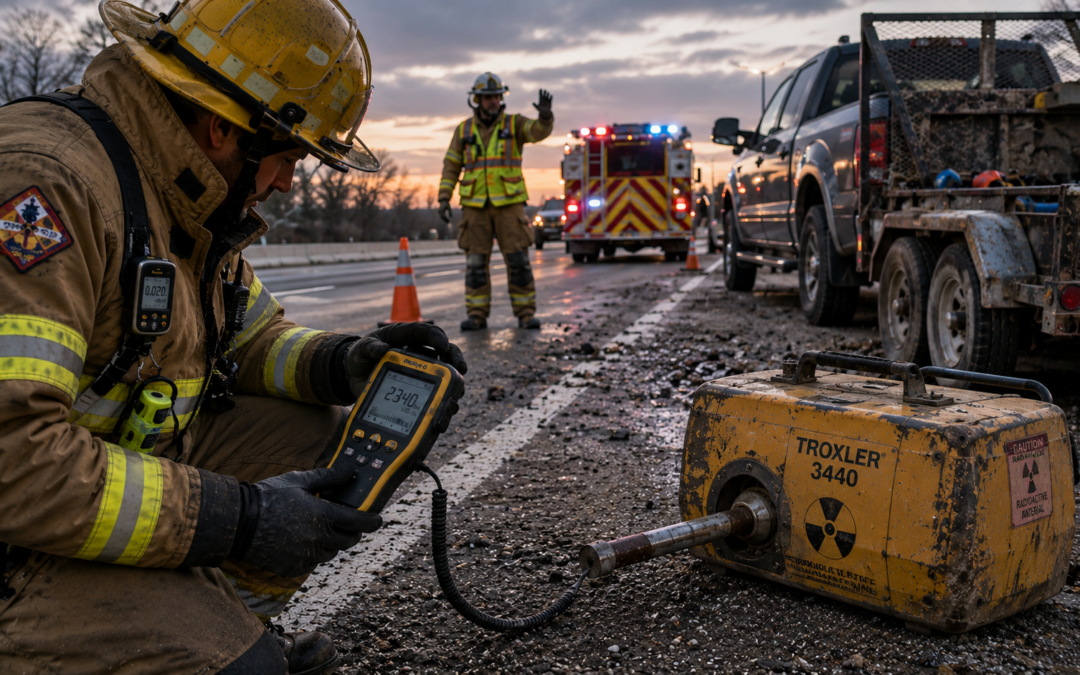
If you want proof that radiation incidents do not have to look dramatic, look no further than the Troxler Electronic Laboratories Troxler gauge.
These things are everywhere in construction, and most responders have probably driven past them a hundred times without noticing. But inside them are sealed radioactive sources. If that source is damaged or not fully retracted, now you have a problem.
There was a case where a kid was driving around with one that was not secured correctly. He was getting irradiated the whole time and had no idea.
No smoke. No leak. No smell. No visible hazard. That is the aspect of radiation that sets it apart from almost everything else we deal with. It gives you nothing. No sensory warning. No clue that you are standing in it unless your meter catches it.
That is why the basics matter so much. Time, distance, and shielding are not old-school concepts we memorize for class and forget. They are the entire game. The less time you spend near it, the less dose you take. The farther away you are, the better off you are. The more shielding between you and it, the more survivable the exposure becomes.
Simple. But simple only works if you remember it. And you only remember what you train on.
Three Mile Island Was Not Just A Reactor Problem
Most people in hazmat know the Three Mile Island accident as the most significant nuclear accident in U.S. history. But for responders, the bigger lesson was not just the mechanical failure inside the plant. It was the communication breakdown outside of it that made the incident harder to control.
The plant had a mechanical issue in the cooling system. That led to an automatic shutdown. A valve stuck open. Coolant escaped. Operators misread the conditions, made corrections based on bad information, and pushed the reactor toward partial meltdown.
The physics was complicated. The human failures were not. Nobody was operating off the same page. Plant staff knew one thing. Government agencies knew each other. Local responders were trying to keep up. The public was hearing mixed messages while evacuations kept expanding.
That is where the real chaos started. By the time it was over, about 140,000 people had left. Not because they fully understood radiation, but because uncertainty spreads faster than contamination.
That lesson still matters today. Unified command, interoperable communications, public messaging, and interagency drills all exist for a reason. If you wait until the radiation call to figure out who is in charge and who has the better meter, you are already behind.
Radiation Gets In Your Head
What makes radiation different is not just what it does to the body. It is what it does to the mind. You cannot see it. You cannot smell it. You cannot hear it. That creates stress fast. Some people freeze. Some people overcommit because they want to “just get it done.” Others panic and pull back too far.
That psychological pressure matters because hazmat is already a thinking job. Add an invisible hazard, uncertain readings, public fear, and incomplete information, and cognitive overload sets in quickly.
That is why radiation training cannot just be technical. It has to be practical. Hands-on. Meter work. Real scenarios. Background checks. Alarm recognition. Dose calculations. Contamination surveys. Because when the meter finally chirps for real, that is not the moment you want to be learning what it means.
Your Meter Is Not A Decoration
This is probably the most important takeaway. If your rig has a radiation meter, stop treating it like a decoration.
Turn it on. Know your district background. Know what normal looks like. Know what elevated looks like. Know what contamination looks like.
Because the next radiological incident you run probably will not come in as “radiation exposure.”
It will come in as a vehicle accident. A dumpster fire. A construction mishap. A scrapyard complaint. A suspicious package. A weird medical waste call.
And if you are not thinking about radiation, you will walk right into it.
That is the reality. Radiation is not rare. It is just quiet. And the teams that will survive it are not the ones with the best gear or the fanciest detector. They are the ones who pulled the meter out before the call, trained with it, and built the habit of paying attention.
So this week, grab the meter. Walk around your house. Check your apparatus. Run a drill. Know your numbers. Because radiation does not care if you forgot how your equipment works.