When Chemistry Refuses to Stop
Most hazardous materials incidents begin with the assumption that something can be stopped. We shut valves, plug leaks, patch containers, and isolate damaged systems because the emergency usually exists somewhere between the product and the environment. The sooner responders interrupt that relationship, the sooner conditions begin moving in the right direction. Runaway polymerization refuses to play by those rules. By the time crews arrive, the chemistry itself may already be committed to a path that cannot simply be turned off. The challenge is no longer stopping the reaction. The challenge becomes preventing that reaction from destroying the container before it finishes.
That was the reality responders faced during the methyl methacrylate incident in Garden Grove, California. What appeared on the surface to be a storage tank problem was actually a chemistry problem unfolding inside the vessel. A refrigeration failure allowed temperatures to rise inside tanks containing methyl methacrylate, or MMA, a monomer used to manufacture acrylic plastics. As temperatures increased, responders became concerned that an uncontrolled polymerization reaction could generate enough heat and pressure to rupture the tanks, forcing the evacuation of tens of thousands of nearby residents while technical specialists worked to keep the situation stable. It was a reminder that some of the most dangerous hazmat incidents are not driven by impact damage or mechanical failure. Sometimes the emergency begins because a chemical starts doing exactly what it was designed to do, only at the wrong place and the wrong time.
When Making Plastic Becomes the Emergency
One of the more confusing aspects of polymerization is that there is nothing inherently abnormal about the chemistry itself. In fact, polymerization is exactly why products like methyl methacrylate exist. Manufacturers intentionally convert liquid monomers into solid polymers every day to produce everything from aircraft transparencies to automotive components and countless other plastic products. Under controlled conditions, the reaction is predictable, carefully managed, and highly desirable.
The problem begins when that same reaction occurs inside a storage vessel instead of a manufacturing process. Imagine dumping thousands of individual chain links onto a table. Each link represents a single monomer molecule. Left alone, they remain separate pieces. Under the proper conditions, however, those links begin connecting together, forming longer and longer chains until what started as individual molecules becomes a massive polymer. That transformation is the product manufacturers actually want. Unfortunately, building those molecular chains also releases energy. As MMA molecules link into polymer chains, the overall polymerization reaction releases heat. If that heat cannot escape as quickly as it is generated, the reaction can begin accelerating itself.
That is the defining characteristic of a runaway polymerization. The chemistry generates heat, the heat accelerates the chemistry, and the faster the chemistry proceeds, the more heat is produced. Unlike many emergencies where the hazard comes from outside the container, this one is literally building itself from within.
Reading the Chemistry Instead of Memorizing Numbers
One of the easiest mistakes responders can make is treating physical and chemical properties like isolated trivia. We memorize flash points, vapor pressures, boiling points, and explosive limits because they appear on every certification exam and every reference sheet. Those numbers certainly matter, but they only tell part of the story. Their real value comes from understanding how they interact with changing conditions on an actual incident.
Take methyl methacrylate as an example. At normal storage temperatures, its vapor pressure may not initially appear extraordinary compared with some other volatile flammable liquids encountered by hazmat teams. Looking at that number alone could easily lead someone to believe vapor production is not especially concerning. That assumption changes the moment the product is no longer sitting quietly at ambient temperature. An exothermic polymerization reaction continuously adds heat to the system. As temperature rises, vapor pressure rises with it. The liquid that looked relatively calm on a data sheet begins behaving very differently inside a tank that is generating its own heat.
This is one of those moments where experienced hazmat technicians separate themselves from everyone else. They are not simply reading physical properties. They are interpreting them. Every property must be viewed through the lens of the container, the environment, and the chemistry occurring inside. Learning the product is only the first step. Predicting its behavior is where the real work begins.
Why This Isn’t a BLEVE
A runaway polymerization and a BLEVE describe two different things. Runaway polymerization describes what the chemical reaction is doing. BLEVE describes one way a vessel containing a heated liquid can catastrophically fail. A runaway polymerization does not automatically produce a BLEVE, but under the right temperature, pressure, and vessel conditions, the first could potentially create conditions leading to the second.
A BLEVE is fundamentally a pressure vessel failure involving a liquid that has been heated above its atmospheric boiling point. The energy comes from the rapid expansion of that superheated liquid as containment is suddenly lost. A runaway polymerization is different because the energy is being generated internally by the chemical reaction itself. The vessel is not simply absorbing heat from an external fire. It is becoming the container for an increasingly energetic chemical process.
That distinction matters because mitigation strategies follow the mechanism of failure. Misunderstanding how the pressure is being generated often leads responders toward solutions that fail to address the actual problem. Hazmat has always demanded technical precision, not because terminology makes us feel smarter, but because correct terminology usually reflects correct understanding. When we understand the mechanism, we begin making better tactical decisions.
Sometimes Every Option Is Bad
One of the reasons runaway polymerization incidents become so challenging is that nearly every possible solution introduces a new problem. Opening the container might relieve pressure, but it also releases a flammable liquid capable of producing flammable vapors. Adding inhibitor chemicals may slow the reaction if conditions allow, but that depends on the stage of polymerization, the ability to safely introduce the inhibitor, and whether effective mixing is even possible. Simply allowing the reaction to continue risks further heat generation, additional pressure, and eventual vessel failure.
This is where hazardous materials response becomes an exercise in consequence management rather than problem solving. Responders are rarely choosing between a good option and a bad option. More often, they are deciding which undesirable outcome creates the least overall risk to responders, nearby communities, and critical infrastructure.
That reality is often difficult for the public to understand. From outside the evacuation zone, it is easy to ask why responders do not simply “fix” the problem. Inside the command post, the conversation is very different. Every action changes the chemistry, the pressure, the fire potential, or the environmental consequences. The operation becomes less about finding the perfect answer and more about avoiding the worst one.
Buying Time Instead of Winning Quickly
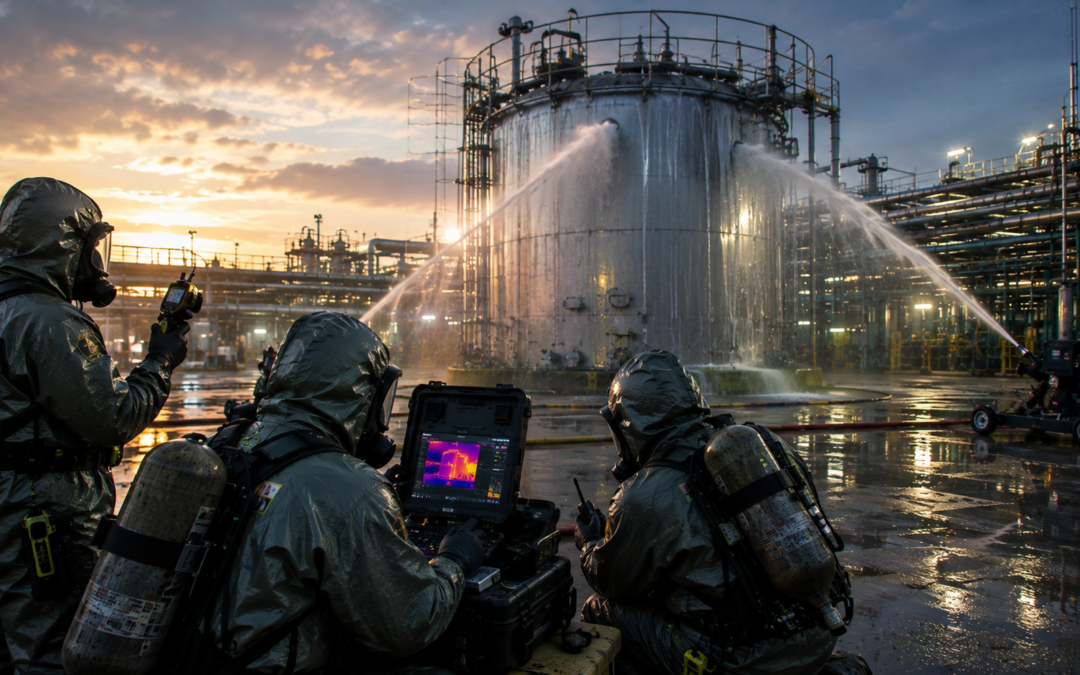
One of the more fascinating aspects of the Garden Grove response was how little it resembled the dramatic hazmat scenes often portrayed in movies. There was no heroic race toward the tank with a miracle solution waiting in the back of the apparatus. Instead, crews settled into something that looked surprisingly ordinary. Hose streams cooled the exterior of the vessel while technical specialists continuously monitored conditions and evaluated whether temperatures were stabilizing or continuing to climb.
At first glance, cooling a tank may seem almost disappointingly simple. In reality, it reflects a deep understanding of what the chemistry is doing. Every gallon of water flowing across the vessel removes heat that would otherwise remain trapped inside the system. The goal is not to stop polymerization entirely. The goal is to slow its acceleration enough that the reaction can eventually consume itself without producing pressures beyond what the vessel can safely withstand.
If successful, the ending is almost anticlimactic. The liquid monomer gradually becomes solid polymer, the heat generation subsides, internal pressures stabilize, and responders are left with an enormous block of hardened plastic rather than an exploded storage tank. From an operational standpoint, that is an extraordinary success, even if it leaves behind a difficult cleanup operation.
The Real Skill Is Prediction
Runaway polymerization reminds us that hazardous materials response has never been about memorizing chemical properties or carrying the newest detection instrument. Those tools matter, but they are only pieces of a much larger puzzle. The real skill lies in taking everything we know about the product, the container, and the environment and combining those pieces into a prediction of what the incident is likely to do next.
That prediction shapes every tactical decision. It determines whether cooling becomes the priority instead of extinguishment, whether pressure relief creates more risk than benefit, and whether the safest operation is the one that appears, to the public, to be doing very little at all. The calm scene they see from outside the evacuation zone may actually represent hundreds of technical decisions working together to keep chemistry from reaching a point of no return.
The Garden Grove incident serves as a reminder that not every hazmat emergency can be defeated outright. Sometimes the chemistry has already made its decision before the first apparatus arrives. In those moments, the job of the hazmat technician is not to overpower the reaction. It is to understand it well enough to keep it from becoming something far worse. Because when chemistry refuses to stop, knowledge becomes the only tool capable of buying the one thing every responder desperately wants more of: time.
enjoy reading all your articless