Lessons From an ESS Fire: Beyond “Let It Burn”
Energy storage systems are becoming increasingly common across the country, creating a new challenge for emergency responders. Unlike traditional fires that firefighters have spent decades training around, ESS incidents require a deeper understanding of system design, battery behavior, toxic hazards, and the limitations of traditional tactics.
A recent ESS fire in Warwick, New York, provided valuable lessons about decision-making, communication, and the importance of understanding the technology before the emergency occurs. Retired FDNY firefighter and hazmat instructor Wayne Melton shares his experience managing an incident that involved multiple ESS failures, severe weather, political pressure, and difficult tactical decisions.
ESS Incidents Require Understanding Before Action
One of the biggest challenges with battery energy storage systems is that they challenge traditional firefighting instincts. When firefighters see fire extending toward an exposure, the natural response is to protect that exposure. When smoke is visible, the instinct is to identify the hazard and remove the threat. ESS incidents require responders to slow down and understand the system before taking action.
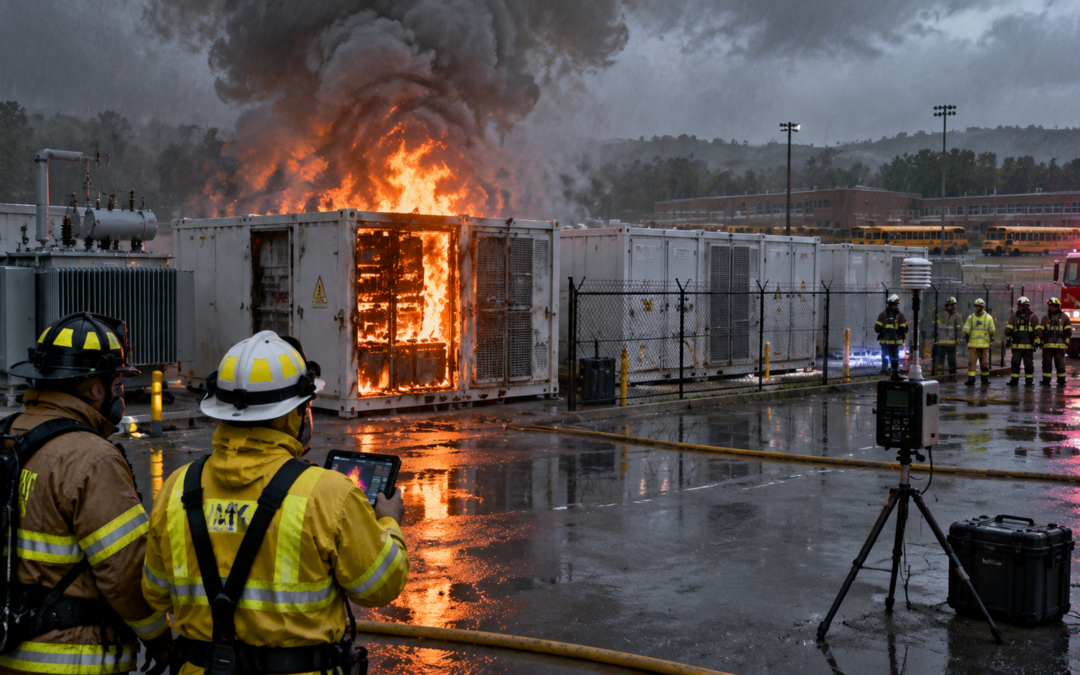
During the Warwick incident, responders were faced with a burning battery cabinet with additional ESS equipment, transformers, and electrical infrastructure nearby. The immediate question was whether traditional exposure protection tactics were appropriate. Instead of immediately applying water, the team gathered information from the battery representative, assessed the system, and began building a clearer picture of what was occurring.
This decision-making process is critical for ESS incidents. The question is not simply whether firefighters can apply water to a fire. The question is whether that action supports the overall incident objectives and whether it introduces additional hazards.
The incident also highlighted how many variables can influence ESS behavior. Weather conditions, system design, cabinet construction, state of charge, and previous system history all became important pieces of information. The team found that both ESS incidents within the same 24-hour period shared a potential connection: severe weather conditions that may have allowed water intrusion into systems not designed to withstand that exposure.
The Fire Is Only One Part of the Problem
One of the most important lessons from ESS incidents is that the fire itself is only part of the challenge. These events involve manufacturers, utilities, facility owners, emergency responders, public officials, and the surrounding community.
During the Warwick incident, responders faced many of the questions that accompany emerging technology fires. What is in the smoke? Is the public at risk? Do nearby facilities need to evacuate? Why is the fire department not aggressively extinguishing the fire?
These questions are understandable, but they require information before they can be answered responsibly.
The hazmat team approached the incident by creating data. Multiple air monitoring instruments were deployed around the site, including locations upwind, downwind, near the facility, and near the nearby school. Continuous monitoring allowed responders to make decisions based on actual conditions rather than assumptions.
This is an important lesson for hazmat operations. Monitoring is not simply about confirming a hazard exists. Monitoring provides the information necessary to communicate risk, protect responders, and make operational decisions.
Communication and Unified Command Matter
ESS incidents often involve many different stakeholders, each with different priorities. The fire department is focused on life safety and incident stabilization. The utility is concerned with electrical infrastructure. The manufacturer is concerned with system performance and investigation. Community leaders are concerned about public safety and the impact on residents.
Managing those competing concerns requires strong communication.
In Warwick, the response benefited from having the right people involved and maintaining communication between agencies. Fire, police, hazmat personnel, utility representatives, company representatives, and community leadership worked together toward the same goal.
This also reinforced the importance of identifying who the decision-makers are during an ESS incident. Unlike a traditional structure fire where the chain of command is usually straightforward, emerging technologies often involve multiple organizations with specialized knowledge.
Understanding who owns the system, who maintains it, who manufactured it, and who can provide critical information is essential to incident management.
The Lessons Learned From ESS Fires
One of the biggest takeaways from the Warwick incident is that ESS fires cannot be approached with a one-size-fits-all mindset. The answer is not simply “put water on it” or “let it burn.” The correct approach requires understanding the system, identifying hazards, evaluating risk, and making informed decisions.
The incident also reinforced the importance of training before the emergency occurs. Many departments will encounter energy storage systems before they feel completely comfortable with the technology. Having relationships with utilities, manufacturers, and neighboring agencies before an incident occurs can dramatically improve the response.
Perhaps the most important lesson is that restraint can be a tactical decision. The fire service is built around action, but sometimes the most effective action is gathering information, protecting exposures, monitoring conditions, and preventing a bad situation from becoming worse.
Energy storage systems will continue to expand. The technology will evolve, the challenges will change, and responders will continue learning from each incident.
The goal is not to eliminate uncertainty.
The goal is to be prepared to make good decisions when uncertainty is unavoidable.