ESS Fires: When the Same Battery Fire Happens Twice
Energy storage systems are becoming increasingly common, and with them comes a new category of incidents that challenges some of the traditional assumptions we bring to the fireground. But understanding an ESS fire isn’t just about understanding thermal runaway or knowing when to put water on something. It’s about understanding the system, recognizing what has changed, and learning from what happened the last time.
In the previous article, we looked at two ESS incidents in Warwick, New York, with Wayne Melton. This time, Wayne takes us back to the same location for another battery fire. The system had been rebuilt, the cabinetry improved, and the batteries replaced. Yet somehow, the same site experienced another fire in the same string and the same cabinet. This time, however, responders had something they didn’t have during the first incident: experience.
The Same Site, The Same Cabinet, A Different Fire
The Warwick system had changed significantly after the previous incident. The batteries had been removed, new cabinetry installed, unaffected batteries put back into service, and the damaged batteries replaced. The system was preparing to return to operation when the fire department received another call.
When Wayne arrived, he realized just how strange the situation was. This wasn’t simply another ESS somewhere in Warwick. It was the same site involved in the original incident, and the fire was occurring in the same string and the same cabinet.
The response immediately benefited from everything the department had learned previously. The fire chief kept most of the firefighters staged rather than committing them to an incident that didn’t require traditional fire suppression. Wayne’s hazmat team established monitoring, and everyone began gathering information before making unnecessary tactical commitments.
One of the first questions was the state of charge. The system was fully charged. That was significant because the previous incidents had involved systems at substantially different states of charge. One had been about 20 percent charged, another around half charge, and this system was fully charged.
The fire itself also appeared more energetic than the previous incident, eventually burning for approximately eight to ten hours. While the team did not have a root cause analysis that could definitively explain why the incidents behaved differently, the comparison provided an important operational lesson: responders need to know the state of charge.
Let the Meters and Drones Do the Work
The response to this incident was much more organized because the team had already been through the process. They knew what to monitor, where to place their instruments, and how to observe the fire without unnecessarily putting people in harm’s way.
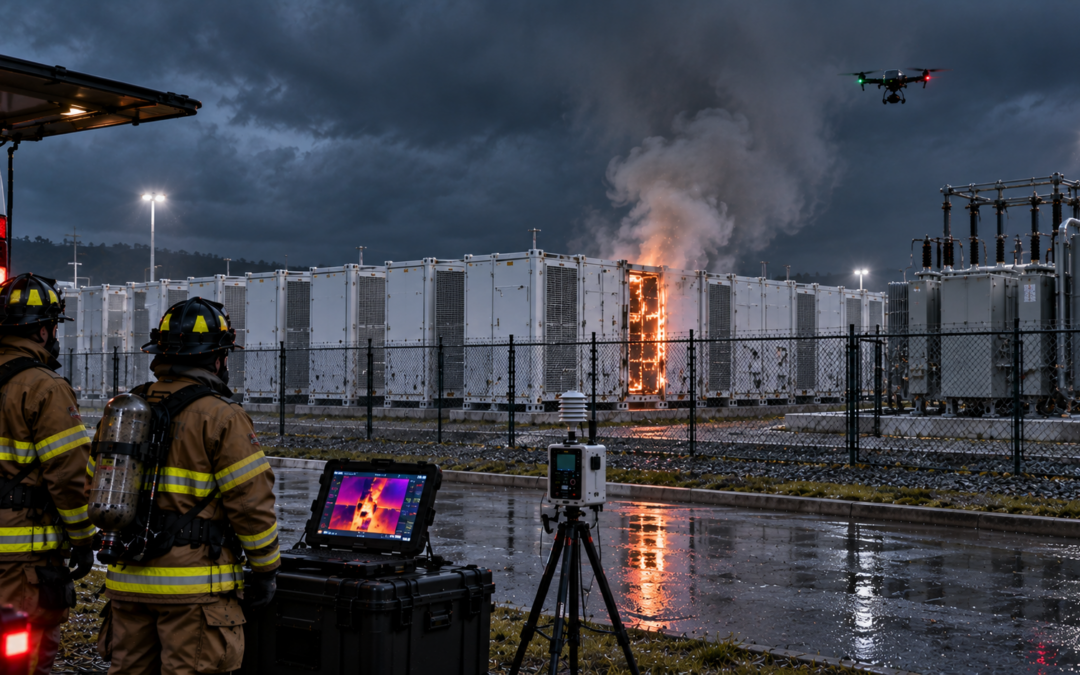
The prevailing wind was strong and consistent, so the team positioned an air monitor approximately 10 feet outside the fence near the fire. The team established additional monitoring upwind and near the hazmat apparatus. Another instrument was placed approximately 1,100 feet downwind in the direction of a residential area and park.
That monitor created one of the more entertaining logistical problems of the incident. Wayne didn’t want a $25,000 instrument sitting unattended in a public baseball field for several days, so the police department helped secure it inside a dugout. The instrument remained there for approximately three and a half days.
Drones became another valuable tool. The Orange County Sheriff’s Department, New York State Police, and OFPC all contributed aerial monitoring capabilities. With a thermal imaging camera mounted on a mast, responders could monitor the system from a distance and identify changes without repeatedly sending personnel toward the fire.
Around 3 a.m., the fire began to darken down. The drone confirmed what the responders were seeing, and the thermal imaging equipment continued to provide information about the condition of the system.
The air monitoring also gave responders actual data rather than assumptions. One instrument near the fire recorded approximately 1.5 parts per million of hydrogen cyanide during the early stages of the incident. The monitor positioned 1,100 feet away later recorded carbon monoxide after the fire had already gone out. Wayne questioned whether that reading was actually related to the ESS fire, particularly because of the instrument’s location in the baseball dugout.
That’s an important reminder about monitoring. A meter reading is not, by itself, an explanation. Location, timing, environmental conditions, and potential background sources must all be considered before deciding what the data actually means.
The Fire Protection Actually Worked
One of the most interesting differences between this incident and the previous fire was how the system behaved.
The fire propagated within the affected section, but it did not spread into the adjacent battery segments. Some heat was visible toward the next segment, particularly around the upper cabling area, but the thermal signature never developed into the same type of fire.
That appears to have been one of the benefits of the redesigned cabinetry.
The new system incorporated additional fireproofing, including brick lining and increased separation between the battery segments. Wayne estimated about four to six inches of separation between the sections, whereas the previous configuration packed them much more tightly.
That relatively small amount of additional separation, combined with the improved fireproofing, appeared to make a significant difference. The affected segment burned, but the surrounding segments remained intact.
This is an important lesson for responders. Not every ESS is built the same way, and not every ESS fire will behave the same way. Cabinet design, fire protection, spacing, state of charge, and the condition of the system can all influence what happens during an incident.
For firefighters, that means the system itself needs to become part of the size-up. We can’t simply look at a battery installation and assume we already know how it will behave.
The Fire Is Out, But the Hazard Isn’t
One of the biggest lessons from this incident is that putting out the visible fire isn’t necessarily the end of the problem.
If damaged batteries remain, stranded energy can still exist inside the system. There isn’t necessarily a traditional overhaul phase where firefighters simply pull the ceiling, check for hidden fire, and go home. Damaged battery systems may require specialized personnel to dismantle and remove the equipment, and the remaining energy can create hazards long after the flames are gone.
That was one reason the team continued monitoring the site for approximately three and a half days. The cabinet temperature gradually decreased until it eventually returned to ambient temperature.
The response also demonstrated the value of experience. During the earlier Warwick incident, responders had to deal with political pressure and a community that understandably wanted answers. This time, they were ready.
The meters were already going out. The drones were already being coordinated. The appropriate people were already involved. When political leaders arrived with questions, the team could explain what they were doing and what they already knew.
They had essentially checked the boxes before anyone asked them to check the boxes.
That’s one of the biggest lessons from the Warwick ESS fires. Preparation isn’t just knowing what tactics you might use. It’s understanding the technology, establishing relationships, knowing who can provide information, having monitoring capabilities available, and learning from every incident you encounter.
And perhaps most importantly, remember that an ESS incident doesn’t necessarily end when the fire goes out.
The hazard may simply have changed.
The fire may be gone, but stranded energy, damaged batteries, contaminated equipment, security concerns, and the challenges of dismantling the system can all remain.
The more ESS systems we encounter, the more experience we’ll gain. Until then, the best tool we have is understanding what we’re looking at before we decide what we’re going to do about it.