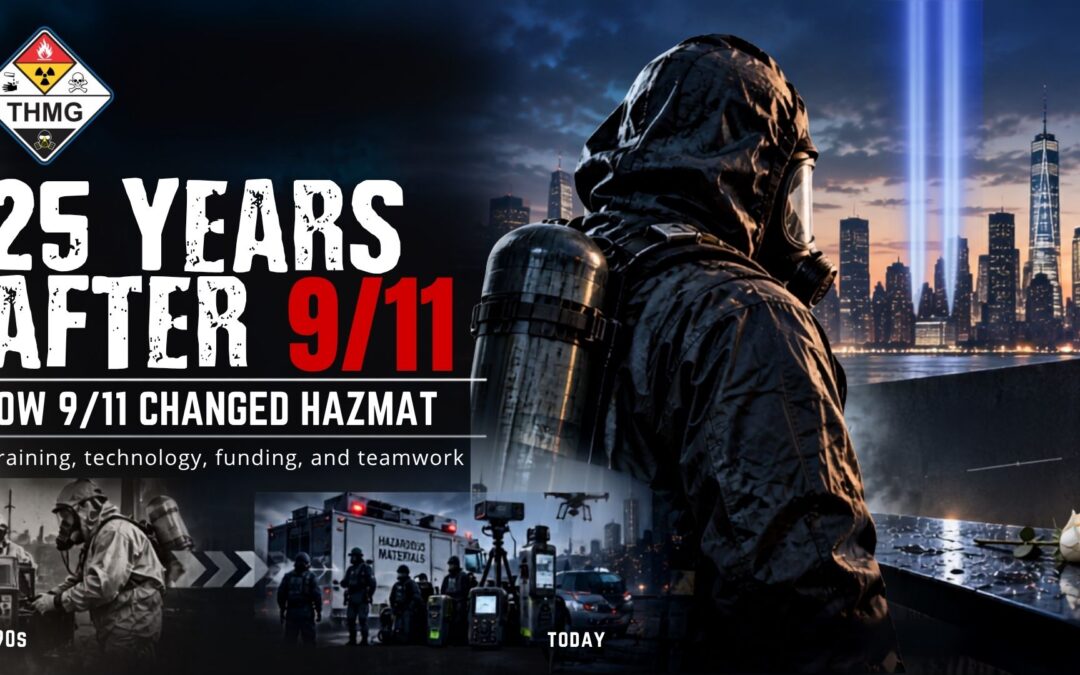
9/11 Changed HazMat Forever: 25 Years of Evolution
September 11, 2001, changed the fire service in countless ways, but the evolution of hazardous materials response was among the most significant. That day exposed gaps in equipment, training, experience, interagency coordination, and preparedness that would reshape the HazMat community for decades.
In this episode, we brought together three people who experienced that evolution from very different perspectives. FDNY HazMat 1 Lieutenant John Cassidy, retired NYPD Emergency Service Unit member Mike Kenny, and Mike and Bob look back at what HazMat looked like before 9/11, what changed afterward, and how those changes continue to shape the way we respond today.
The Spark That Changed the Pace
The evolution didn’t actually begin on September 11. John points to previous incidents, particularly the 1984 Bhopal disaster and the 1995 Tokyo Sarin attack, as events that drove funding, training, and development of HazMat capabilities. But 9/11 was different. It sparked the acceleration.
For FDNY, that acceleration came at an enormous cost. The department lost many firefighters, including many members of Special Operations Command and much of the department’s HazMat experience. The International Association of Fire Fighters stepped in early, helping rebuild that capability through technician training and instructor development.
Then the funding began to arrive.
Equipment that once seemed like laboratory technology started making its way into the field. Training opportunities expanded. Consortium and specialty schools became accessible to more personnel. Instead of sending one senior member away and hoping they could bring the information back, departments could send younger members to receive specialized training themselves.
That change was critical. As John points out, an experienced technician can bring years of institutional knowledge to a class, but a younger technician can sometimes approach new information without the same assumptions about how things have always been done. That created an opportunity for new ideas to enter the organization and evolve with it.
From Basic Meters to the Laboratory on the Street
The equipment transformation was enormous. Before 9/11, HazMat teams had meters and technology, but much of the advanced analytical capability remained in laboratories. After 9/11, the technology began moving directly to the street.
Suddenly, responders were dealing with increasingly sophisticated instruments and analytical tools, including Raman, FTIR, GC/MS, and other systems that could provide information that previously required laboratory equipment.
But buying the equipment was only part of the problem.
Responders now had to figure out how to actually use it. They had to develop concepts of operation, understand what the instruments were telling them, and determine how that information affected tactical decisions.
At the same time, HazMat was becoming increasingly intertwined with law enforcement. The anthrax attacks that followed 9/11 created a new environment where fire and police personnel had to work together around incidents involving both hazardous materials and potential criminal activity.
Mike described the development of joint teams that combined detectives, firefighters, HazMat technicians, ESU personnel, and other resources. That level of cooperation wasn’t necessarily the norm before 9/11.
It wasn’t always easy.
Over the years, organizational structures, funding streams, and competing priorities sometimes created separation between agencies. The people working on the street generally understood the value of cooperation, but the organizations themselves didn’t always make that cooperation easy.
Training, PPE and Learning From Everyone Else
One of the biggest changes wasn’t simply more training. It was that people began looking outside their own organizations for knowledge.
Mike described going to specialized schools around the country, including bomb schools, LSU, TEEX, Dugway, and other programs. Those experiences exposed New York City responders to techniques, equipment, and operational philosophies they weren’t necessarily seeing at home.
That outside perspective mattered.
For organizations accustomed to being among the biggest and most capable agencies in the country, it could be humbling to see smaller teams accomplishing impressive work with fewer people and different approaches.
The lesson wasn’t that one organization had all the answers. It was that nobody did.
The same evolution occurred with PPE. In the immediate aftermath of 9/11, responders didn’t have the range of chemical protective clothing available today. Military-style protective equipment, splash suits, and Level A were among the primary options being considered. The development of newer protective garments took years and was supported by federal research and development funding.
The result was a much broader range of PPE options and a better understanding of what responders actually needed to accomplish while wearing that PPE.
That evolution also extended to specialized operations. Law enforcement personnel were increasingly being exposed to HazMat concepts, while HazMat personnel had to understand the implications of incidents involving evidence, criminal investigations, and tactical operations.
Not every idea worked.
Mike recalled training law enforcement personnel who believed they could conduct tactical entries in Level A suits. The problem became obvious quickly: limited visibility, mobility, communication, and the consequences of a breach made the concept impractical.
That kind of experimentation was part of the process. The community had to learn what worked, what didn’t, and why.
Twenty-Five Years Later, We’re Still Evolving
Perhaps the most important change following 9/11 was cultural.
The HazMat community became much more willing to learn from outside sources. Younger technicians were sent to specialized schools. State and national conferences expanded. Transportation-specific training became more accessible. FEMA Urban Search and Rescue teams developed stronger HazMat capabilities. Departments gained access to equipment that would have been unimaginable in the field decades earlier.
Even decontamination evolved significantly. The transition toward modern approaches, including hybrid decon, wasn’t immediate. It developed over years and was shaped by military experience and lessons learned during overseas conflicts.
The same is true of interagency cooperation.
John and Mike both point out that the relationship between NYPD and FDNY HazMat has changed substantially. The agencies now have much more dialogue about PPE, decon equipment, operational capabilities, and specialized response. The same principle extends beyond New York City to relationships with federal, state, and local agencies.
That may ultimately be one of the biggest legacies of the post-9/11 HazMat evolution.
We became better at talking to each other.
The equipment is better. The training is better. The technology is better. The PPE is better. But none of that matters if the people using it aren’t willing to communicate, learn, and adapt.
Twenty-five years after September 11, the HazMat community is still changing. Some of the funding that fueled that transformation is beginning to shrink. Some specialized programs have disappeared. Equipment eventually becomes outdated, and today’s cutting-edge technology will eventually become tomorrow’s obsolete equipment.
But the lessons remain.
The HazMat community learned that it cannot rely solely on what it already knows. It has to keep looking outside itself, keep sending people to learn, keep bringing new people into the conversation, and keep asking whether there is a better way to do the job.
The question now isn’t whether HazMat has changed since 9/11.
It clearly has.
The more interesting question is what the next 25 years will look like.