
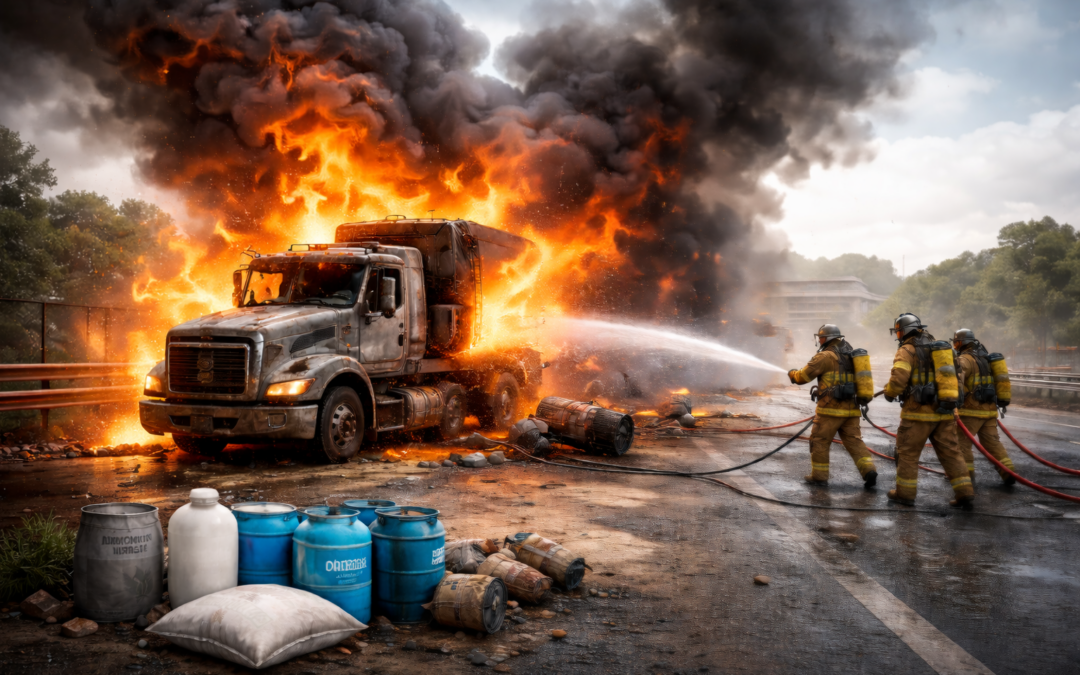
Blowtorches on the Highway: Responding to DOT Class 5 Oxidizers and Peroxides
“We’re halfway through the DOT classes,” Mike said into the mic, “and if you happen to respond to a DOT Class 5, that’s what we’re going to be talking about today.”
We were sitting in the studio, coffee cups off to the side, when he dropped the line that should make every hazmat tech sit up a little straighter: “Transportation incidents involving oxidizers and organic peroxides.”
They both downplayed it at first. “This one’s going to be a relatively short one,” Bobby joked. But anyone who’s ever really worked with Class 5 knows the truth: we could talk oxidizers and organic peroxides for eight hours and still only scratch the surface. What we ended up doing in that conversation was something in between-a fast, brutal reality check on a class most of us think we understand and quietly don’t.
DOT Class 5: The Quiet Complication in the Middle of the Highway
When most firefighters picture danger on the highway, they think flammable liquids, tankers, maybe a nasty inhalation hazard. Class 5 doesn’t always trigger that same visceral response. The placards look harmless enough-yellow for oxidizers (5.1), that flaming “O” in the center, and the split red-yellow background for organic peroxides (5.2).
On paper, it’s just another number. On scene, it can turn a routine vehicle fire into a street-level detonation or a blowtorch that eats through a strip mall.
As we talked, what kept coming back was this: most oxidizers, by themselves, don’t scare firefighters the way they should. Outside of some organics and a few ugly exceptions, many 5.1 materials aren’t going to melt your skin off on contact. They’re not chlorine gas or HF. And that’s part of the trap.
“The chemical itself doesn’t do a whole lot to us,” Mike said, “but what it does to the environment around it can absolutely ruin your day.”
Oxidizers don’t have to be directly toxic or flammable to be deadly. Their weapon is intensification-pushing a fire harder, faster, and hotter than you thought was possible in that space, with that fuel load, at that time.
What an Oxidizer Really Is (And Isn’t)
Somewhere in almost every hazmat tech class, there’s a throwaway line: “What’s an oxidizer? Something that gives off oxygen.”
Technically? Sometimes true. Practically? Deeply incomplete.
Sitting across from Mike and Bobby, you could hear the frustration in the way they circled this point. Oxidizers tend to yield oxygen, but that’s not the whole game. Many of the nastiest oxidizers don’t give off oxygen at all-and they don’t need to.
Chlorine, for example, is a strong oxidizer. It doesn’t “release” oxygen, but it aggressively supports combustion and drives certain reactions that can go violently exothermic. From a chemistry standpoint, oxidizers are really about electron transfer and the ability to drive oxidation reactions; from a street standpoint, they’re about this:
They make fires bigger, faster, and less forgiving than you were planning for.
Bobby reminded me of a demo they’d done years back: filling a balloon with pure oxygen, lighting a match, and touching it to the balloon. The latex pops, the balloon bursts-and that’s it. No Hollywood fireball, no explosion. It’s a simple but brutal correction for the mental shortcut a lot of us carry: “more oxygen = explosion.”
The explosion, the violence, the sudden blowtorch effect-that comes when the oxidizer gets married to fuel, heat, or the wrong contaminant. That’s when you discover you’ve been fighting the wrong enemy.
On the street, those oxidizers show up as:
- Ammonium nitrate
- Sodium or potassium nitrates
- Permanganates
- Hydrogen peroxide
- Pool chemicals like sodium hypochlorite
- Bromates and other industrial salts
Common, boring names. Deeply unforgiving chemistry.
Fire on Arrival: When Pool Chemicals Become a Blowtorch
If you’ve ever been to a taxpayer fire where one of the occupancies is a pool store, you already know how fast “pretty bad” becomes “what the hell just happened.”
Bobby and Mike both went back to that image: fire working down a row of stores, ordinary combustibles chewing away, smoke column predictable-and then the fire hits the pool chemical stock.
“All of a sudden it’s like a blowtorch,” Mike said. “Nothing in the building layout changed. What changed was the chemistry.”
Those “boring” buckets and bags on the shelf-cal-hypo, chlorinating tablets, oxidizing shocks-don’t just burn. They drive burning. Strong oxidizers will react with:
- Organic materials
- Reducing agents
- Certain metals
…and when they do, they generate heat. That heat feeds the cycle: more decomposition, more reaction, more gas, more pressure. If fire gets involved, you get intense burning. If flame doesn’t show up but heat does, you can still get runaway decomposition and a release of highly toxic decomposition gases.
Sometimes, in the best case, all you get is a stubborn, over-performing fire. In the worst case, you’re standing in front of a cargo body that is quietly transforming into a bomb.
That’s why, tactically, the Class 5 mindset has to shift from “treat it like any other fire” to “protect the oxidizer from everything it likes-fuel, heat, friction, sparks, contamination.”
Building the Box: Zones, Water Curtains, and What Not to Bring In
When we started talking tactics, the conversation stopped being theoretical and got painfully practical.
First move at a Class 5 transportation spill? You build the box.
We walked through the rule-of-thumb distances: establishing initial control zones on the order of 50 meters (about 150 feet) in all directions for liquids and a bit tighter for solids, then adjusting based on your ERG, product data, and conditions. The purpose isn’t just life safety-though that’s obviously front and center-it’s also about what you accidentally bring into the hot zone.
We don’t usually think about arriving with fuel, but our world is full of it: diesel in the rigs, hydraulic oil, plastics, turnout gear, absorbents, trash, cardboard, roadside debris. In a Class 5 environment, every bit of that is potential reaction mass.
Two points Mike hammered on stuck with me:
- Use water smart.
Many oxidizers “play nicely” with water. They don’t all, so you still check your references, but a lot of Class 5.1 products can be cooled, diluted, and defended with copious water. A well-placed fog curtain or water shield is a legitimate tactical barrier to keep radiant heat and external fire from involving that oxidizer load. - Stop adding fuel.
Keep as many combustibles as possible out of that inner zone. That includes absorbents, dirty tools, and even the choice of equipment you bring off the rig.
We talk a lot about “don’t smoke near flammables,” but Mike pulled a story out that goes way beyond someone lighting a cigar.
Spark, Steel, and Gasoline: The Queens Bridge That Lit Back Up
“Don’t do hot work near an oxidizer” sounds obvious-until there’s pressure to “reopen the bridge,” “finish the job,” or “get traffic flowing.” That psychological squeeze is where bad decisions sneak in.
Mike told me about a scene in Queens in the mid-2000s. It was winter. A 406 cargo tank rolled over and lit up the BQE-gasoline, fire, chaos. Eventually the visible fire was knocked down, but there was still fuel all over the structure.
Hazmat was strongly opposed to any cutting or welding while product remained on the bridge. The compromise was one we’ve all heard in some version: send a hazmat firefighter up with the welders, monitor for flammable vapors, and “make it safe.”
“So they go up in the bucket,” he said, “and I’m about a hundred yards back just watching.”
The welders strike an arc. A piece of glowing slag falls, lazily, the way hot metal does when you’ve been staring at it all day. It hits the pavement.
The gasoline lights off.
Now you’ve got three men in a cherry picker suspended over a re-ignited gasoline fire-“like a marshmallow over a bonfire,” as Mike put it. Two construction workers jump from the bucket to a beam and run. The bucket shifts, swinging back, and the hazmat firefighter is left hanging over a roaring flame front he had just spent the day helping to suppress.
That scene didn’t even involve an oxidizer. But it’s the same human pattern: we underestimate residual hazard, overestimate our control, and let economic or operational pressure chip away at our safety instincts.
Now sprinkle a strong oxidizer into that story-pool chemicals, ammonium nitrate, oxidizing solids in a van body-and you’ve lined up every domino you need for a catastrophic escalation.
Contamination, “Clean” Tools, and the Gear You Wear Home
The part of Class 5 that doesn’t get talked about enough is contamination-not the stuff we pick up on scene, but the contamination we bring in with us.
We spent a few minutes just on shovels.
Think about your average shovel or broom, the overpack drums bouncing around in the rig, the hand tools rattling around next to absorbents, fuel remnants, and whatever else has been on the last ten calls. Somebody “cleaned” them at some point with a quick hose-down at the firehouse. You wouldn’t eat off them, and you definitely wouldn’t call them “uncontaminated.”
Dust alone is organic material. Residual fuel, oil, or absorbent is reactive mass waiting for a strong oxidizer. When you plunge that “clean” shovel into a pile of spilled oxidizer, you may very well be introducing exactly the kind of fuel that makes the reaction self-accelerating.
The fix isn’t glamorous, but it’s critical:
- Use non-combustible, non-sparking, non-reactive tools that are truly clean for product handling.
- Control runoff so product doesn’t wash into trash, vegetation, or mixed waste.
- Avoid tools and tactics that introduce heat, shock, friction, or sparks into the spill area.
And then there’s your gear.
We default to bunker gear at a lot of oxidizer incidents, especially roadway events where it starts as “just a car fire” and turns into something more. By the time you realize you’re deep into a Class 5 problem, your turnouts have already picked up product or decomposition byproducts.
Now picture this stack:
- Carbon-based turnout gear = fuel.
- Absorbed oxidizer = oxygen source / reaction driver.
- Your next job is a working structure fire = heat.
You’ve built your own little three-part fire triangle and strapped it to your body.
That’s why Mike flatly said: if you go to an oxidizer incident, clean your gear as soon as humanly possible. Not, “send it out whenever the schedule allows.” Not, “it doesn’t look that bad.” Immediate, copious water, and a proper decon / cleaning cycle for anything that might have picked up product or smoke.
Lessons Written in Fire: Texas City and the Cost of Getting Class 5 Wrong
Near the end of our talk, we circled back to one of the grim classics: Texas City, 1947. A cargo ship loaded with ammonium nitrate, improperly packaged, contaminated, and quietly decomposing at the dock.
The firefighters on scene did almost everything we now know you shouldn’t do around an unstable oxidizer. They tried to control it like an ordinary fire problem instead of treating it like an energetic material on the edge. They didn’t evacuate when they should have. They didn’t understand what the chemistry was trying to tell them.
The ship detonated.
The blast destroyed most of the city, threw an airplane out of the sky, and killed virtually the entire fire department.
When you look at that event through a modern hazmat lens, it’s not just a historical tragedy; it’s a case study in misreading Class 5. Improper packaging. Contamination. Heat. Decomposition. A failure to recognize when “we’re still in control” quietly turned into “we’ve set the timer.”
And that’s the thread that runs from Texas City to a pool store in your district, to a box truck on your interstate, to a flatbed with totes of oxidizer parked next to a welding operation on a bridge.
Final Thoughts
We’re not going to solve Class 5 in a short article any more than Mike and Bobby could solve it in a short podcast. Oxidizers and organic peroxides deserve four- to eight-hour blocks in your training calendar, not four minutes at the end of a PowerPoint.
But we can do this:
The next time you see that yellow 5.1 or red-and-yellow 5.2 placard, slow down.
Ask what fuel is nearby. Ask what heat is already in the system. Ask what contamination you might be about to introduce.
Treat your tools like they’re dirty until proven otherwise. Treat your gear like it’s carrying tomorrow’s problem. Treat hot work near product like the disaster movie you’ve already seen.
And if your department hasn’t done a deep-dive Class 5 drill recently-make some noise, push it up the chain, and put oxidizers back on the training calendar before your next “routine” highway fire turns into your Texas City.