Boiling Fillings and Condemned Homes: A Mercury Hot Wash
In this hot-wash, Bobby Salvesen and Michael Monaco interviewed four hazmat responders about a call that started as a “simple” mercury spill and ended with a six-family building on the brink of being condemned.
From “Easy Saturday” to Red Flags
The incident began as a regional hazmat response for a reported mercury spill in a mid-sized city. Their regional system uses tiered levels of activation, and this came out as a Level One response: five hazmat technicians, advisory in nature, expected to investigate and, if reasonable, handle mitigation on their own. Level One for these teams often means broken thermometers, damaged blood pressure cuffs, tiny beads of mercury in a little puddle on a linoleum floor.
Rolling up to calls like that, the mindset is quick in and out-an hour, maybe ninety minutes. The techs have vacuums, specialized amalgam equipment, duct tape, chem tape, and a standard playbook. Most “mercury spills” are handled so frequently that they feel almost routine.
On this day, the first arriving technician saw exactly what he expected from the outside: one engine, one district chief, one ambulance, and a 150-year-old six-family, three-story tenement-style building. Houses were packed tightly against each other, a familiar urban streetscape. It looked like the textbook footprint for a minor hazmat call.
Then the briefing started to unravel that comfort.
The initial report from the incident commander was blunt: four dead pets, one person in the ICU, and another person sitting in the back of the ambulance, waiting for evaluation and advice. At that moment, the word “mercury” no longer matched the scene. Multiple animal deaths and a critically ill patient sounded less like a tiny spill and more like a serious atmospheric or toxic exposure.
Mercury, in the way most responders encounter it, tends to be a chronic exposure problem-low-level vapor building up over time to slowly damage the nervous system. The story unfolding in front of the team sounded acutely lethal. The technician’s suspicions shifted toward carbon monoxide in an old building, or possibly some kind of clandestine chemistry going wrong in a confined space.
As the remaining technicians arrived, they gathered for a quick hazmat huddle. One of the arriving members joked about getting it “wrapped up” quickly and heading out, reflecting the expectation of a minor call. The briefing wiped that away: a Level One response, yes, but with one occupant already in a trauma center’s ICU and four dead animals from the same building. The idea that this would be just another broken thermometer was effectively dead on arrival.
At that point, no hazmat entry had been made. No meters had crossed the threshold of the house. All the information so far was coming from the curb, the incident commander, and the ambulance.
An Ambulance Turns into the First Hot Zone
With the temperature sitting around nine or ten degrees, traditional outdoor decon tactics were immediately challenged. Urban density and bitter cold do not mix well with the image of a stripped, soaking-wet patient standing in a portable shower on the sidewalk. Instead, the responders looked to the ambulance as their first controlled environment.
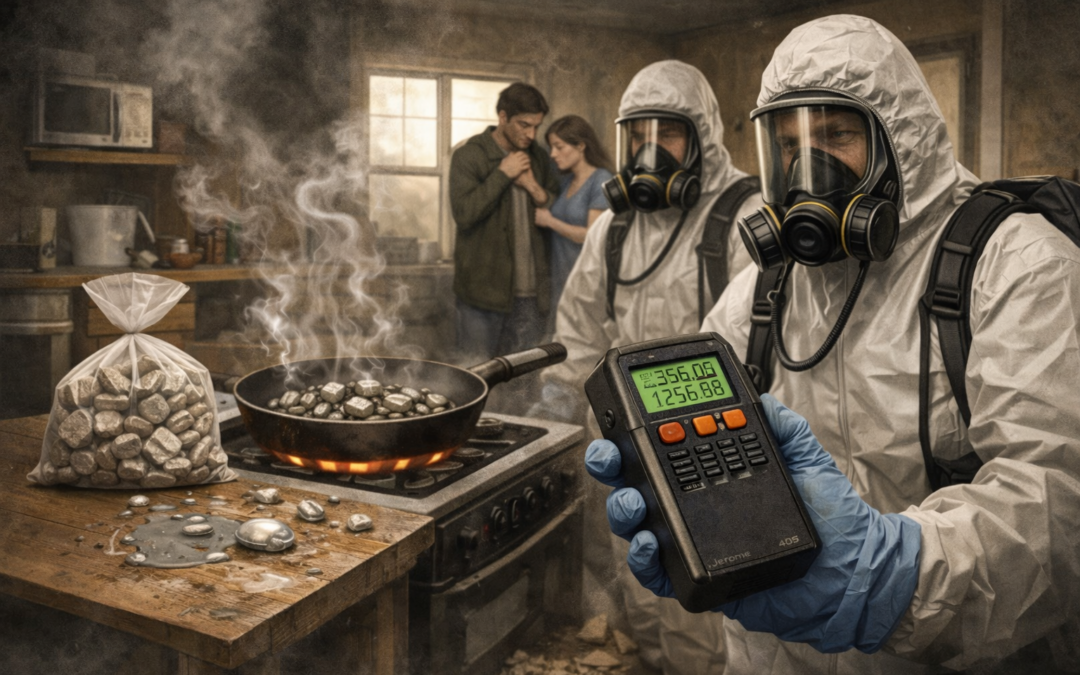
The team brought a Jerome mercury vapor analyzer to the rear doors and began a survey. They took readings from the patient first, then from the two paramedics who had been treating and handling her. Numbers in the back of that rig climbed to the mid-70s micrograms per cubic meter.
For technicians used to cleaning up trace spills, those readings were alarming. Ambient indoor mercury levels considered acceptable for long-term residential living are typically orders of magnitude lower. Even without converting to every possible regulatory benchmark, the team recognized that the patient and the interior of that ambulance were far beyond anything resembling a “safe” breathing environment for prolonged exposure.
In the cramped box of the ambulance, a familiar hazmat problem surfaced: the unit debate. Different references express limits and toxicity thresholds in micrograms or milligrams per cubic meter, and in the heat of the moment, conversions can blur. The responders on scene talked through IDLH values and chronic exposure numbers, trying to align mental notes with what the meter was telling them. Regardless of the exact threshold they had in mind, the conclusion was simple: the readings were extremely high, and this was not a trivial contamination.
Complicating the picture was the patient herself. She was not reporting symptoms that would immediately suggest acute mercury poisoning. She was sitting upright, interacting, and did not match the mental image of someone at death’s door. Meanwhile, her clothing, body, and likely hair were off-gassing enough mercury vapor to drive the meter wild.
The paramedics were now also part of the hazard. Their sleeves and heavy sweatshirts carried contamination from contact with the patient and possibly with items brought from the apartment. The responders had to decide how far to push decon measures in this cramped space.
Textbook decon procedures-strip, wash, rinse, and contain runoff-were simply unrealistic in that weather and setting. Sending the patient back into the building to use a shower risked re-exposure to whatever source had already killed four animals and hospitalized her partner. Leaving her clothed as-is risked turning the ambulance into a rolling hot zone.
The team chose a compromise. A female medic assisted in removing the patient’s outer clothing inside the ambulance. The clothing was bagged, the patient was placed in a Tyvek suit, and wrapped in blankets for both warmth and modesty. Re-surveying the patient and the box showed readings reduced to roughly half the original level, but still significantly elevated.
Decon was far from perfect, but it was better. With that, the focus shifted: one Jerome would remain to work the building; another would be sent with the patient to the hospital, where staff could evaluate ongoing contamination around the ICU environment and the ventilated partner.
The Story Behind the Mercury
While colleagues prepared for entry, one technician stayed with the patient and began the most critical investigative step: the interview.
The conversation revealed the chain of events that converted a bag of dental scrap into a building-wide contamination issue. The critically ill patient in the ICU had inherited a bag of old dental fillings from a deceased relative who had once been a dentist. To him, they represented scrap silver-something valuable that could be reclaimed with a bit of kitchen chemistry.
Unaware that these “fillings” were mercury amalgam, he poured them into a 12-inch cast iron skillet and placed it on the stovetop. He turned on the range hood above the stove, assuming it was venting outside, and heated the amalgam for three or four hours. The practical reality was much worse. The hood recirculated air, offering minimal filtration and blowing heated mercury vapor directly back into the room and across his face.
This process did not just release a small amount of vapor. Heating amalgam significantly increases mercury volatilization. In a small, poorly ventilated rooming-style apartment, vapor accumulates in the breathing zone, saturating the air. The man continued this process, collecting the liquid metal that condensed, believing solid silver would appear after cooling. Instead, what he actually collected was more mercury.
Over the following days, his health deteriorated to the point where he required intubation and intensive care. Three cats and a dog from the same apartment died over roughly two weeks. Animal Control eventually responded to remove the fourth animal, which triggered calls to the fire department, and, in turn, to the regional hazmat team.
The picture was clear. The responders were not dealing with a dropped thermometer. They were standing outside a building that had effectively been gassed from the inside with mercury vapor.
Entry into a Toxic Home
Two technicians donned Tyvek, SCBA, and taped boots, then made their way into the building with the Jerome. Even before they reached the apartment, the path told its own story.
On the approach to the affected unit, they passed a deceased cat in a carrier sitting outside the door, staged for Animal Control. Metering near the carrier produced extremely high readings, reflecting how much mercury the animal’s fur and surroundings had absorbed. This was not simply a one-room problem; it was radiating outward.
They climbed to the second floor, monitoring the air on the stairs and landing. Readings in the common areas were already elevated, showing that mercury vapor had migrated beyond the single apartment. Once inside the unit, the conditions matched the narrative they had pieced together from the interview.
The apartment was small, hot, and cluttered-more a rooming house than a traditional family home. The skillet still sat on the stove, containing liquid metal. Bags and improvised containers with residual beads of mercury were scattered nearby. Cockroach tracks cut through residue like tiny footprints in silver dust. The signs suggested that mercury had been spilled, tracked, and smeared across multiple surfaces.
Readings throughout the apartment, even two weeks after the heating event, remained in the double-digit micrograms per cubic meter. Floors, corners, likely soft goods, and structural gaps all contributed to persistent vapor levels. The contamination was not confined to a single visible pool, but embedded in the apartment’s fabric.
The technicians backed out, returning to the cold air outside. Even with careful movement and avoidance of obvious hot spots, their boots were now showing contamination. Simply walking the space had made them “hot.”
When the Problem Is Bigger Than the Team
On the sidewalk, with the building behind them and displaced residents watching, the hazmat team assembled again for a crucial huddle. Under normal circumstances, a Level One response that proves larger than expected can be escalated: more techs, more equipment, and more time. The natural instinct is to say, “Let’s go to the next level, bring in twenty technicians, and clean this up.”
This time, that instinct did not hold.
The two technicians who had just come out of the apartment made the reality blunt: additional manpower would not change the chemistry or the structure. The building was old, with countless cracks, gaps, and porous surfaces. Mercury had been heated, vaporized, and allowed to permeate for days to weeks. No reasonable amount of vacuuming or surface scraping performed by an emergency response team could guarantee safe long-term occupancy.
The question had shifted from “How do we clean up this spill?” to “Should anyone be living in this building at all until professional environmental remediation is completed?”
This raised another major barrier: jurisdiction. The hazmat team was regional, operating as a technical resource to the local incident commander. They could recommend, warn, and quantify. They could not unilaterally condemn a building or permanently displace tenants. Those decisions belonged to city officials-health department, building department, code enforcement, and possibly environmental agencies.
Despite that limitation, they had an obligation to tell the incident commander exactly what the instrumentation and observations implied. The team explained that mercury contamination extended through the apartment and into common areas, that readings remained high two weeks after the initial heating event, and that four animals and one human had already paid a heavy price. This was no longer a case where a few techs could vacuum a spill, sprinkle sulfur powder, and turn the building back over to its occupants.
Their recommendation was unambiguous: the building needed to be emptied and held that way until proper environmental remediation and post-testing confirmed it was safe. Whether that meant full condemnation, partial closure, or extensive structural work was beyond the hazmat team’s authority, but failing to sound that alarm would have been a failure of duty.
The conversation was not comfortable. Six families stood outside, facing the possibility that home was gone, at least for a long time. The district chief had to digest the idea that a “simple mercury call” had escalated into a multi-agency, long-term problem. The hazmat team, for its part, had to accept that sometimes the correct outcome is not a neat on-scene mitigation, but a hard line that says, “We cannot responsibly put anyone back in there today.”
The Lesson Living Behind the Numbers
The hot wash that Bobby and Mike captured in that Baltimore hotel room is more than a strange story about someone cooking dental fillings in a cast iron skillet. It is a case study in how hazmat work often straddles the line between emergency response and long-term public health.
This call exposed several realities:
Hazmat technicians may arrive expecting a routine task and instead find a chronic, building-wide exposure issue.
Standard decon procedures can be constrained by weather, environment, and human dignity.
Instrumentation can reveal risks that cannot be solved with manpower alone.
Jurisdictional lines dictate who can make the truly disruptive but necessary decisions about people’s homes.
Most importantly, the incident underscored that “cleanup” is not always a reasonable or honest promise. In some situations, the best, most responsible thing a hazmat team can do is define the hazard, protect the responders and immediate victims, and then insist that the problem be handed off to agencies equipped for long-term remediation.
For departments and teams listening to this story, the takeaway is clear: these conversations should not happen for the first time on a frozen sidewalk with residents staring at a condemned doorway. Agencies need to decide in advance who has authority to clear and close a building, how to support contaminated patients when outdoor decon is not feasible, and when to shift from “we can fix this” to “this requires a different kind of response.”
Those answers, worked out in training and policy, will shape how the next “simple mercury spill” is handled when it turns out to be anything but.