
Gross Decon: The Myth, The Science, and The Risk
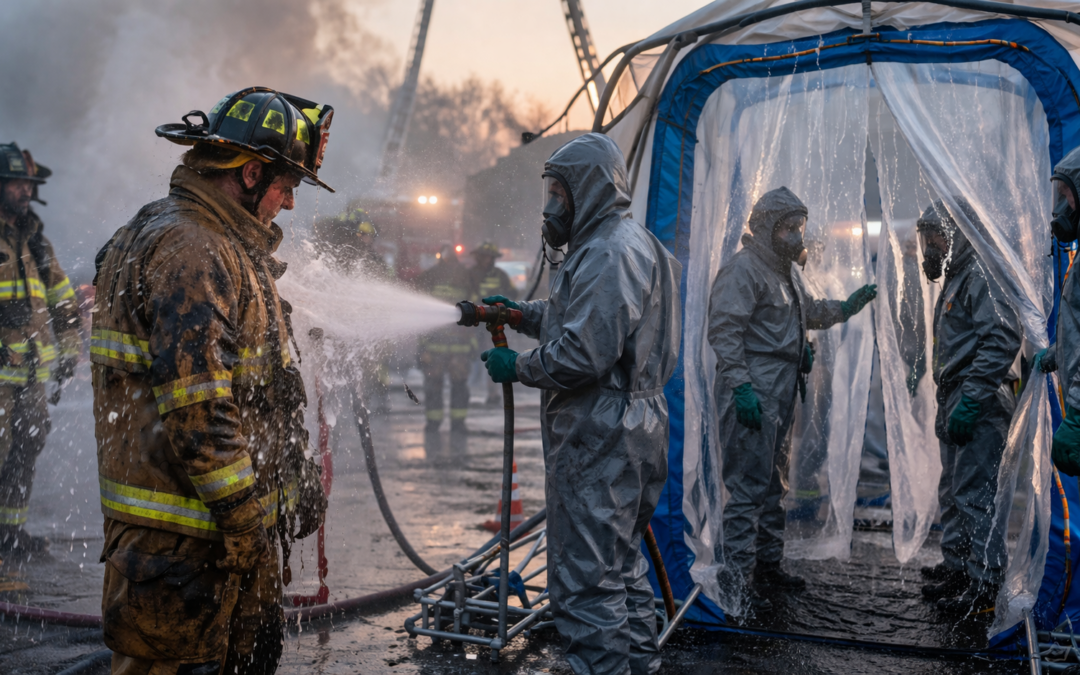
I’ve had this conversation more times than I can count, usually with good firefighters who are trying to do the right thing and want a clean answer they can hand the crew: here’s gross decon, here’s the brush, here’s the soap, here’s the hose, now everybody stand there and get scrubbed down. It feels organized. It feels proactive. And in the fire service, “doing something” has a way of becoming “doing the right thing,” even when those two things are not the same.
That was the heartbeat of my conversation with Mike and Bobby. A listener had written in after seeing one of our clips, and his question was the kind I wish we got more often: not defensive, not territorial, just honest. He’d been the guy in the room pushing gross decon at his department, trying to drag the culture in the right direction, and then he ran into information that challenged his assumptions. Instead of doubling down, he asked us to show the work. That matters, because this entire debate is really about whether we are trying to clean gear or protect firefighters. Those are not always the same thing.
The first truth we had to lay on the table was the one the fire service still resists. Structural firefighting gear is not chemical protective clothing. Not sort of. Not close enough. Not “good for a quick rinse.” It is built for heat, flame, steam, water, abrasion, and the ordinary violence of the fireground. Manufacturer guidance for NFPA 1971-compliant turnout gear says exactly what many of us should have been saying more clearly for years: the garment provides only limited liquid integrity, has not been evaluated against all chemicals encountered in firefighting, and does not offer protection from hazardous vapors or gases. Newer user guidance also warns that the limited splash resistance to six common fireground chemicals should not be read as permission to use the garment in a hazmat environment.
That distinction is not academic. It is operational. If the equipment was never designed to keep aggressive contaminants from moving through the system, then soaking that system while a firefighter is still inside it becomes a gamble masquerading as doctrine.
Bunker Gear Is Clothing, Not a Suit
Mike and Bobby walked through the construction the way good instructors do, not to impress anyone with terminology, but to make the mistake impossible to miss. Bunker gear is a layered package: outer shell, moisture barrier, thermal liner. Each layer has a mission, and none of those missions is “make me safe in a chemical environment.” The shell is there to survive flame and abuse. The thermal liner buys time against heat transfer. The moisture barrier is where the confusion usually starts, because firefighters hear the word “barrier” and imagine a sealed chemical shield.
It isn’t.
That barrier helps manage water penetration, body fluids, and limited incidental splash. It is not the same thing as a material selected, tested, and certified for chemical permeation resistance. Chemical protective clothing is built around that exact problem. NFPA 1991 covers vapor-protective ensembles intended for gas-tight integrity where no chemical contact is permissible. NFPA 1992 addresses liquid-splash protection for hazardous materials emergencies. OSHA’s own technical manual describes NFPA 1991 vapor-protective suits as “gas-tight” and intended for situations where no chemical contact is permissible. That is a completely different design philosophy from turnout gear.
And that difference matters because chemicals do not care about our intent. They care about material science. They care about seams, closures, interfaces, pressure gradients, absorption, penetration, and permeation. Hazmat suits are chosen for a known or suspected hazard. Turnout gear is chosen for a fire.
Once you understand that, the common firehouse comparison starts to collapse. We watch hazmat teams go through decon corridors, so we assume turnout gear should be handled the same way. But the hazmat team’s clothing was selected because the contaminant was expected. The decon corridor is part of a complete system built around that expectation, including runoff control, suit compatibility, time limits, and post-entry evaluation. Structural gear has none of that chemical promise built into it, and pretending otherwise only gives us false confidence.
The PRISM Problem Nobody Wanted to Hear
This is where the argument gets uncomfortable, because now we move from tradition to evidence. The PRISM guidance developed under BARDA looked at mass casualty chemical decontamination and reached a finding that should have landed much harder in our world than it did: when contaminated clothing remains on the body during gross wet decontamination, the clothing generally reduces the effectiveness of decon and can transfer contaminants to the underlying skin. The recommendation is to disrobe before showering. PRISM also found that adding detergent to gross decon water did not significantly improve effectiveness, and that delay makes decontamination less effective.
Read that again and then think about how often we line firefighters up in contaminated turnout gear and start applying water and soap because it looks like decisive action.
Now, to be fair, PRISM was not written specifically for soot-loaded bunker gear after a room-and-contents fire. But the physics it points to should make every firefighter pause. If contaminated clothing on the body can worsen transfer to skin during wet decon, then we need a very good reason to believe bunker gear behaves differently before we normalize hosing people down in it. We do not have that reason. What we do have are gear warnings that chemical protection is limited, research showing contamination can persist in multiple PPE layers, and a long-standing habit of confusing contamination reduction on gear with exposure reduction for the person wearing it.
That is the critical divide. A study can show a washdown reduces surface contamination on the outside of gear and still fail to answer the more important question: what happened to the firefighter during that process?
The Fireground’s Favorite Error: Cleaning the Gear Instead of Stopping the Exposure
This was the sharpest point Mike and Bobby made, and it’s the one I kept coming back to after the microphones were off. On the fireground, we say we care about cancer reduction, toxin reduction, and exposure reduction. But then we build practices around the visible dirt on the gear instead of the invisible exposure clock on the firefighter.
If the goal is to protect the firefighter, the fastest way to drive exposure toward zero is often brutally simple: get the contaminated gear off. Stop the contact. Bag it. Isolate it. Launder it properly before it ever goes back in service. The instinct to wash first and undress later is backwards if the gear itself is part of the contamination pathway.
That does not mean on-scene gross decon is useless. It means its purpose needs to be framed honestly. If the crew is going to remove gear, bag it, and send it through proper cleaning under the department’s care program, then a heavy wet scrub on the firefighter may not be the smartest first move. If, on the other hand, the system is broken and the contaminated gear is likely to be tossed back into the rig, thrown on the bunkroom floor, or worn again before laundering, then crews will reach for gross decon because they are trying to compensate for a larger failure. The washdown becomes a patch over bad PPE management.
NFPA’s cleaning and care framework recognizes the problem. Research tied to NFPA 1851 cleaning verification has shown that contamination removal varies across moisture barriers, thermal barriers, gloves, and hoods, and that evaluation methods had to be adapted beyond outer shells because contaminants persist in more than the visible layer. That is not the profile of a simple “hose it and forget it” problem.
What We Owe the Firefighter in the Gear
There is also a psychological piece here the fire service doesn’t talk about enough. Under stress, we default to rituals that feel familiar. Brush. Soap. Rinse. Repeat. They give the impression of control. And firefighters, especially operations personnel, are conditioned to trust tactile work over abstract warnings. If you tell a crew to stop, strip contaminated gear, control the bagging process, and focus on removing the firefighter from the exposure pathway, it can feel less active than a dramatic scrub-down. But less theatrical does not mean less protective.
That is where training has to get better. We need to teach the difference between incidental splash resistance and chemical protection. We need firefighters to understand that “moisture barrier” is not the same as “hazmat barrier.” We need officers to recognize that turnout gear warnings are not lawyerly fine print; they are operational limits. And we need departments to stop treating contamination control as a social-media-ready ritual and start treating it as a systems problem involving gear selection, scene discipline, transport, laundering, storage, and return-to-service decisions.
What stayed with me most from the conversation was not just the technical case. It was the humility behind it. A firefighter asked whether a practice he had championed might be wrong. Mike and Bobby answered by dragging the issue back to first principles: what is the gear designed to do, what does the evidence actually say, and what action best reduces human exposure right now?
That is the standard we should be holding ourselves to. Not whether a practice looks like hazmat decon. Not whether it has become popular on the conference circuit. Not whether it satisfies our urge to act. The question is simpler and harder than that: are we cleaning equipment, or are we protecting firefighters?
If your department’s gross decon policy cannot answer that clearly, it is time to pull the gear apart, pull the science apart, and rebuild the practice before the next hose line turns a contamination problem into an exposure problem.