Curious, Not Judgmental: The Hazmat Leadership Journey of Ralph Suppa
Chasing That Championship Feeling
When we brought Ralph “Supa” Suppa onto the show, the first thing that came through wasn’t chemicals, tactics, or acronyms-it was this raw, almost addictive way he talked about leadership.
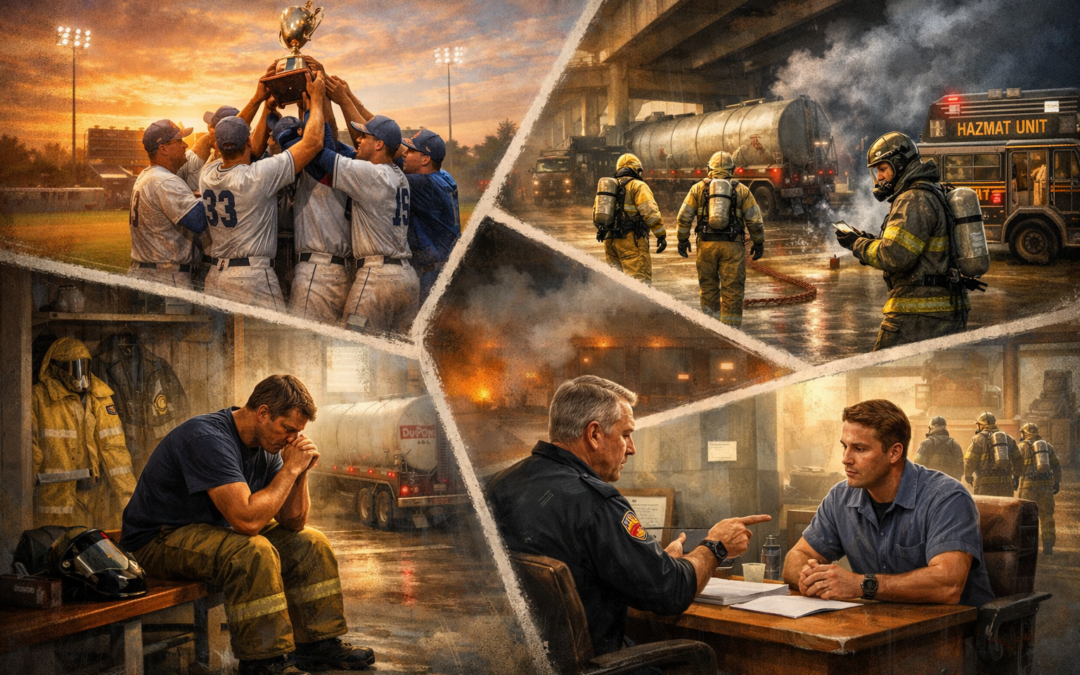
Before he ever pulled a hazmat line or suited up for Special Ops, he was a high school kid on a state championship team. That experience has been haunting him-in a good way-ever since.
“I was part of something special,” he told us. “You see great leadership take a group all the way to a state championship, and once you feel that, you end up chasing it almost like a drug.”
Two decades in the fire service, fifteen years in hazmat and special operations, and he’s still chasing that feeling. He coaches high school baseball now, trying to give his kids that same sense of being part of something bigger than themselves. He wants them to feel what it’s like when leadership isn’t just a word in a PowerPoint, but a force you can almost touch.
We started out joking with him-Supper, Super Supper, Suppa-typical hazmat humor, food and mispronunciations. But it didn’t take long before the conversation turned to something heavier: the way leadership shows up in failure just as much as in success.
“Leaders don’t give up,” Mike said at one point. “If you want to be a follower, give up. You’ll be a great follower.”
Suppa didn’t flinch. He agreed there’s leadership at both ends: the leaders that guide winning teams and the leaders who show up when things go wrong. And in hazmat, things do go wrong. Procedures break down, meters misbehave, data’s incomplete, and the margin for error is razor-thin.
That set us up perfectly for the story that really defines him.
The DuPont Call and the Choice to Cower
Suppa never wanted to be “the hazmat guy.” He’ll tell you that himself. In his own words, he wanted to be a rock breaker-a technical rescue guy, not the one doing math over a plume model.
He came out of the academy into a busy house, caught a couple of good fires, including one where he and his officer ran out of water and got cut off upstairs. They fought through it and survived, and he earned some credibility with that officer. That goodwill would matter later in ways he couldn’t see at the time.
Then came the Memorial Day weekend call.
A truck, leaking an experimental chemical from DuPont. A major interstate shut down. The governor’s office on the phone: You need to open this roadway. DuPont’s answer: If this reacts, you evacuate a one-mile radius. Inside that radius? A state capital with over a million people.
To make it worse, it was pouring rain. The driver had at least had the sense to park under an overpass, but the chemical was highly water-reactive. They expected phosgene as one of the potential byproducts. Thermal runaway was in the conversation, and they were talking about catastrophic levels of energy if the wrong sequence of events kicked off.
“Pretty big pucker factor,” Suppa said.
The way he tells it, they made the assignment volunteer-only. They needed people to go up, monitor, and figure out what was coming off that load. And this is the moment where he doesn’t try to sugarcoat it.
“I Homer Simpson’d into the bushes,” he admitted. “I just backed out. I didn’t want to do hazmat. I wanted to be technical rescue. Six people on the team, nowhere to hide, and I still tried.”
Eventually he did go up and help with some investigation, but the damage-internally-was done. He was embarrassed. He knew he’d cowered. And the next shift, he got the summons nobody wants: “Come into the office.”
Two officers. Closed door. You know the vibe.
“What happened?” they asked.
He could have said he didn’t understand the chemical, or that someone else stepped up first. Instead, he told the truth.
“I cowered,” he said. “I got scared. I don’t want to do hazmat.”
That’s the point in the fire service where a lot of careers take a hard turn. We are, as he put it, very good at kicking people when they’re down. Very good at judging quickly. One mistake, one bad moment, and it’s easy to decide, This isn’t for you. Pack your stuff.
Instead, his lieutenant, Chris Kane, chose a different route-one that Suppa tied to that often-misattributed line from Ted Lasso: Be curious, not judgmental.
“They could’ve thrown me off the team right then,” Suppa said. “No questions asked. It would’ve been easy. Instead, my lieutenant says, ‘Okay. What are you going to do next time?’”
Suppa didn’t hesitate: “Next time, I’m going to volunteer. I’m going to go up and get after it.”
And Kane’s response is the line that changed everything.
“Awesome. By the way, you’re my new hazmat guy.”
Suppa laughed telling it, but you could tell it still hits deep. “I’m sitting there going, ‘Were you not listening? I just told you I don’t like hazmat.’”
Fifteen years later, he’s running Servitas with a focus on hazmat leadership and lithium-ion/EV incidents, teaching the very work he once tried to hide from. For him, that’s the difference between a decent mentor and a life-changing one.
“A good mentor can point you in the right direction,” he said. “A great mentor can change the trajectory of your entire life.”
Hazmat Officers, Mavericks, and the 95 Percent
As we dug into what makes hazmat leadership different, Suppa kept coming back to the idea that a hazmat officer isn’t a “boss” in the same way a truck boss is.
On the fireground, the boss is often right there in the smoke with you. Hand on your shoulder. You make a mistake; you get burned, crushed, or smoked over. The feedback is instant.
On a hazmat, you can be a quarter mile away working out of a command post while your team disappears into the hot zone with meters and radios. You might be relying on a grainy digital photo some guy with an old camera told you not to scroll through. You might not know whether you got it right until lab results or medical symptoms show up days, weeks, or years later.
Suppa had just come back from CBRN World in Charleston, where one of the big themes was the “point of no return” for many of the agents we worry about-chemical, biological, or radiological. Once exposure passes a certain threshold, the outcome is locked in. That’s the kind of reality that raises the stakes on every decision a hazmat officer makes.
“You can’t just be the recipe in the kitchen,” he said. “This isn’t ‘go here, turn this, then that.’ It’s real-time decision-making outside the playbook. Your people need to know the fundamentals, but they also need to be able to think beyond them.”
You can’t get that from micromanagement. You get that from trust.
He told us about a recent call where he geared up at the beginning, fully expecting to go in, and then realized they had enough personnel in suits. He stepped back out and stayed on the outside.
“I had a chief next to me who said, ‘This is your show,’” Suppa said. “I think I said three words on the radio the whole incident. First crew reconned, second crew isolated, they stayed on air the entire time even though we only had a PID hit. We solved it clean.”
It wasn’t a glamorous incident. He called it “low budget.” But the way the crews handled it-solid fundamentals, clean communication, small lessons afterward about better wording on the radio-that’s where his pride really came through.
That’s also where his view of leadership lines up with guys like Jocko Willink: the dichotomy of stepping back enough to let people operate, but staying engaged enough to bump them back on track when needed.
And he doesn’t just apply that to the company or battalion level. He watches what’s happening nationally too. He talked about people like Rob Kadlec stepping into high-level roles over nuclear, chemical, and biological deterrence, and Dr. Will Walters, the former special operations surgeon tied into Ebola biocontainment, COVID movements, and later the massive private evacuation effort out of Afghanistan.
“These guys are mavericks in the best sense,” Suppa said. “Not freelancers, but people willing to push just outside the normal operating procedures for the right reasons-and then drag the playbook forward so everyone can follow.”
From DOD and HHS down to the engine pulling up on the chemical plant, that kind of leadership can change how we track exposure, care for responders, and design the next generation of hazmat playbooks.
Feedback, Mentors, and Building Bridges
For all the talk about big-picture strategy, the part of the conversation that stuck with me most was brutally simple: if you’re not getting hard feedback from your people, you’re probably not actually leading them.
“If you’re not getting negative-constructive-feedback from your subordinates, they’ve lost faith in you,” Suppa said. “They don’t think it’s worth telling you the truth anymore.”
He had that person in his life: his best friend Vince Nicholas. They came up together, and when Suppa promoted, Vince eventually became his driver in Special Ops. Vince’s catchphrase was simple: “Step into the office.”
“It wasn’t even my office,” Suppa laughed. “It was just the office. And he’d tell me, ‘You’re too emotional. You’re all over the board. It’s affecting the crew.’ That kind of honesty is gold.”
He’s the first to admit that his own default is to speak up now and deal with repercussions later-something he’s still learning to temper with tact. But he’d rather err on the side of the hard conversation than live with “I should have said something.”
That played out again at his new station. One of his firefighters came to him quietly: “Hey, can I talk to you about something?” It turned out to be an issue affecting the entire crew that wasn’t even on his radar.
“Because he came to me, I could either address it myself or ask the senior person to handle it,” Suppa said. “That’s leadership too-giving someone else the authority to solve the problem.”
And those mentors he keeps naming? They’re everywhere in his story. The DARPA-connected mentor he met through a babysitter’s dad. The mentors who pushed him to think about white papers instead of just ‘firefighter stuff.’ The blue shirts who told him he should be presenting. The folks at Hazmat Consultants 101 who suggested, instead of joining them, that he start his own company. The Stash Training crew, Patrick, Adam McFadden, Chief Mark Secuso, and the Southernmost Hazmat Conference crowd-two-thirds of whom he considers mentors.
He kept circling back to one quote he attributes to Ralph Waldo Emerson: “You never look down on someone unless you’re helping them up.”
Then he added, deadpan, “Just remember, that’s probably an HR issue. Maybe put gloves on if you’re going to lift people.”
That’s Suppa in a nutshell: faith-driven, deeply grateful, but still grounded in the dark humor we all use to survive this job.
Today, with Servitas, his focus is clear: leadership, lithium-ion battery events, and EV response. He’s worked with UL on their EV burns, thanks to Assistant Chief Craig Blake. He’s part of international teams pushing out data that will likely show up in serious publications. And through all of it, he keeps repeating the same mission.
“We like to bridge the gap between the science and the responders,” he said. “Real-world experience plus deep dives into the science. We’re in the business of building bridges, not burning them.”
If you’re reading this as a hazmat tech, officer, or chief, here’s the quiet challenge baked into his story: ask yourself where you’re judging instead of getting curious, where you’re hoarding knowledge instead of handing it off, and where you’re shutting down feedback instead of inviting it in.
Then go build one more bridge-to a younger firefighter, a mentor outside your rank structure, a scientist, or even that one crew member who has been waiting for you to say, “Step into the office,” and actually mean, I’m ready to hear you.
That’s how we grow the next generation of hazmat leaders who don’t cower when the DuPont trucks show up-but who are brave enough to admit it when they do, and determined enough to say, “Next time, I’m going to volunteer.”