
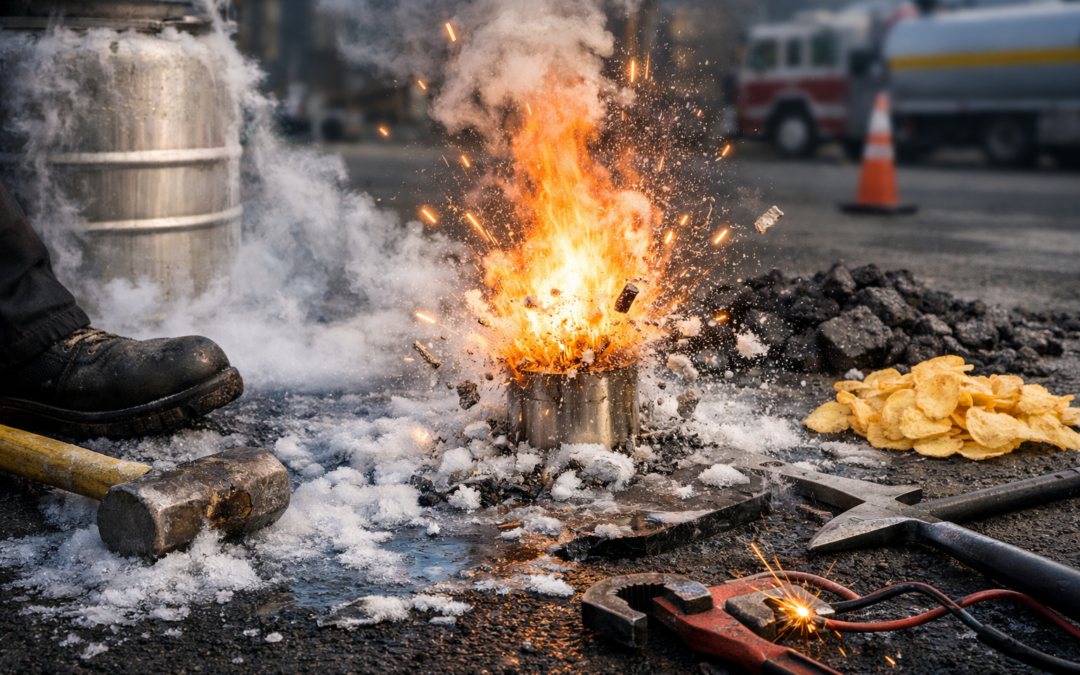
Liquid Oxygen: The Myth, The Science, and The Explosive Truth
When it comes to hazmat situations, some stories become so ingrained in the lore of the industry that they take on a life of their own. One such story is the idea that stepping on liquid oxygen could cause a catastrophic explosion-an urban legend passed from one responder to another, often told with the kind of certainty that makes you believe it’s true. But what if I told you that this legend might not be as explosive as it sounds?
Bobby and Mike sat down with Andy Burns, a hazmat expert with years of real-world experience, to talk about the truth behind liquid oxygen (LOX) and its potential hazards. His insights from a groundbreaking study shed light on a series of misunderstood reactions and, in some cases, defused the myths we’ve all heard. Here’s what we learned.
The Dangerous Power of Liquid Oxygen- Fact or Fiction?
At the heart of the debate is a seemingly harmless substance: oxygen. We’re surrounded by it daily, breathing in the 21% oxygen that makes up our atmosphere. It’s a benign, life-sustaining element-until it’s cooled to the extreme, liquefied, and stored as LOX. The potential for disaster arises when LOX interacts with flammable materials, but is it truly as volatile as some stories suggest?
Andy recounts an incident that’s become a fixture in hazmat folklore: a liquid oxygen leak on asphalt, resulting in a horrific explosion when someone stepped on it. “You’ve probably heard it too,” Andy said, his voice laced with skepticism. “The classic story that someone stepped on liquid oxygen on the ground and-boom-their leg was blown off. That’s the stuff of nightmares.”
This story, like many in the hazmat world, is passed down through anecdotes and hearsay, often without verification. But Andy and his colleagues wanted to see if there was any truth to it. They didn’t just accept the legend; they decided to test it.
The Study That Shattered the Myth
While many believed stepping on liquid oxygen could trigger an explosion, Andy and his team took a scientific approach to this claim. “When we looked at the literature, we found that the idea of a spontaneous explosion from stepping on liquid oxygen was completely unverified,” Andy explained. “There were 63 incidents recorded in the NFPA 53 guidelines about liquid oxygen, but none of them had solid evidence to back up the explosion stories.”
In essence, the story was lacking. There were no verifiable cases where someone had stepped on liquid oxygen and caused an explosion. The research wasn’t just hypothetical-it was experimental.
Andy and his team set up a series of tests to determine if mechanical impact could actually cause a reaction. They poured liquid oxygen onto asphalt, pressed it under pressure, and even used tools like sledgehammers and halogens to strike the substance. The results were disappointing for anyone hoping for a dramatic explosion. Despite the various attempts to induce a reaction, liquid oxygen on asphalt just didn’t explode-not with the pressure, not with the impact, and not even when they stomped on it. It simply wouldn’t react.
The Real Danger: When Oxygen Meets Fuel
If liquid oxygen by itself isn’t the issue, what’s the real danger? The answer lies in its interaction with flammable materials. When you combine liquid oxygen with a hydrocarbon- like gasoline, diesel fuel, or even something as innocent as a potato chip- the results can be more dramatic. But the key ingredient here isn’t just the oxygen-it’s the ignition source.
“We tried pouring liquid oxygen into various hydrocarbons, including acetone and even potato chips,” Andy explained. “The result was just a frozen block of liquid oxygen. It did nothing until we added a spark or heat source. The moment we had an ignition source, the reaction was violent. But without it? No explosion.”
What Andy and his team discovered is that while liquid oxygen can significantly expand the flammable range of certain materials, it doesn’t spontaneously combust on its own. The spark is what initiates the chain reaction. That’s a critical distinction that many first responders miss- especially in situations where liquid oxygen is spilled or mishandled.
The Mechanics of Combustion: How Pressure and Temperature Play a Role
To fully understand why liquid oxygen doesn’t explode on asphalt or other surfaces, we need to look at the science behind it. Andy describes a study where they tried to replicate NASA’s infamous 1973 incident. In that case, a liquid oxygen and asphalt mixture exploded violently when compressed by a mechanical device. They recreated the conditions using similar materials: liquid oxygen, asphalt, and an aluminum plate.
The key to the explosion, Andy explains, wasn’t just the liquid oxygen-it was the way it was compressed. “What happens is, when you have liquid oxygen in a confined space and apply mechanical impact, the pressure increases rapidly. That, in turn, causes the temperature inside the system to rise. It’s essentially the same principle as a diesel engine,” he said. “As the pressure increases, the temperature rises, and if the conditions are right, you get ignition.”
But it’s important to note that this is a very specific scenario-one that doesn’t occur in everyday conditions. The general surface of asphalt on a road, for example, doesn’t create the necessary conditions for this kind of violent reaction.
The Real World: What First Responders Need to Know
For first responders, the takeaway from Andy’s study is both simple and complex. On one hand, they don’t need to fear the everyday risks of stepping on liquid oxygen or simply being in its presence. It’s not going to explode just because someone walks across a puddle of it on the road. But, on the other hand, they must understand that when liquid oxygen combines with flammable materials, the situation changes entirely.
“When liquid oxygen meets a combustible, like gasoline or acetone, that’s where the danger lies,” Andy said. “The critical thing is to eliminate any potential ignition sources. That’s the real hazard.”
While this new understanding of liquid oxygen’s behavior doesn’t change the basic safety protocols-cryogenic precautions, PPE, and controlling ignition sources-it does suggest that many first responders may be over-cautious in some situations. For example, Andy points out that manufacturers who handle liquid oxygen routinely- like Air Liquide- don’t panic when they walk across frost-covered surfaces. Their experience tells them that the real threat lies elsewhere.
But when liquid oxygen is mixed with a fuel, whether in an industrial setting or after a spill on a road, the risk becomes real. “I’d say we’re overly cautious in some areas, but there’s still a good reason to be cautious,” Andy explains. “Just because you can’t get an explosion from stepping on it doesn’t mean you can ignore the potential for ignition when fuel is involved.”
The Importance of Critical Thinking and Training
Andy’s final takeaway is one that echoes the core philosophy of hazmat response: critical thinking and adaptability are essential. “We need to stop treating every hazmat call the same,” he says. “Each situation is different, and we have to assess the risks based on the conditions we’re facing. This study proves that just because something sounds dangerous doesn’t mean it always is.”
First responders need to be aware that the science doesn’t always match the stories they’ve heard or the training they’ve received. By staying open-minded, testing assumptions, and adapting to new information, hazmat teams can continue to improve their response strategies and reduce unnecessary panic. As Andy puts it, “It’s about making sure we’re not letting myths control our actions. We need to be smarter than that.”
As hazmat instructors, it’s up to us to ensure that our teams are equipped with the most accurate information and the ability to think critically in high-pressure situations. And while liquid oxygen may not be as explosive as the legends suggest, its potential dangers should never be underestimated- especially when combined with other flammable materials.
So, the next time you’re responding to a hazmat call, remember: the truth is often stranger than fiction. And the science? Well, that might just surprise you.