7-OH: When a Gas Station Opioid Becomes a Hazmat Problem
Walk into almost any convenience store and there is a good chance you have passed some version of this problem without realizing it. Behind the counter, beside the energy shots and nicotine products, are brightly colored packages promising energy, relaxation, focus, pain relief, or some other carefully worded benefit. Gummies, tablets, capsules, liquid shots, powders, and sometimes vape products occupy a strange space between familiar consumer goods and substances most responders know very little about. Somewhere in that growing marketplace is 7-hydroxymitragynine, better known as 7-OH, a potent opioid-active alkaloid associated with kratom products that has drawn increasing attention from regulators, poison centers, healthcare providers, and now emergency responders.
For hazmat technicians, however, the important question is not whether 7-OH is the next fentanyl. That kind of thinking is exactly how responders end up turning an unfamiliar substance into something more frightening than the evidence supports. The better question is what kind of incident we are actually standing in front of. A sealed package of tablets on a convenience store shelf is one problem. An unconscious patient surrounded by gummies and empty packages is another. An unlabeled bag of bulk powder sitting beside glassware, solvents, heating equipment, and improvised processing equipment is something else entirely. The chemical name may be the same, but the response should not be. Understanding that distinction is where 7-OH becomes useful to the hazmat community.
What 7-OH Actually Is
The first thing we need to get right is the terminology. Kratom is not simply another synthetic opioid. It comes from Mitragyna speciosa, a tree native to Southeast Asia whose leaves contain a collection of naturally occurring alkaloids. Two of the most important are mitragynine and 7-hydroxymitragynine. Natural kratom leaf contains relatively small amounts of 7-OH, but concentrated commercial products can contain considerably more than would normally be encountered in the plant itself. That distinction is important because the brightly packaged 7-OH product sitting behind a counter should not automatically be treated as equivalent to traditional kratom leaf.
What makes 7-OH particularly relevant is its activity at opioid receptors. At sufficient doses, its effects can begin looking very familiar to anyone who has treated an opioid overdose. Decreased level of consciousness, respiratory depression, sedation, and other opioid-like findings can develop, especially when concentrated products are consumed in excessive quantities. The risk becomes even more complicated when 7-OH is combined with alcohol, benzodiazepines, opioids, or other central nervous system depressants. In the real world, responders rarely get the luxury of assuming that the substance identified on one package is the only substance involved.
That means the first clue may not come from a meter or laboratory instrument. It may come from the patient. If someone has an altered level of consciousness and depressed respirations while packages of 7-OH products are scattered nearby, that environmental information matters. It does not prove what caused the patient’s condition, but it belongs in the overall picture. Hazmat responders have always been taught to read containers, placards, shipping papers, and physical properties. Drug-related incidents remind us that sometimes the human being lying on the floor is part of our detection system too.
Do Not Repeat the Fentanyl Mistake
There is an important line to draw before we go any further. The fire service has been down this road before.
When fentanyl first became a major public safety concern, fear often traveled faster than toxicology. Stories circulated suggesting that simply touching a small quantity or being somewhere near fentanyl could cause an immediate overdose. Responders became understandably concerned about a substance they knew could be extraordinarily potent, but potency and exposure are not the same thing. Eventually, better occupational guidance helped separate legitimate exposure concerns from scenarios that were biologically implausible.
We should not repeat that cycle with 7-OH.
Finding an intact tablet on the floor does not automatically create a high-level hazmat entry. Neither does seeing a package of gummies behind the counter of a convenience store. The existence of a potent substance does not eliminate the fundamentals of exposure assessment. We still need a route into the body, a sufficient dose, and enough time for that exposure to matter. Those principles do not disappear simply because the chemical name is unfamiliar.
That does not mean responders should become casual about it either. Bulk powder creates a different exposure potential than an intact tablet. An active processing operation creates different hazards than a sealed consumer package. An impaired patient covered in unknown material presents different problems than unopened products sitting on a shelf. The correct response lives somewhere between panic and complacency, and finding that middle ground requires us to evaluate what is actually present instead of responding to the reputation of the chemical.
When the Package Disappears
The incident becomes considerably more interesting to hazmat when 7-OH stops looking like a consumer product.
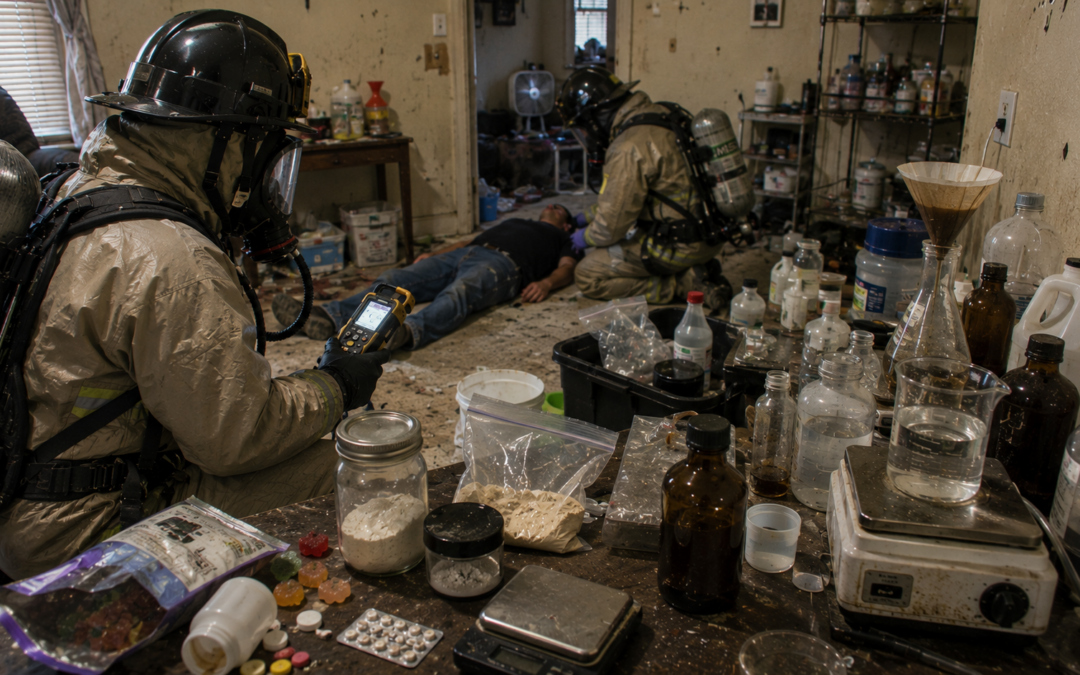
Imagine entering a residence during what initially appears to be a medical call. There are the familiar packages scattered around the room, but farther inside you begin seeing unlabeled jars, bags containing off-white powder, filters, funnels, glassware, heating equipment, liquid containers, and improvised ventilation. At that point, whether somebody tells you the operation involves 7-OH almost becomes secondary. The environment has changed the problem.
Now we are no longer dealing exclusively with the toxicology of one opioid-active substance. We may be dealing with powders capable of becoming airborne, unidentified solvents, flammable vapors, corrosives, oxidizers, compressed gases, heat sources, incompatible chemicals, contaminated surfaces, and unknown reaction products. We may not know whether the material is being extracted, concentrated, purified, converted, diluted, repackaged, or whether an entirely different process is occurring alongside it.
That is the point where responders should resist the temptation to become amateur chemists. An unlabeled bag does not become 7-OH because someone at the scene says it is. A brown bottle does not become a known solvent because it resembles something seen during training. Labels in an uncontrolled processing environment should be treated as clues, not guarantees. The more improvised the operation becomes, the less confidence we should place in assumptions about what any individual container holds.
The best working classification may simply be an unknown mixed-hazard processing environment. That sounds less satisfying than immediately identifying the operation, but it produces much better decisions. Establish control zones. Limit personnel. Identify ignition hazards. Monitor the atmosphere. Protect against splash and particulate exposure based on what is actually present. Gather information from a position of safety and allow the evidence to narrow the problem instead of deciding what the problem is before the evidence arrives.
The Process Can Be More Dangerous Than the Product
This is one of the most important lessons in clandestine and improvised chemical operations. The substance everyone recognizes is not necessarily the thing most likely to hurt the entry team.
A responder may arrive worried about 7-OH while standing in an atmosphere containing flammable solvent vapor. The powder on the table may draw everyone’s attention while an improvised heating device provides the ignition source that actually determines whether the room remains tenable. A patient may demonstrate opioid toxicity while the environment surrounding that patient presents an entirely separate inhalation, fire, or explosion hazard.
Solvents are particularly important because extraction and chemical processing can introduce volatile organic compounds into spaces that were never designed for that purpose. An industrial laboratory controls those hazards with ventilation systems, rated electrical equipment, proper storage, grounding and bonding where required, process controls, and trained personnel. A residence, motel room, storage unit, or back room may have none of those protections. Add improvised heating, extension cords, ordinary switches, pilot lights, refrigerators, HVAC equipment, or smoking materials and suddenly the ignition problem becomes just as important as the toxicological one.
This is why atmospheric monitoring should begin early whenever the scene suggests active chemical processing. Oxygen concentration, flammability, toxic gases where appropriate, and volatile organic vapors can help responders determine whether the environment is telling a different story than the product on the table. A meter will not identify every chemical present, and a normal reading does not magically make an unknown laboratory safe, but monitoring gives us something far more useful than intuition: data.
The same principle applies to ventilation. Opening doors, turning on fans, shutting down equipment, or manipulating electrical systems may seem like obvious ways to improve conditions, but every intervention needs to be considered against the possibility of a flammable atmosphere. The first responder who recognizes that the room may contain volatile solvents should be thinking about ignition control before somebody casually flips a switch.
Read the Patient and the Scene Together
For firefighters and EMS personnel, 7-OH creates another challenge because the hazmat problem and the medical problem may arrive at exactly the same time.
An opioid-like toxidrome should immediately move respiratory status toward the top of the assessment. A patient with progressively decreasing mental status, inadequate ventilation, hypoxia, or other signs consistent with opioid toxicity can deteriorate quickly. Pinpoint pupils may support the picture, but their absence should not be used to rule an opioid-type exposure in or out. Patients do not read textbooks, and mixed-substance exposures make clinical presentations even less predictable.
Naloxone may have a role when clinically indicated for suspected opioid toxicity, particularly when respiratory depression is present, but responders should follow their medical protocols rather than treating the presence of a 7-OH package as an automatic diagnosis. Airway management and adequate ventilation remain fundamental. The goal is not to make the patient instantly awake and angry. The immediate problem is inadequate respiration.
At the same time, rescuers have to keep asking whether the environment is safe enough to provide that care. An unconscious patient creates enormous pressure to move quickly, but a medical emergency does not neutralize a flammable atmosphere, unidentified powder, or active chemical process. Sometimes the first medical intervention is removing the patient from the hazardous environment while properly protected responders control the scene around them.
This is also where communication between hazmat and EMS becomes critical. The hazmat technician needs to understand what the patient is doing. The medic needs to understand what the environment is telling the entry team. Neither discipline has the entire picture by itself.
Identification Is a Process, Not a Label
One of the easiest ways to get hurt at an unknown drug operation is to allow the first piece of information to become the final answer.
Someone says they were making 7-OH. A package says kratom. A patient says they took a gummy. Suddenly everything in the room gets mentally labeled as the same substance.
That is confirmation bias wearing turnout gear.
The better approach is the same product-container-environment model hazmat technicians already use everywhere else. What do we believe the product is? What physical form is it in? How much is present? What type of containers are being used? Are they original containers or repackaged materials? Is there evidence of processing? Are materials being heated? Are there vapors present? What are our instruments telling us? What is happening to the people inside the environment?
Those observations build behavioral predictions. A handful of commercially packaged tablets leads us in one direction. Kilograms of powder, unlabeled liquids, laboratory equipment, heat sources, and measurable organic vapors lead us somewhere completely different. The chemical name did not necessarily change. Our understanding of the incident did.
That is why responders should be careful about allowing labels to create false confidence. Even legitimate-looking packaging can be misleading in gray-market or illicit distribution. Bulk materials may have been transferred repeatedly between containers. A bottle originally containing one solvent may now contain another. A handwritten label may represent what someone hoped was inside rather than what chemistry ultimately produced.
Treat identification as something that develops throughout the incident. Every new observation should either strengthen the working hypothesis or force us to reconsider it.
Respond to the Scene You Actually Have
7-OH is worth knowing about because responders are increasingly likely to encounter concentrated products in the communities they serve. Its opioid activity matters. Its potential for respiratory depression matters. The changing regulatory environment matters. But none of those facts justify treating every encounter like a clandestine laboratory.
The package matters.
The quantity matters.
The physical form matters.
The patient matters.
The environment matters.
A sealed consumer product is primarily a recognition issue. An overdose is primarily a medical emergency with appropriate responder precautions. A damaged container of bulk powder may introduce contamination and inhalation concerns. An improvised processing operation involving unknown chemicals, heating equipment, powders, and volatile solvents deserves an entirely different posture.
That progression is the real lesson.
Hazmat responders do not become valuable because we know the longest chemical names in the room. We become valuable because we can walk into uncertainty, resist the urge to panic or oversimplify, and systematically determine which hazards actually matter. Sometimes the substance everyone is afraid of turns out to be the least dangerous thing in the building. Sometimes the ordinary-looking bottle beside it is what can ignite the room.
7-OH may be the name that gets the call dispatched. It may be the package that catches the firefighter’s attention or the clue that helps the medic understand why a patient’s respirations are disappearing. But once bulk powders, unknown liquids, improvised equipment, and chemical processing enter the picture, the response cannot remain fixated on a single drug.
At that point, the lesson is much bigger than 7-OH.
Stop responding to the name on the package and start responding to the scene in front of you.