“Making Water Wetter”: What Surfactants Really Mean on the Fireground
Where Wetting Agents Actually Fit on the Fireground
When we picked up part two of the emulsification and surfactant conversation with Mike and Bobby, we didn’t start in a lab. We started where it matters: on the fireground.
We’d already talked about what surfactants are and how they work. Now the question was, “So what? Where does this fit into an actual hazmat response?”
For hazardous materials operations, wetting agents give us a surprising amount of flexibility. Properly proportioned, they can be extremely effective on:
- Class A fires: the usual suspects-wood, paper, ordinary combustibles.
- Class B fires: flammable and combustible liquids.
- Some Class D scenarios: certain combustible metals and metal fires, depending on product and conditions.
- Cooking oils and fats in very specific, controlled circumstances.
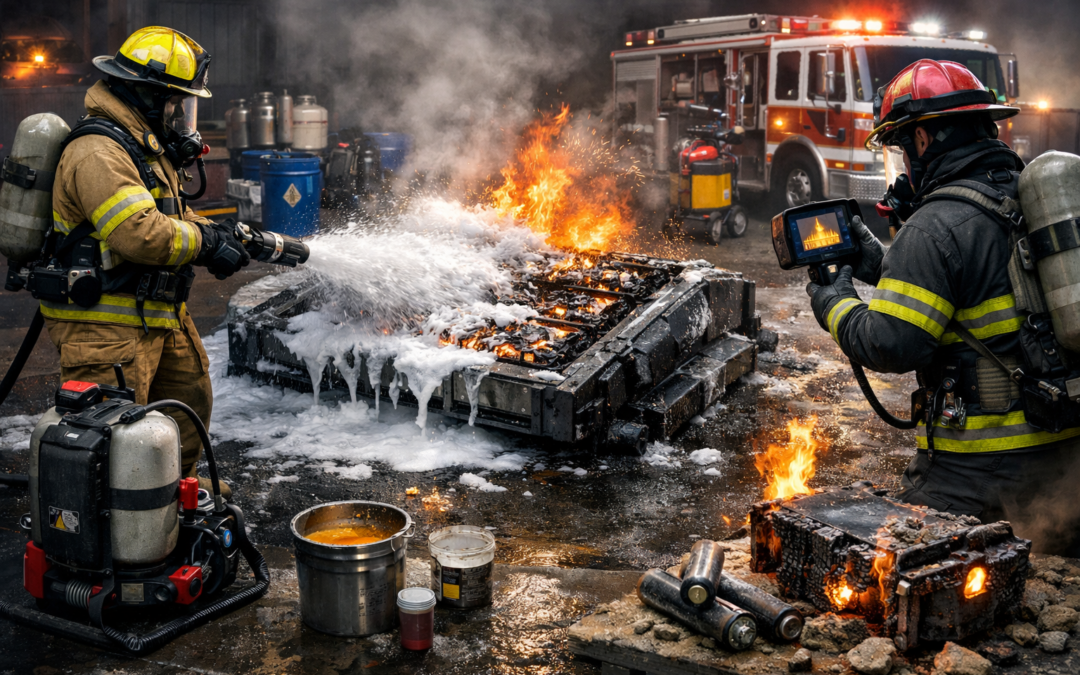
And then there’s the part where everyone tenses up: lithium-ion batteries.
The guys almost choked on the words. “I hesitate to even say ‘lithium-ion battery fire’ in the same sentence as ‘wetting agent,’” one of them said. And I get it. Our industry has been burned-sometimes literally-by oversimplified claims and magic-bullet products.
So they drew a very important line: wetting agents are not a universal lithium-ion fix. But the reasons they’re marketed that way do make sense, if we’re honest about the limitations.
Before we got into the nuance of that, they made one thing crystal clear:
Nobody said Class C. We are not blasting energized electrical panels with water and wetting agents. That joke about “unless we don’t like it” might get a laugh in the kitchen, but on scene that’s a hard no. Electricity plus conductive solutions is how careers (and people) end early.
Lithium-Ion Batteries: Why Saying It Out Loud Hurts
In class, when we talk lithium-ion, we hammer a single concept: stop propagation.
The goal is simple to say and hard to do-keep the heat from moving from one cell to the next. If you can suck that heat out fast enough, you can, in theory, stop the domino effect of thermal runaway.
On paper, that’s exactly where a wetting agent shines. It’s designed to:
- Lower surface tension so it can penetrate deeper.
- Increase cooling efficiency by spreading and soaking instead of beading and rolling.
- Absorb heat more effectively than plain water over the same contact area.
So in principle, a wetting agent solution bathing exposed cells could pull heat and help break that propagation chain. That part actually tracks.
But here’s the hard truth they kept circling back to: the issue isn’t whether the product works on the cell-it’s whether you can physically get it to the cells at all.
Most of the time, the cells are buried in a casing, a pack, a vehicle structure, or behind layers of material that we are not going to surgically dismantle while it’s actively venting, burning, and exploding in our faces. We’re limited by physics, construction, and our own survival instinct.
So yeah, from a chemistry standpoint, a wetting agent can help pull heat from the cells. From an operational standpoint, it may never get there. That’s the line that has to be drawn in bold, black ink. If the product can’t contact the fuel, it’s just expensive, slippery water.
Proportioning, CAFS, and Using the Gear You Already Own
Once we moved past the “can it, should it, will it actually get there” debate, the guys shifted into something every firefighter can relate to: how do we actually put this stuff in play?
We talked proportioning the same way we talk about foam. Wetting agents are typically mixed as a concentrate with water at a specific percentage:
- Class A foam-style operations usually sit in the 0.1–3% range.
- Certain high-risk operations push that higher-up to 6% or more in specialized cases, depending on product and delivery method.
Some products advertise even stronger mix ratios-4:1, 5:1, or more. The guys laughed about the hardware realities: most foam inductors don’t really want to play past 6%. So if you’re chasing wild ratios, you might be forced into improvisation-pouring concentrate directly into the booster tank, or drafting from a pool mixed to the right concentration.
The good news? If your department already runs foam, you probably already own everything you need to deploy wetting agents. Fire engines, foam tenders, CAFS rigs, backpack sprayers, ATVs with skid units-you can adapt them all for wetting agent operations.
Somebody had emailed in asking, “What the hell is a CAFS?” And we had to stop and spell it out: Compressed Air Foam System. Not the moo-calf-C-A-F-S. It’s a system that introduces air into a water/foam or water/wetting agent mix, which boosts reach, cling, and effectiveness. Think of it as taking your solution and putting it on turbo.
Even simple backpack extinguishers charged with a wetting agent can be game changers in wildland or inaccessible terrain. Four gallons, a hand pump, and a properly mixed solution can do a lot of cooling when engines and tenders can’t get anywhere close.
The Science of Making Water “Wetter”
At some point we had to address the word that ruined everyone’s day: dyne.
One of them admitted he could probably fabricate an entire lecture on “dynes per centimeter” and half the fire service would repeat it for the next decade. And honestly, that’s exactly how a lot of us were trained before smartphones.
But in this case, the numbers are real and actually helpful.
Plain water has a surface tension of about 72 dynes per centimeter. That number is basically a measure of how strong the “skin” on the surface of water is over a one-centimeter line-how much force it takes to break that invisible film that makes drops bead up on a waxed car or a leaf.
When we introduce a wetting agent, that surface tension can drop to around 32 dynes per centimeter. Roughly half.
What does that mean for us? Instead of water sitting on the surface like marbles, it spreads and soaks in. It crawls into pores, cracks, fibers, and small voids. In a fire environment, that translates to:
- Deeper penetration into wood and other porous Class A materials.
- Faster and more effective cooling of hot metals and structural elements.
- Less tendency for water to run off and more of it doing real work where the heat is.
So when we say these chemicals “make water wetter,” this is the actual physics behind the joke. Lower the surface tension and the same gallon of water now reaches more fuel, faster, and stays there longer. That’s where we start to see reduced rekindle, improved exposure protection, and shorter knockdown times.
When Water Is the Wrong Answer
Of course, once you realize water is now more aggressive-more penetrating, more active-you also have to admit it can be more dangerous in the wrong situation.
Water-reactive substances are the big red flag. Certain metals, metal hydrides, and reactive chemicals don’t just dislike water-they explode, off-gas violently, or rapidly accelerate combustion when they meet it. If plain water is wrong, a water-based wetting agent is still wrong, and sometimes worse.
We talked through a titanium fire where early arriving units put water on hot titanium chiller components before hazmat arrived. The result was a violent reaction and severe injuries. Later, they brought in a wetting agent as part of the mitigation, but that early application of water alone had already caused serious damage.
The lesson wasn’t “never use wetting agents on metals.” In certain metal fire scenarios, the right product can actually help cool and control. The real message was this:
- Know the chemistry.
- Check both SDSs: the one for the product you’re applying and the one for the material you’re applying it to. Either one can contain critical compatibility warnings.
- Respect contraindications for electrical and reactive hazards.
Some surfactants can actually increase conductivity. So the “no Class C” rule isn’t just water-plus-electricity; it can be water-plus-chemical-plus-electricity, which is an even uglier triangle.
If we’re honest, there’s a tendency in the field to treat wetting agents as “just fancy water.” That’s a dangerous mindset. These are chemicals. They can and do react with other chemicals. Water is a chemical too-we already know there’s a long list of things we don’t put that on.
Less Water, Less EPA: The Logistics and Environmental Angle
When you step back from the chemistry and look at the big picture, wetting agents offer two major operational wins: efficiency and environmental impact.
In testing, some wetting agent systems can double the effectiveness of plain water-putting out the same fire with significantly less volume. On Class A operations, that means less run-off, less water damage to structures, and less time soaking hot spots because your solution is penetrating deeply instead of skating off char.
In places like scrap yards or industrial facilities, that difference is not academic. We were recently involved with product testing for a scrapyard company, and their main concern wasn’t just fire control-it was EPA cleanup costs.
When a fire department dumps tens or hundreds of thousands of gallons on a pile of mixed scrap, all that contaminated water has to go somewhere. Somebody pays for the collection, transport, and disposal. Using a product that lets them knock down fires with far less water is, quite literally, money in the bank.
For rural and exurban departments running tenders and long water shuttles, the math is even more obvious. If you can do the same job with half the water, that’s fewer trips, fewer drivers, less time on the road, and a safer overall operation.
Then there’s the foam elephant in the room. Older foam concentrates with PFOS, PFOA, and related PFAS compounds have been under heavy scrutiny-and for good reason. Those chemicals persist in the environment, build up in our bodies, and are not something we want to be bathing in for the next decade of our careers.
The newer generation of wetting agents and surfactant-based products are increasingly:
- Fluorine-free
- Fully biodegradable
- Designed to minimize aquatic toxicity
- Marketed as non-carcinogenic and safer for responders
Do they work exactly the same as the legacy, super-aggressive, “we’re all going to die at 30” foams we grew up on? Not always. There’s a trade-off-between raw, brutal performance and a reasonable chance at a long, healthy retirement. That balance is uncomfortable for some people, but it’s where the industry is heading whether we like it or not.
The key for us is to stop treating these products as mysterious snake oil and start understanding what they actually do well-and where they don’t belong.
Aerosols, Surfactants, and Your Lungs
Just when you start to feel good about “non-toxic,” “biodegradable,” “environmentally friendly” labels, we have to add one more wrinkle: form matters.
A chemical can be relatively benign on your skin or in a contained liquid but a real problem when it becomes an aerosol-tiny droplets suspended in air that your lungs happily collect like a sponge.
Surfactants can create complex structures in solution that actually protect and carry other hazardous materials in the air, helping them stay suspended longer than they would on their own. Instead of dropping out and settling, those particles keep riding the air currents, staying in your breathing zone.
So even if the label says “safe,” and the SDS doesn’t scream at you, the guys were brutally clear on this point:
If you’re using any product-wetting agent, foam, surfactant-in a way that puts a lot of it in the air as mist or spray, put on your SCBA. Full stop. Don’t trust the marketing more than you trust your lungs.
Final Thoughts
We’ve spent years being told half-truths about foams, wetting agents, and magic fixes. Some of that came from a good place; some of it came from ignorance, and some of it came from people who never had to stand where you stand in a hot zone at 3 a.m.
Now we have better tools, better data, and yes, students with cell phones ready to fact-check our war stories in real time. Let’s use that to our advantage.
Pull the SDSs for the products on your rigs. Look at the mix percentages, the compatibilities, and the contraindications. Walk your crews through where wetting agents belong, where they absolutely don’t, and what PPE you expect when they’re turned into an aerosol.
Then take this conversation back to the firehouse and the training ground. Challenge the old “because we’ve always done it that way” answers. The chemicals have evolved. Our understanding has evolved. It’s time our tactics and policies catch up.