Corrosives Are More Than Just Acids and Bases
Corrosives have a reputation for being predictable. Most responders see a Class 8 placard and immediately think acids, bases, and chemical burns. While none of those answers are wrong, they only scratch the surface of what makes these incidents dangerous. Corrosives are not static hazards. From the moment they are released, they begin interacting with containers, piping, equipment, surrounding materials, and sometimes even the tactics responders use to control them. The leak you arrive to may not be the hazard that ultimately defines the incident.
That is what makes Class 8 incidents different from many other hazardous materials emergencies. Responders are not simply dealing with a chemical sitting in a puddle. They are managing an ongoing series of chemical reactions that can weaken containers, generate heat, produce flammable or toxic gases, and change conditions throughout the response. Understanding the product is important, but understanding what that product can become is what separates a routine response from an effective one.
Looking Past the pH
The DOT defines a corrosive as a material capable of causing full-thickness destruction of human skin or significantly corroding certain metals. While that definition sounds straightforward, it also highlights something responders sometimes forget. Corrosives are not classified solely by their pH. They are classified because of what they are capable of doing to other materials.
Most Class 8 products fall into two broad categories: acids and bases. Sulfuric acid, hydrochloric acid, nitric acid, sodium hydroxide, and potassium hydroxide are all products responders may encounter on highways, rail lines, industrial facilities, and commercial occupancies. Understanding whether the product is acidic or basic is important, but that information alone does not predict how the incident will unfold. Concentration, purity, temperature, contamination, and chemical compatibility often play a much larger role in determining the hazards responders will face.
That is why experienced hazmat technicians rarely stop their size-up after identifying the product. They immediately begin asking a second question: what can this material react with?
The Spill Is Only Part of the Problem
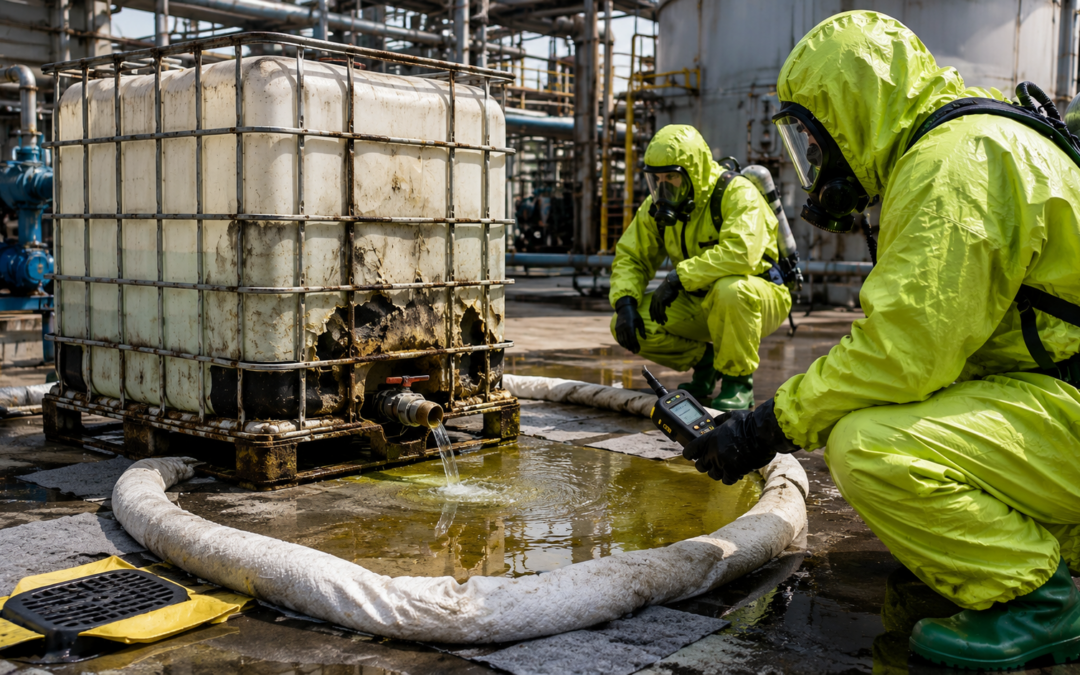
One of the easiest mistakes to make at a corrosive incident is focusing entirely on the visible release. The puddle gets everyone’s attention, but it may not be the greatest hazard on scene.
Corrosives are constantly interacting with whatever they contact. Metals can weaken, plastics may soften, seals can fail, and containers can slowly lose their integrity. In some incidents, there is no dramatic collision or punctured tank. The release happens because the product has quietly attacked its own storage system until something finally gives way.
That same chemistry continues after responders arrive. A damaged valve may deteriorate further during mitigation. A transfer hose may be chemically incompatible. A leaking fitting may fail completely once pressure changes. Unlike many other hazardous materials, corrosives often continue changing the scene throughout the entire operation.
The leak is not the end of the incident. It is usually the beginning.
When Chemistry Creates New Hazards
Perhaps the biggest misconception about corrosives is assuming that their only danger is tissue damage.
Many corrosives become significantly more hazardous after reacting with another substance. Certain acids reacting with metals can generate hydrogen gas, creating a potentially explosive atmosphere inside buildings, cargo spaces, or confined areas. Mixing incompatible chemicals can release toxic gases such as chlorine or hydrogen cyanide. Highly concentrated corrosives mixed improperly with water can generate tremendous amounts of heat.
That means responders cannot simply identify the leaking product. They also need to identify everything the product has come into contact with since the release began. The floor, the container, nearby chemicals, process equipment, runoff, and even prior contamination all factor into the hazard assessment.
The secondary reaction often becomes more dangerous than the original product.
Every Mitigation Changes the Scene
One of the more interesting realities of corrosive incidents is that the atmosphere responders encounter during reconnaissance may not be the atmosphere they experience during mitigation.
Moving a damaged container, patching a leak, transferring product, introducing water, or beginning neutralization all have the potential to change the chemistry. Heat may be generated. Additional vapors may be released. New reaction products may form. An area that initially appeared relatively stable can change quickly once work begins.
That is why continuous monitoring is so important during Class 8 incidents. Air monitoring should not end after the first survey. Conditions need to be evaluated throughout the operation because the chemistry itself is evolving. Instrumentation, product knowledge, and continual reassessment become just as important as the PPE being worn.
Speaking of PPE, this is also one of those commodity classes where Level A protection is often a completely reasonable choice, even when initial atmospheric monitoring appears relatively benign. The goal is not simply protecting against what exists now. It is protecting against what could develop while responders are actively manipulating the product.
Thinking Beyond the Hot Zone
Corrosives also force responders to think differently about scene control. Establishing a hot zone around the visible spill is only part of the equation. Liquids follow topography. Runoff may enter storm drains or utility systems. Vapors from some corrosive products can collect in low-lying areas depending on the chemical and environmental conditions. If water will eventually be introduced, responders need to know where that contaminated runoff is going before they ever open a hoseline.
The same mindset applies to plugging, patching, and product transfer. Every tool, gasket, patch, and repair device should be evaluated for chemical compatibility before it comes into contact with the product. A repair that is mechanically sound but chemically incompatible may fail within minutes, leaving responders in a worse position than when they started.
Professional hazmat response has never been about simply doing something quickly. It is about choosing the right tactic based on the chemistry in front of you.
Respect the Chemistry
Corrosive incidents reward responders who slow down and ask better questions. What is this product reacting with? Could it generate flammable or toxic gases? Will introducing water make the situation better or worse? Is the container still structurally sound? Are my tools and PPE actually compatible with the chemical I am about to handle?
Those questions separate a routine product identification from a true hazard assessment.
The black-and-white Class 8 placard indicates the category the material belongs to. It does not explain how that material will behave on today’s incident. That requires understanding the chemistry, recognizing that conditions will continue changing throughout the response, and resisting the temptation to reduce every corrosive to “it’s just an acid.”
Because at a corrosive incident, the most dangerous hazard is often not the one leaking from the container.
It is the one the chemistry creates after you arrive.