Decon Is Not a Car Wash
Decontamination may be one of the most consistently undertrained parts of hazmat response. Technicians go through class thinking they’ll probably be the ones making entry, so somebody else will wash them when they come out. Operations-level responders know they may be assigned to decon, but often assume somebody will tell them exactly what to do. Somewhere between those two groups is the person responsible for building and managing the decon operation. Suddenly, one of the most important control points on the incident falls to someone who may have spent considerably less training time on decon than almost anything else in hazmat.
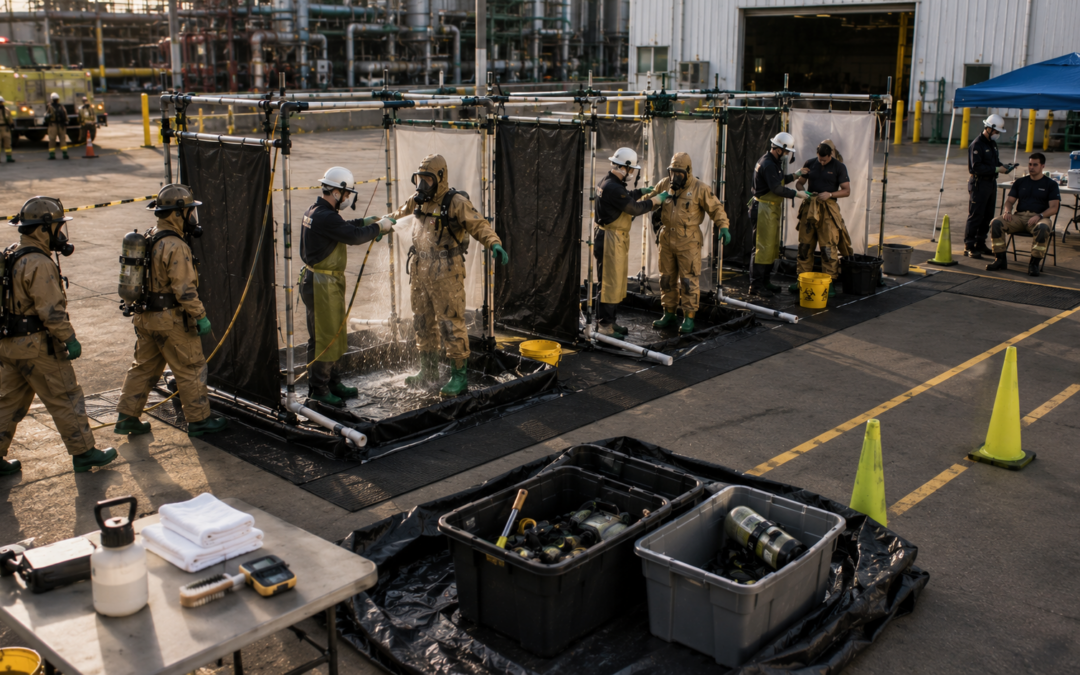
Part of the problem is that we often teach decon as a physical setup rather than an operational mission. Put this pool here, that brush there, establish a dirty side and a clean side, and start washing people. That makes for an easy training evolution, but it does not necessarily prepare someone to manage decon at a real incident. Before deploying the first tarp, hose, wipe, brush, or collection container, the Decon Group needs to understand what the incident is trying to accomplish. The corridor supports the operation. It is not the operation itself.
Mission Before Method
When somebody arrives and hears, “Set up decon,” the first response should not be to grab equipment and build the department’s traditional corridor. The first question should be: decon for what? Are we supporting a single technical entry team, multiple teams, or contaminated civilians? Do we have ambulatory or nonambulatory patients? Does equipment need processing before returning to service? Several of those things may happen simultaneously. Those answers determine what the operation needs to look like.
The Decon Group supports the incident commander’s objectives while reducing contamination and preventing its transfer beyond the controlled area. That means protecting responders, victims, equipment, medical personnel, transport units, facilities, and anyone else who could encounter secondary contamination. Safe PPE removal is a major part of that mission because poor doffing can defeat an otherwise effective cleaning process. A responder could operate successfully inside the hazard area without exposure, then transfer contamination onto themselves while removing equipment.
This is why thinking of decon as a car wash is so limiting. The objective goes far beyond making somebody look clean. We need to control contamination as people and equipment move from a contaminated environment toward a cleaner one. The method depends on the contaminant, its physical and chemical properties, the amount present, PPE, exposure route, operational objectives, and available resources.
Decon Has to Move With the Incident
One of the biggest weaknesses of traditional decon setups is how static they can become. Once crews lay everything out, they may become reluctant to move or change it. Unfortunately, the incident has no obligation to cooperate with the diagram used during technician school. Wind shifts. Hazard zones move. Entry objectives change. Additional teams deploy. Patients appear. Weather deteriorates. A relatively simple entry can quickly become considerably more complicated.
A good decon operation needs to expand, contract, and change with those conditions. One two-person entry team may only require a relatively simple personnel corridor. If three teams deploy together, the Decon Group should already be thinking about what happens when six responders return at approximately the same time. Equipment processing may compete with personnel for space and staffing. Add contaminated patients to the operation and the entire flow may need to change again.
That ability to anticipate demand separates managing decon from simply working in decon. The person supervising the operation should constantly look ahead. What is happening ten minutes from now? How many people are downrange, and how much air do they have? When are they likely to return? Are additional teams preparing to enter? What equipment is coming back? Do we have enough people to process everything without creating a bottleneck? If six low-air responders are already standing at the entrance to the corridor, the problem has arrived.
Avoiding the Decon Traffic Jam
Operational flow is one of the most overlooked parts of decon. A corridor may be technically perfect and still fail because it cannot process people quickly enough. That matters when responders are standing in chemical protective clothing or operating on SCBA. Heat stress, equipment loads, medical needs, and dwindling air supplies make unnecessary delays increasingly dangerous.
Think about a grocery store with one checkout lane. Everything works beautifully until ten customers arrive simultaneously. Decon can experience the same problem.
Multiple lanes may make sense during larger incidents, and they do not have to perform identical functions. One may process returning entry personnel while another handles equipment. A separate path may serve ambulatory or nonambulatory patients. Someone experiencing a medical emergency or running low on air may need an expedited route. The exact configuration depends on the incident. The principle remains simple: design the system around expected traffic instead of forcing all traffic through a predetermined system.
That does not mean every hazmat incident needs a massive multi-lane corridor. Building more decon than necessary wastes personnel and equipment needed elsewhere. The goal is scalable capacity. Start with what supports the current mission while maintaining the ability to expand quickly. If multiple entry teams prepare to go in together, start thinking about what happens when they all want to come back out together.
People Are Usually the Limiting Resource
Decon takes people, and those people have their own limitations. Personnel working the corridor on SCBA have finite operating time. Chemical protective clothing introduces heat stress and fatigue. Crews need relief, bottles need changing, supplies need replenishment, and contaminated materials require management. Meanwhile, the operation may continue long after the first entry team returns.
Staffing cannot stop at having enough people to open the corridor. The Decon Group needs enough resources to sustain it. If the incident will involve multiple entries over several hours, plan personnel rotations before the first group becomes exhausted. Appropriately trained and equipped operations-level personnel can often provide substantial support within department procedures. That allows technicians or experienced decon personnel to supervise without consuming every technician on scene.
Equipment creates similar constraints. Departments do not all arrive with identical decon trailers filled with specialized supplies. One team may have dedicated wipes, containment systems, shelters, and purpose-built equipment. Another may have relatively basic materials. Effective decon must work with the resources actually available. A sophisticated plan requiring equipment sitting 100 miles away is not much of a plan.
Wet, Dry, and Everything in Between
Another trap is assuming decontamination means water. Wet decon has an important place in hazmat response, but it is not automatically the best answer for every contaminant or environment. Dry methods can be extremely useful under the right conditions. They may also reduce water use, runoff, setup requirements, and the corridor’s footprint. Choose the method based on the contamination, not tradition.
The contaminant’s physical and chemical properties matter. Powder sitting on the exterior of a suit creates a different problem than liquid spread across the surface. A volatile liquid requires different considerations from a material with very low volatility. Water-reactive materials require another level of thought before somebody starts flowing a hose line. Build decon around how the contaminant behaves and how crews can remove or reduce it without unnecessarily spreading it.
Weather, Space, and Runoff
Weather can completely change that calculation. A water-intensive corridor that works perfectly on a warm summer afternoon may create serious problems in freezing conditions. Temperature can change vapor pressure and evaporation, which can alter contaminant behavior on PPE. It may also affect the usefulness of certain removal techniques.
Wind, precipitation, terrain, drainage, and available space affect where and how decon can function. A team working in an open industrial complex may have tremendous flexibility. Another team may need to accomplish the same mission inside a small urban footprint or confined staging area.
Crews must also consider runoff and waste when using wet methods. Decon water does not stop being contaminated simply because it leaves a responder’s suit. Depending on the material and circumstances, teams may need to control, collect, characterize, and ultimately manage contaminated water and other waste. That provides another reason to avoid automatically building the largest possible wet corridor when a targeted approach can accomplish the mission.
Communication Is Part of Decon
The Decon Group cannot operate in isolation. A supervisor who simply builds a corridor and waits for contaminated people to arrive is already behind the incident. Communication with command, entry, rescue, medical, and safety allows decon personnel to anticipate what comes next.
The incident commander’s objectives can dramatically change demand. An aggressive mitigation strategy may place more personnel into the hazard area and send more contaminated equipment back through decon. A strategic change may reduce entry operations but suddenly introduce civilian movement or patient decontamination. A rescue problem can completely rearrange priorities. Without good communication, the Decon Group discovers those changes when they arrive at the corridor. With good communication, the group has time to prepare.
Decon also needs contingency plans. What happens if a responder arrives critically low on air or collapses inside the corridor? How will the team handle a significant suit breach? What happens when several teams return simultaneously? A wind shift could force crews to reposition the corridor. Water could fail, equipment could break, or staffing could suddenly drop. The middle of one of those events is a bad time to develop the answer.
The Corridor Is Not the Mission
A successful Decon Group should almost disappear into the larger hazmat operation. Entry teams come out, crews control contamination, personnel remove PPE safely, and equipment moves where it needs to go. Patients continue toward medical care while the next team prepares to operate. Decon never becomes the limiting factor. When everything works correctly, the operation can look deceptively simple.
Making it look simple takes far more thought than setting up a few pools and handing somebody a brush. The person managing decon has to understand the contaminant, entry objectives, staffing, equipment, weather, terrain, space, air supply, expected throughput, waste management, and medical priorities. They also need to understand what command intends to do next and have enough flexibility to change the original plan when conditions demand it.
That is why decon deserves more attention in hazmat training than simply learning where to place equipment. The skill is not memorizing a corridor. The skill is understanding the mission well enough to build the corridor the incident requires, then continuously modifying it as conditions change.
Entry may be where the mitigation happens, but every contaminated responder eventually has to come back. The Decon Group’s job is to make sure the contamination does not come back with them.