Designing a Decon Corridor That Works
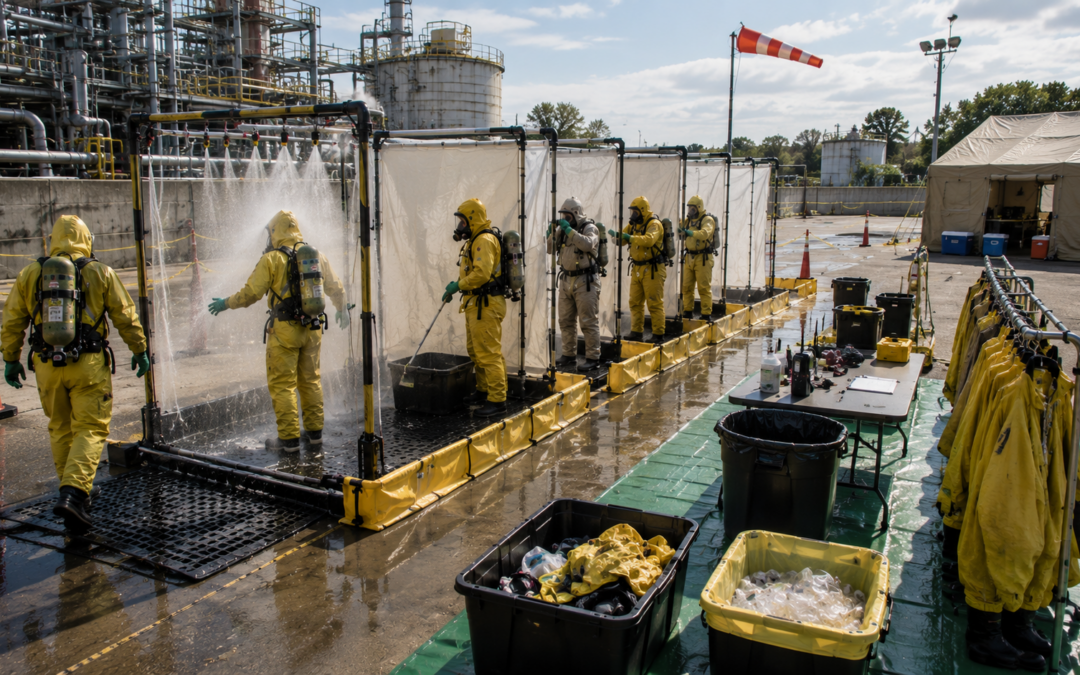
Setting up a decon corridor should involve more thought than finding an open piece of pavement and throwing down a tarp. Where you put it, how people get to it, what happens around it, and whether it can grow with the incident all matter. The corridor is the controlled transition between contaminated operations and the cold zone, so its design has to support everything happening around it.
On a small hazmat incident, that may seem simple. The entry team goes downrange, completes its assignment, and walks directly back to decon. Scale that incident up to multiple blocks, a rail incident, a large industrial facility, or significant structural damage, and those assumptions can fall apart quickly. Responders may operate from different directions, physical obstacles may prevent them from returning along the same route, and one decon corridor may not safely serve everyone involved.
Think about a major explosion that damages several blocks. Putting decon on one side of the incident doesn’t help responders who physically cannot get there without crossing another contaminated area. The same problem can occur at a rail incident where railcars, terrain, additional hazardous materials, or the incident itself interfere with movement. At some point, the size and configuration of the incident may even require multiple decon corridors. The question isn’t simply, “Where do we have room to set this up?” It’s whether everyone who needs the corridor can actually get to it safely.
Location Is More Than Geography
Environmental conditions factor into that decision. Wind direction matters, but simply checking it once when the incident begins isn’t enough. Buildings and city streets can create complicated airflow, and conditions can change considerably during a long operation. A location that worked three hours ago may no longer be appropriate. This is why some level of environmental monitoring around decon matters. It doesn’t necessarily mean dedicating someone to constantly walk circles around the corridor with a meter. It means staying aware enough to recognize when conditions have shifted, and the supposedly controlled area is no longer where we think it is.
Drainage, surfaces, lighting, and weather protection deserve the same consideration. Wet or hybrid decon creates water that has to go somewhere. A corridor set up on polished indoor flooring can become dangerously slippery. Responders already have reduced mobility in chemical protective clothing, oversized boots, and SCBA. Add water to a smooth surface, and a contamination-control operation can quickly create an injury.
An operation established during daylight may also still be running at 3 a.m. Crews need enough lighting to inspect PPE, manage equipment, assist with doffing, and move safely through the corridor. Rain can interfere with products that require contact time, freezing temperatures can affect decon operations, and severe weather could make the location itself unsafe. We shouldn’t only ask whether a location works right now. We need to consider whether it will keep working as the incident develops.
The corridor also needs enough room for what comes afterward. Medical monitoring and rehab need to fit logically into the operation, and there should be a plan for someone who doesn’t simply walk out of their suit and head to rehab. A responder may become symptomatic, suffer heat stress, run critically low on air, or require immediate medical treatment. That means thinking about whether medical personnel can safely access the area and how a patient would move toward an ambulance without dragging contamination into the cold zone.
Plan for Decon Creep
Another major consideration is what happens to the decon area over time. Contaminated PPE gets removed and bagged. Tools, meters, radios, and other equipment accumulate. Supplies and waste begin consuming space. Entry teams may start lining up as they return from the hot zone. What began as a relatively compact operation can slowly spread into the surrounding area.
That decon creep becomes a problem when the corridor was designed with barely enough space for the first entry team. If you’ve got several teams making multiple entries, what does the area look like toward the end of the operation? Where is all that contaminated PPE going? Where are the tools going? Where do returning personnel wait? What happens when several responders arrive at approximately the same time? The last thing we want is a line of responders backing toward the hot zone while they’re tired, heat-stressed, and running low on air.
Expansion also requires more than empty pavement. It requires personnel, equipment, supplies, air, and the ability to establish additional stations or lanes. One lane might handle routine returning personnel while another handles someone critically low on air. A heavily contaminated responder may require additional time. Patients could require another process entirely. If multiple teams enter at roughly the same time, the Decon Group should already be considering what happens when they all want to come out at roughly the same time.
The incident can also introduce another contaminant or objective that changes the preferred decon method. Maybe the original operation calls for wet decon, but another objective develops where a dry method makes more sense. Now the Decon Group needs the space, personnel, and equipment to support both. Flexibility isn’t simply having enough room to add another pool or tarp. It’s having enough resources to change the process when the mission changes.
Personnel movement can complicate that expansion even further. We tend to picture decon as one-way traffic, with contaminated responders entering from the hot side and eventually emerging on the clean side. Real incidents don’t always cooperate. Incoming entry teams may use roughly the same access point as personnel coming out. Poor corridor design can put clean incoming personnel directly in the path of contaminated outgoing personnel.
The equipment drop can make that worse. If another entry team needs the meters, radios, or tools being dropped by the outgoing team, how are they retrieving them without stepping into the decon flow? Radios are a good example of how a seemingly minor logistical problem can affect the operation. If one team drops contaminated radios and the next team picks them up, the radio identifiers may no longer correspond with the people carrying them. If every entry team takes fresh radios downrange instead, a significant number of the department’s radios may end up sitting in contaminated equipment bins. These aren’t glamorous hazmat problems, but they’re exactly the kind of details that can screw up an extended operation.
Manage the Process, Not Just the Setup
Once people arrive at decon, the operation needs structure. Entry control establishes order before responders begin moving through the process. That can become surprisingly difficult when everyone is wearing respiratory protection, equipment is running, and multiple people are trying to communicate at once. Something as simple as a whiteboard can be useful. Instead of screaming through a facepiece trying to explain what happens next, incoming personnel can receive basic visual instructions before moving through the corridor.
Accountability also matters more than it sometimes gets credit for. Almost anyone who has spent enough time around hazmat operations has encountered the responder who decides they don’t need decon. Maybe they believe they stayed clean. Maybe they don’t want someone taking their helmet. Maybe they forgot their wallet in their pocket and know what’s about to happen to it. Whatever the reason, letting personnel walk around the corridor defeats the entire concept of controlled egress. If decon is supposed to control movement out of the contaminated area, it actually has to control that movement.
Gross contamination reduction generally comes early in the process. Whether crews wipe, brush, scrape, rinse, or use another appropriate technique, the objective is to remove the bulk of the contamination before moving deeper into decon. But whatever comes off the responder still has to go somewhere. If we’re brushing off a powder, where are we collecting it? If we’re wiping a suit, where are those wipes going? If we’re rinsing material away, where does the contaminated water end up? Removing contamination from somebody and spreading it across the corridor isn’t much of an accomplishment.
From there, technical decon can concentrate more closely on the areas that matter during PPE removal. Interfaces, closures, zippers, gloves, boots, respiratory protection, and other areas where contamination could transfer during doffing deserve particular attention. The objective isn’t necessarily to make every square inch of the protective ensemble look brand new. The objective is to reduce contamination and control PPE removal well enough that what remains on the exterior doesn’t end up on the responder or the people helping them.
What PPE the entry team is wearing also affects how the corridor should operate. Removing someone from Level A protection is not the same process as removing Level B. An SCBA may need support during part of the removal process, while bulky suits may require additional personnel to prevent contact with contaminated exterior surfaces. PPE selection and decon design can’t be treated as completely separate decisions.
Monitoring shouldn’t stop just because we’ve established the corridor. Conditions can shift, and contaminated materials accumulating around decon can create their own problems. Radiation provides an obvious example. As crews remove and collect contaminated suits and equipment, they can concentrate radioactive material in a new location. The basic concept applies beyond radiation. Whatever comes off responders remains part of the contamination-control problem.
One Corridor Can’t Do Everything
The standard technical decon corridor is only one version of decontamination. A larger incident may require separate processes for ambulatory patients, nonambulatory patients, emergency decon, contaminated equipment, or evidence. Trying to force every one of those missions through the same corridor can create more problems than it solves.
Equipment decon can become an operation of its own, and we’re not just talking about a Halligan and a meter. Pumps, hoses, machinery, and even apparatus may eventually need controlled movement out of contaminated areas. That equipment has different surfaces, different contamination concerns, and plenty of places where material can hide. They may need their own space and process, rather than interfering with personnel moving through technical decon.
Evidence creates another challenge. Investigators may need an item preserved while hazmat personnel still need to reduce contamination enough to move or handle it safely. Cleaning the hell out of something without considering its evidentiary value can create an entirely different problem. That requires coordination between hazmat personnel, law enforcement, sampling personnel, and whoever will ultimately maintain custody of the evidence.
Medical emergencies can also completely change the operation. The routine process designed for a healthy entry team may no longer make sense when someone is critically low on air, injured, symptomatic, or unable to walk. That may require an expedited process or an entirely separate corridor. The Decon Group needs enough flexibility to recognize when the normal process is no longer appropriate.
A good decon corridor isn’t necessarily the biggest or most elaborate setup. It’s one designed around the incident in front of you, with enough flexibility to handle the incident you may have an hour from now. Location, access, wind, drainage, surfaces, lighting, weather, PPE, personnel flow, equipment, monitoring, medical needs, accountability, and expansion all influence what that corridor should look like.
None of those decisions should be made simply because “this is how we always set up decon.”
Decon doesn’t start when somebody enters the corridor. It starts when we decide where that corridor belongs, how people will move through it, and how it will support the rest of the incident.