DOT Class 8: The Quiet Violence of Corrosives
More Than Just “An Acid or a Base”
When it comes to hazmat, corrosives don’t get the same mythic treatment as explosives, poisons, or radioactive materials. They don’t usually arrive with the cinematic drama people expect. There’s no fireball, no glowing cloud, no obvious moment when everybody in the room realizes just how bad things are about to get. And that may be exactly why they deserve more respect.
Mike and Bobby’s conversation on DOT Class 8 made that point over and over again. Corrosives are easy to oversimplify. Ask most responders what a corrosive is, and they’ll give you the shorthand answer: an acid or a base, something that burns skin, something nasty. None of that is exactly wrong. It’s just incomplete. The truth is a little more precise, and a lot more dangerous.
Under the DOT definition, a corrosive is a substance that can cause full-thickness destruction of human skin or corrode steel and aluminum. That wording matters. It forces us to stop thinking in vague terms and to start thinking in terms of mechanisms. A corrosive doesn’t just irritate. It destroys. It degrades. It changes the structure of whatever it touches, whether that’s skin, metal, plastic, or the inside wall of a container that looked perfectly stable an hour ago.
That’s where this class gets deceptively complicated. The examples are familiar enough: sulfuric acid, hydrochloric acid, nitric acid, sodium hydroxide. Some of them practically identify themselves by name. Others don’t. And on the scene, that difference matters. A responder who recognizes sulfuric acid immediately may not have the same instant reaction to sodium hydroxide, even though both can do catastrophic damage in very different ways.
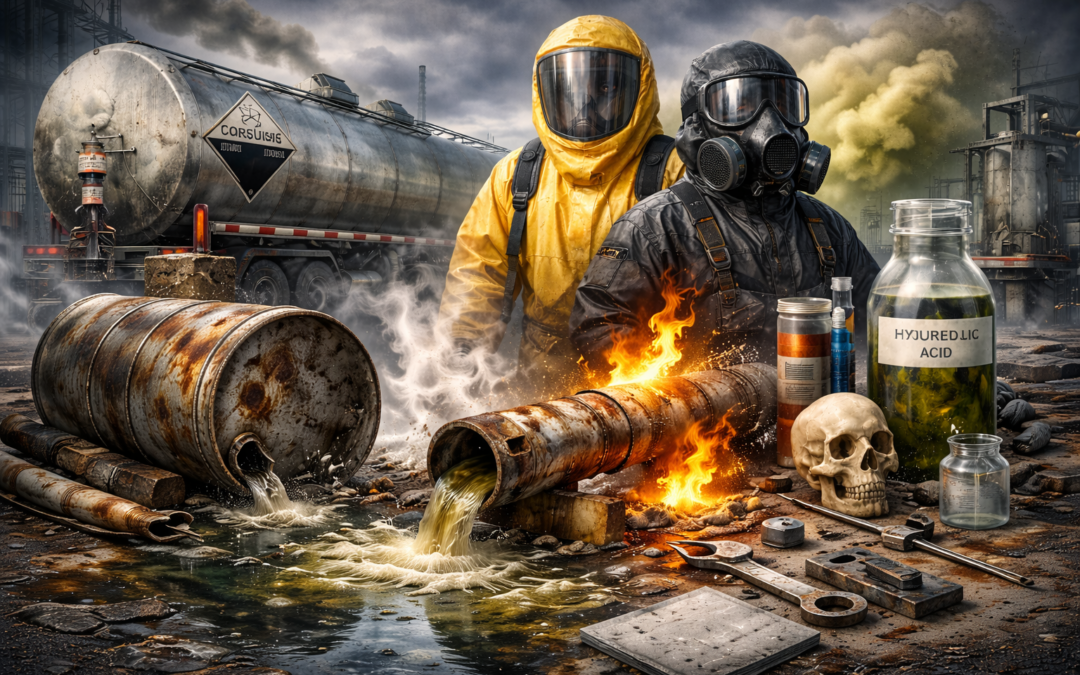
The placard helps, of course. Class 8 gives us one of the most recognizable symbols in hazmat transportation: the black-and-white corrosive label, with liquid eating through a hand and a piece of metal. It’s almost cartoonishly direct, but that’s part of what makes it effective. It tells the story at a glance. This product destroys whatever it contacts.
Still, as Mike pointed out, placards and UN numbers only get you so far. Sulfuric acid carries UN 1830. Sodium hydroxide is UN 1824. But hazmat responders know better than to treat a number as the whole answer. Some UN numbers are highly specific. Others cast a wider net. The paperwork narrows the field, but it doesn’t finish the job. You still have to read the container, read the scene, and read the behavior of the product itself.
The Container Is Already Part of the Problem
With corrosives, the container is never just background information. It is part of the problem. These products move in carboys, drums, totes, and lined tank trucks, sometimes in containers specifically designed to resist the very product they hold. That alone should tell us something. A corrosive is one of the few hazmat classes in which the material may be actively working its way through the package from the inside out. You don’t always need a crash, rollover, or dramatic failure to trigger an incident. Sometimes the release is the result of a slow chemical argument between the product and its own storage system.
That is what makes Class 8 incidents so unnerving. They can develop without spectacle. A leaking valve, a softened drum bottom, a compromised fitting, a little fuming around a seam-none of it looks dramatic at first. But a corrosive release is often more dangerous because it doesn’t announce itself like a fire. It waits for responders to get comfortable.
Mike and Bobby both kept coming back to the physical clues, and rightly so. Long before an instrument confirms your suspicions, the scene may already be talking. Fuming liquid. Smoking residue. Strange deterioration on nearby metal. Surface damage on flooring or equipment. Victims report a sharp acidic odor or a strong ammonia-like smell. None of that replaces monitoring, but all of it should slow you down.
That pause is one of the most important tactical decisions on any Class 8 scene. Corrosives punish responders who act on instinct rather than observation. A smoking liquid might be a dozen different things, but it should never be treated casually. Once you understand that a corrosive is not just sitting there but actively reacting with its surroundings, the whole incident changes. The spill is not static. The chemistry is still underway.
It Doesn’t Burn Like Fire
That becomes even clearer when you stop calling it a “burn” and start describing what it really is. Mike and Bobby made a point that deserves to stick with anyone teaching this material: corrosives don’t burn in the same sense that fire burns. They destroy through chemical reaction. They degrade tissue and materials through ion transfer and chemical breakdown. We use the phrase chemical burn because it’s familiar, but that phrase can flatten the reality of what’s happening.
And the reality matters. On the skin, this means rapid tissue destruction, severe injury, and deep ulceration. On metal, it means pitting, corrosion, thinning, and eventual failure. On plastic, it can mean swelling, softening, or loss of integrity. Sometimes what looks like a product “eating through” a surface is not just a chemical attack in the simplest sense. It may also be heat generation, an exothermic reaction intense enough to weaken the material until it fails.
That heat issue came up repeatedly in the conversation, and it should. Responders often remember the rule from chemistry class-add acid to water, not water to acid-but in the field, those old lessons can fade until someone gets reminded the hard way. Highly concentrated corrosives can generate significant heat when mixed with water. That means violent splashing, accelerated reaction, and, in some cases, thermal injury layered on top of the corrosive exposure itself.
That’s not a minor detail. It changes how you think about the suit, the patient, the container, and the mitigation strategy. A responder in Level A or Level B may be fixated on a chemical splash while forgetting that a reaction on the suit surface can lead to significant heat transfer. A leaking product may not only be chemically destroying the container, but also heating it enough to physically compromise it. In corrosive work, temperature is often part of the story even when no one initially thinks of the material as a “hot” product.
When Corrosives Become Something Worse
The acid-base split matters here too, not just academically but operationally. Acids, with their hydrogen ions, tend to react aggressively with metals and can generate flammable gases such as hydrogen. That means a corrosive release can quickly become a flammability problem, especially in enclosed or poorly ventilated spaces. Bases, or caustics and alkalis, bring their own hazards. Products like sodium hydroxide and potassium hydroxide attack fats, proteins, and organic tissue, which is exactly why they show up in drain cleaners and industrial cleaning systems.
But as Bobby noted, bases carry a nasty human factor problem: the pain may be delayed. A victim exposed to a strong caustic may not immediately appreciate how serious the injury is. That delay can create dangerous complacency. It can fool the patient, the bystander, and even the responder into thinking the exposure is minor when the tissue damage is already progressing.
And then there are the outliers. Hydrofluoric acid stands apart for good reason. It is not just another corrosive in the ordinary sense. It brings a toxicity concern that goes beyond surface destruction, and that alone makes it a material every hazmat team should treat with heightened respect. It does not rewrite the whole Class 8 playbook, but it absolutely changes the stakes.
If there was one larger lesson running beneath the entire discussion, it was that corrosives rarely stay neatly inside their assigned hazard class. A Class 8 product may begin as a corrosive problem and end as a toxic gas problem, a flammable gas problem, or both. Acids mixed with bleach can generate chlorine gas. Acids mixed with cyanides can release hydrogen cyanide. Acids reacting with metals can produce hydrogen. Suddenly, the responder who thought this was a straightforward corrosive leak is standing inside a much more complicated atmosphere.
That’s why Mike’s emphasis on continuous monitoring matters so much. On a corrosive scene, you are not just monitoring the product you started with. You are monitoring the scene that the chemistry is creating as it unfolds. The secondary hazard may be the one that kills you.
Tactics That Respect the Chemistry
From a tactical standpoint, that changes everything. Isolation distances have to be approached with discipline, not convenience. Fifty to one hundred feet may be a reasonable starting point for a small spill, but the scene footprint should be built around behavior, topography, and runoff potential, not a desire to make the hot zone as small as possible. Many corrosive vapors and reaction products stay low, follow grade, and collect where people least expect them. Evacuating civilians downhill from a corrosive release is not just sloppy; it can be dangerous.
PPE decisions deserve the same level of caution. This is one of the few areas where going to Level A, even when the initial atmosphere is relatively quiet, can be a very defensible call. Not because the scene is guaranteed to worsen, but because corrosive incidents can change character very quickly once mitigation begins. Sampling, movement, transfer, contamination, neutralization-any of those steps can alter the atmosphere and the exposure risk.
The same careful thinking applies to product control. Damming, diking, booms, and pads-these basic operations tools still matter. But as Bobby pointed out, even a simple plugging or patching operation has to pass the compatibility test. A material that works on one leak may fail completely on a corrosive, or worse, become part of the reaction. In a Class 8 incident, even your fix has to be chemically literate.
The decon conversation was just as practical. For patient care, the answer is straightforward: remove the product and flush with copious amounts of water, unless you are dealing with a confirmed water-reactive exception. What you do not do is neutralize someone directly. That is not patient care. That is gambling with a reaction on damaged tissue.
Bobby made a particularly strong point about the value of dry decon for Class 8 work. In the right setting, dry decon can outperform wet decon by reducing runoff, shrinking the contaminated footprint, and preventing responders from creating gallons of secondary acid or base waste that then become their own disposal problem. It is one of those ideas that sounds simple until you realize how many teams still default to water-heavy thinking because that is what they know best.
The Real Lesson of Class 8
In the end, what makes corrosives so dangerous is not just their chemistry. It is their familiarity. The names sound common. The containers often look routine. The damage may begin quietly. The victim may still be standing. All of that can trick responders into acting before they have really understood what the product is doing.
That is the trap Class 8 sets better than almost any other hazard class. It lures you into thinking the incident is simple.
It isn’t.
Corrosives do not need flames, smoke columns, or headlines to be deadly. They just need contact, time, and a responder willing to underestimate them. That’s why this class demands more than memorization. It demands discipline, awareness of compatibility, and the ability to think beyond the placard.
Because in the end, the real lesson from Mike and Bobby’s conversation is the same lesson that keeps surfacing in every good hazmat discussion: if you only identify the product, you are halfway there. The real work is understanding what that product is doing, what it is reacting with, and what it is becoming while you watch it.
That is the difference between responding to a corrosive and actually understanding one.
Pull your Class 8 kit back out. Revisit your dry decon procedures. Check the compatibility of your patch materials. Run a scenario that forces your team to think about runoff, secondary gases, and delayed injury. Because the next corrosive call is not going to care whether you remembered the definition. It will care whether you understood the behavior.