
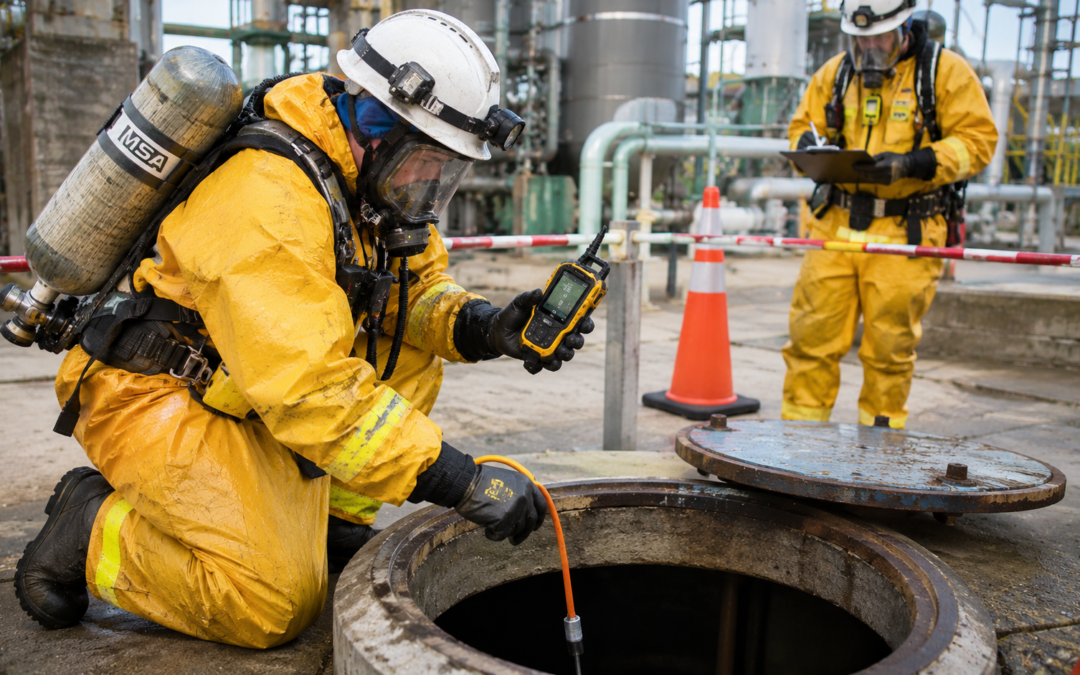
Hydrogen Sulfide: The Hazard Behind the Rotten Egg Smell
Hydrogen sulfide is one of those chemicals nearly every HazMat technician encounters in training, yet how many of us actually understand why it’s such a significant threat? We know it’s toxic. We know it smells like rotten eggs. We know it’s one of the four gases we’re supposed to monitor. But when someone asks why H₂S deserves a place on virtually every four-gas meter, can we explain the answer beyond simply saying it’s dangerous?
That question sparked this two-part deep dive into hydrogen sulfide. What started as a conversation about why we monitor for it became a broader look at its history, industrial applications, toxicity, and the real-world incidents that show how unforgiving this gas can be.
For first responders, hydrogen sulfide isn’t just an industrial problem. It’s present in wastewater systems, agricultural operations, oil and gas production, confined spaces, and even ordinary situations like a backed-up sewer. The challenge is that it doesn’t take a complicated industrial accident to create a potentially lethal atmosphere. Sometimes all it takes is walking into the wrong room without the right meter.
A Brief History of Hydrogen Sulfide
Hydrogen sulfide has been recognized as a hazardous gas for centuries, although our understanding of its properties and effects developed gradually. In the early 1700s, Italian physician Bernardino Ramazzini documented eye irritation and inflammation among sewer workers, recognizing that exposure to sewer gases caused their symptoms. His observations helped establish an early connection between occupational environments and the health effects of toxic gases.
Later in the eighteenth century, Swedish chemist Carl Wilhelm Scheele investigated the production of hydrogen sulfide through chemical reactions involving sulfur-containing materials. The gas was described as stink air, which, while not particularly scientific by today’s standards, captured one of its most recognizable characteristics.
By the nineteenth century, industrialization and expanding urban sewer systems brought additional attention to hydrogen sulfide exposure. Incidents involving sewer workers and hazardous gases demonstrated that this wasn’t simply an unpleasant odor. It was an occupational hazard capable of causing serious injury and death.
As industrial processes expanded, our understanding of hydrogen sulfide continued to develop. Today, we recognize it as a naturally occurring gas and a byproduct of numerous industrial and biological processes. Unfortunately, the same characteristics that made it difficult to understand centuries ago still create problems for responders today.
Why Is Hydrogen Sulfide on Our Four-Gas Meters?
This was the question that originally started the conversation, and the answer is more interesting than simply saying that OSHA requires us to monitor for it.
Hydrogen sulfide is a common occupational hazard across several industries. Oil and gas production, petroleum refining, wastewater treatment, agriculture, and other industrial processes can all generate or encounter H₂S. It can also develop naturally through the decomposition of organic material. That means responders don’t need to be standing at an oil refinery to encounter it. A sewer backup, a manure storage facility, a wastewater treatment plant, or an underground utility space can all create opportunities for exposure.
Its widespread presence is one reason industrial workers and emergency responders need to monitor for it. Another is its toxicity. Unlike some chemicals, which require a relatively long period of contact to cause significant effects, hydrogen sulfide can produce severe effects very quickly at high concentrations.
There is also a regulatory component. OSHA establishes permissible exposure limits, while NIOSH provides recommended exposure limits and identifies concentrations that are immediately dangerous to life and health. These standards are not interchangeable, and understanding the difference matters when interpreting meter readings.
For general industry, OSHA establishes a 20 ppm ceiling limit, with a narrowly defined exception allowing a peak of 50 ppm for up to 10 minutes if no other measurable exposure occurs during the shift. Construction and shipyard standards use a 10 ppm eight-hour time-weighted average. NIOSH recommends a 10 ppm ceiling for 10 minutes and identifies 100 ppm as immediately dangerous to life or health (IDLH).
Those numbers should get your attention. We’re talking about a gas where parts-per-million concentrations can have serious consequences. That’s why H₂S monitoring isn’t an optional accessory or an extra sensor on a meter. It’s an important part of identifying an atmosphere that may otherwise look completely ordinary.
Where Are We Actually Finding H₂S?
One of the reasons hydrogen sulfide deserves so much attention is how many different environments can produce it. We tend to associate it with oil fields and industrial processing, but it occurs well beyond those settings.
In the oil and gas industry, hydrogen sulfide can occur naturally in underground petroleum and natural gas deposits. When natural gas contains significant concentrations of H₂S, it is commonly called sour gas. The industry must account for the gas’s toxicity and corrosivity during production, processing, storage, and transportation.
Agricultural operations are another important source of concern. The decomposition of organic material, particularly animal waste, can generate hydrogen sulfide. Manure storage areas, waste pits, and poorly ventilated agricultural buildings can create dangerous atmospheres. These environments are especially concerning because workers may enter them believing they’re dealing with an ordinary maintenance or equipment problem.
Wastewater treatment facilities and sewer systems are another familiar source. Hydrogen sulfide can develop through the biological decomposition of organic material, particularly in oxygen-limited environments. This is why responders can encounter H₂S while investigating something as seemingly routine as a sewer backup or an unusual odor inside a building.
The common denominator is that hydrogen sulfide doesn’t belong exclusively to one industry. It can be generated through natural processes, industrial operations, and biological decomposition. For responders, that means the potential for exposure exists across a much wider range of incidents than many people realize.
When the Rotten Egg Smell Stops Helping
Most people recognize hydrogen sulfide by its distinctive rotten-egg odor. At low concentrations, that smell can be unmistakable. But here’s where things become particularly dangerous: your nose is not a reliable detector of hydrogen sulfide.
Olfactory fatigue, sometimes described as olfactory paralysis, occurs when exposure to hydrogen sulfide impairs the ability to smell it. As concentrations increase, a person may lose the ability to recognize the gas even while remaining in a dangerous atmosphere.
Think about what that means operationally. A responder enters an area and immediately notices a strong rotten-egg smell. A few minutes later, the smell seems to disappear. It’s tempting to assume that the situation has improved or that the gas has dissipated. In reality, the responder may simply have lost the ability to detect it.
OSHA identifies loss of smell as a potential effect around 100 ppm, with the possibility of olfactory fatigue developing within minutes. That concentration is also the NIOSH IDLH value. In other words, the point at which your natural warning system can disappear is also a concentration considered immediately dangerous to life and health.
This is why we cannot use odor as a substitute for atmospheric monitoring. You might smell hydrogen sulfide before your instrument registers a meaningful reading, but that doesn’t make your nose a measurement device. And once the smell disappears, you have no reliable way of knowing whether the atmosphere has improved.
The lesson is simple: if H₂S is a possibility, monitor for it. Don’t wait for your nose to tell you something is wrong.
When a Routine Maintenance Call Turns Deadly
One incident shows why hydrogen sulfide deserves a place on our meters: the October 26, 2019, incident at the Aghorn Operating Waterflood Station in Odessa, Texas.
This incident matters because it wasn’t initially a major industrial emergency. It began with a maintenance employee responding to a pump oil-level alarm. What followed was a fatal exposure that ultimately claimed two lives.
Jacob Dean, an Aghorn employee, responded to the alarm at the facility’s pump house. While attempting to isolate the pump, he did not properly complete the required lockout/tagout procedures. At some point, water containing hydrogen sulfide escaped from a failed pump component, releasing toxic gas into the enclosed building. Jacob was overcome by the atmosphere and died.
Several hours later, his wife, Natalie, became concerned when she couldn’t reach him. She drove to the facility with their two children. Leaving the children in the vehicle, she entered the pump house to look for her husband. She, too, was overcome by the hydrogen sulfide and died. Fortunately, the children remained safe.
The investigation by the U.S. Chemical Safety and Hazard Investigation Board (CSB) identified several critical safety failures. These included improper lockout/tagout procedures, inadequate ventilation, nonfunctioning hydrogen sulfide detection and alarm systems, deficient site security, and the failure to use personal H₂S detection equipment.
One particularly troubling detail was that Jacob’s personal H₂S detector was found in his truck, not on his person. The instrument that could have warned him about the atmosphere wasn’t where it needed to be.
Post-incident measurements near the pump house identified hydrogen sulfide concentrations of approximately 150 ppm. That’s 50% higher than the NIOSH IDLH concentration of 100 ppm. At that level, the atmosphere presents an immediate threat to life and health.
For us as first responders, this incident raises an uncomfortable question: If we received a call for a person down inside a pump house, how many of our personnel would immediately recognize the possibility of a hazardous atmosphere? Would somebody grab a meter before entering? Would we recognize the potential for hydrogen sulfide, or would we treat it as another medical emergency?
The Aghorn incident demonstrates why those questions matter. It also reinforces that we cannot assume a facility’s installed detection and alarm systems are functioning properly. We need to bring our own equipment, evaluate the atmosphere, and establish an appropriate entry plan.
The CSB ultimately issued recommendations addressing personal gas detection, lockout/tagout, ventilation, alarm systems, safety management, and site security. These weren’t complicated scientific discoveries. They were fundamental safety practices that could have prevented a tragedy.
What Actually Happens When H₂S Gets Into Your Body?
So why is hydrogen sulfide so dangerous? What makes relatively small concentrations capable of producing such devastating consequences?
Hydrogen sulfide is more than an irritant. It is a systemic toxicant that interferes with the body’s ability to produce energy at the cellular level. One of its primary mechanisms of toxicity is inhibiting cytochrome c oxidase, an enzyme in the mitochondrial electron transport chain. Remember high school biology? The mitochondria are the powerhouse of the cell. They produce much of the energy our cells need to function.
When hydrogen sulfide interferes with this process, cells lose their ability to use oxygen effectively to produce energy. The result is cellular oxygen deprivation, even when oxygen is present in the bloodstream. This is particularly concerning for organs with high energy requirements, including the brain and heart. As cellular energy production becomes impaired, neurological function, respiratory function, and cardiovascular stability can deteriorate rapidly.
The respiratory system is also directly affected. Exposure can irritate and inflame the respiratory tract. At sufficiently high concentrations, pulmonary edema can develop, resulting in fluid accumulation in the lungs and impaired oxygen exchange.
The neurological effects can include headaches, dizziness, confusion, loss of coordination, unconsciousness, and potentially permanent injury. At very high concentrations, hydrogen sulfide can cause sudden collapse and death.
This is not a chemical where we want to experiment with exposure limits or assume that someone will have enough warning to recognize what’s happening. The concentration and duration of exposure both matter, and the consequences can develop much faster than a responder might expect.
Sour Gas vs. Sweet Gas: Understanding the Difference
One final distinction worth understanding is the difference between sour gas and sweet gas.
In the oil and gas industry, natural gas with significant concentrations of hydrogen sulfide is commonly called sour gas. Natural gas containing little or no hydrogen sulfide is called sweet gas. The terminology matters because responders may encounter it in facility documentation, pipeline information, and conversations with industrial representatives.
Sour gas raises additional concerns because hydrogen sulfide is toxic and corrosive. Its presence can affect the equipment used to produce and transport natural gas, as well as the procedures required to manage those systems safely.
For responders, the important thing is recognizing that the material being transported may contain more than the methane we’re accustomed to thinking about when someone says natural gas. And that’s where we’re going next.
In Part 2, we’ll take a closer look at the oil and gas industry, the transportation of sour gas through pipelines, the dangers associated with unscented natural gas, and the operational challenges that hydrogen sulfide creates for emergency responders.
Knowing that H₂S is dangerous is only half the equation. Understanding where it exists, how it behaves, and how it can affect the infrastructure around us helps us make better on-scene decisions.