
Liquid Oxygen: Testing a HazMat Myth
Liquid oxygen has a reputation in the fire service that is hard to shake. We’ve all heard the warnings: don’t step on the frost, don’t drive over a liquid oxygen spill, and whatever you do, keep ignition sources away. Some of those precautions make sense. But what actually happens when liquid oxygen comes into contact with asphalt, fuels, and other combustible materials?
That’s the question Andy Burns and a team of researchers at Utah Valley University set out to investigate. While developing a management and safety course at the National Fire Academy, Andy started questioning a commonly taught HazMat scenario involving liquid oxygen and asphalt. The basic chemistry seemed incomplete. Oxygen provides the oxidizer and asphalt provides the fuel, but where does the ignition energy come from?
The more Andy looked for an answer, the more interesting the problem became. Plenty of anecdotal stories and references to previous incidents existed, but little experimental evidence clearly established the mechanism. Even NFPA 53, which addresses the storage and handling of liquid oxygen, includes historical incidents involving gaseous and liquid oxygen while acknowledging that the incidents listed could not be independently verified.
So instead of continuing to teach the assumption, Andy decided to test it.
Testing the Liquid Oxygen and Asphalt Myth
The research team started with something simple: putting liquid oxygen directly onto combustible materials and trying to make something happen.
They tested diesel fuel, hand sanitizer, and a variety of hydrocarbons, including materials with different molecular structures, viscosities, and flash points. They even tested potato chips. The expected dramatic reaction never materialized. When they poured liquid oxygen into the fuels, the materials essentially became a very cold mixture as the liquid oxygen boiled away.
The same basic result occurred with asphalt under ordinary mechanical impact. The team conditioned a piece of relatively new asphalt in liquid oxygen for approximately 30 minutes, added additional liquid oxygen, and then subjected it to a variety of impacts. A 10-pound sledgehammer, pike pole, Halligan, pipe wrench, screwdriver, stepping, and stomping all failed to produce the expected reaction.
That matters because the common warning about liquid oxygen and asphalt isn’t simply that the combination can burn. The implication is that mechanical impact alone can produce an explosion. The researchers couldn’t reproduce that under ordinary conditions. But then they looked at a much more unusual experiment.
Why NASA’s 1973 Experiment Was Different
NASA had previously experienced an explosion during testing involving liquid oxygen and asphalt. That event became particularly interesting because the researchers were able to examine the configuration that produced it and attempt to reproduce it. Their apparatus was anything but an ordinary roadway.
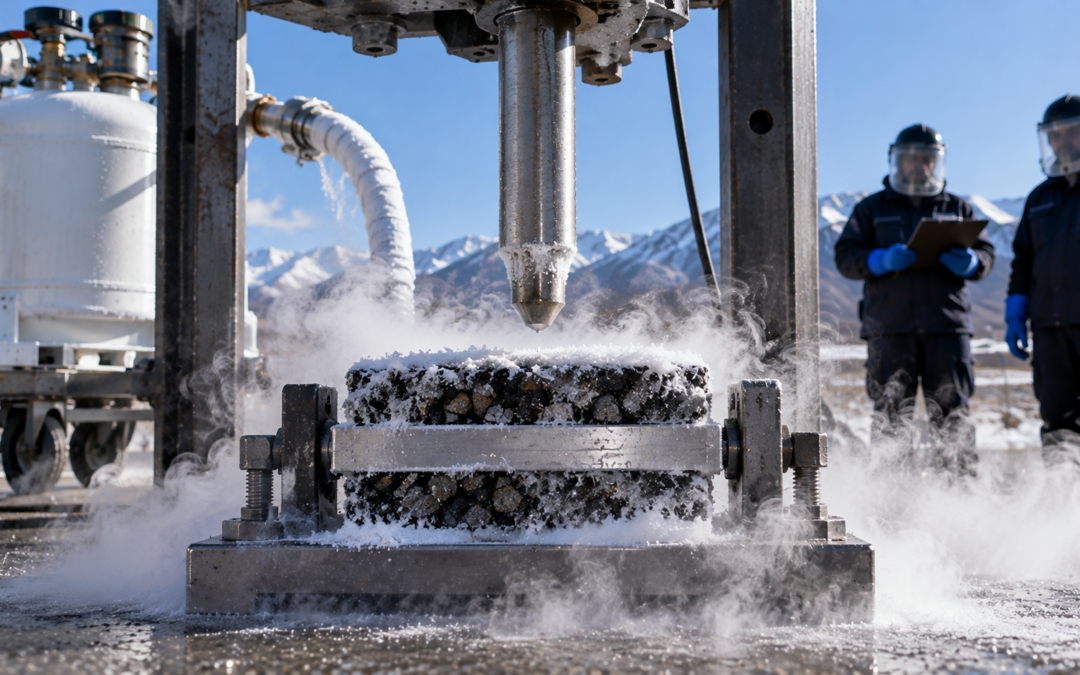
The researchers constructed a mechanical-impact test based on the applicable ASTM methodology. It used a 20-pound sliding mass with a half-inch stainless-steel striking pin. Beneath the impact point was a specific arrangement consisting of approximately one inch of crumbled asphalt, a one-inch aluminum plate, and another inch of crumbled asphalt.
That configuration produced a dramatically different result. Five reactions occurred in 20 tests. Under the ASTM criteria Andy discussed, even one reaction in 20 would indicate mechanical sensitivity. The team therefore had a repeatable reaction under that very specific configuration.
The researchers then began taking the apparatus apart conceptually to determine what was actually causing the reaction. Control tests using liquid oxygen alone, the aluminum plate alone, crumbled asphalt alone, and solid asphalt did not produce the same result. The key appeared to be the combination of the materials and the geometry.
According to the researchers’ interpretation, the impact compressed liquid-oxygen-containing spaces within the asphalt against the aluminum plate. The metal plate created a hard boundary, allowing the gas to compress extremely rapidly. That compression increased both pressure and temperature. This is where adiabatic compression enters the story.
Rather than letting the compression energy dissipate gradually, the rapid compression raises the gas temperature. Andy compared the underlying principle to what happens inside a diesel engine, where compression raises the temperature of the gas sufficiently to contribute to ignition.
In the unusual NASA-style configuration, that mechanism provided the missing piece of the puzzle: an ignition mechanism created by rapid compression rather than a conventional flame or spark.
Liquid Oxygen Doesn’t Mean Instant Explosion
The research becomes even more interesting when the team moved away from asphalt and tested liquid hydrocarbons directly. They tested a variety of fuels and combustible materials, including different types of hydrocarbons, alcohols, acetones, and other materials. They deliberately varied characteristics such as molecular size, viscosity, and flash point. Again, simply combining the liquid oxygen and the fuel did not produce an explosion.
The mixture became extremely cold as the liquid oxygen boiled away. Once an actual ignition source was introduced, however, the behavior changed dramatically. The fuels burned extremely vigorously in the oxygen-rich environment.
The team also investigated static electricity because of anecdotal claims involving liquid oxygen and carpeting. They tried different configurations but could not ignite the material with ordinary static sparks. An electrical arc was different.
When the researchers created an arc with a car battery, they could consistently ignite the mixture. The distinction matters because not every electrical event provides the same energy or duration needed to initiate combustion.
The same principle helps explain why oxygen itself isn’t the fuel in these scenarios. Oxygen supports combustion. When the oxygen concentration increases, many combustible materials become substantially easier to ignite and can burn much more aggressively. The fuel and oxidizer still need an appropriate ignition mechanism to initiate the reaction.
That’s also why the familiar stories about oxygen fires involving cigarettes are somewhat misleading when they’re used as evidence that oxygen itself spontaneously ignites things. In those cases, the cigarette provides the ignition source.
The question Andy’s research was trying to answer was much narrower: can liquid oxygen itself, through mechanical impact, create the conditions necessary to initiate combustion when it is mixed with a combustible material?
Under ordinary conditions, the team’s testing suggests no. Under a very specific configuration that can produce rapid compression, the answer was different.
What Should HazMat Responders Take Away?
The researchers aren’t suggesting that fire departments throw away their existing liquid oxygen precautions. In fact, Andy specifically cautions against changing operational guidelines based solely on this research.
Liquid oxygen remains an extremely cold cryogenic oxidizer, and the hazards associated with cryogenic materials still apply. Once liquid oxygen contacts combustible materials, the environment can become significantly more favorable for combustion. Ignition sources therefore remain an important concern.
The research challenges a more specific piece of conventional HazMat teaching: the idea that simply stepping on a liquid-oxygen-contaminated asphalt surface will inherently create an explosion through mechanical impact. The experiments did not support that scenario under ordinary conditions.
The research instead suggests that the geometry and physical configuration of the materials can be critical. The unusual NASA test apparatus provided conditions that ordinary asphalt roads do not. A specific combination of liquid oxygen, combustible material, a hard boundary, and rapid mechanical compression produced reactions that the researchers could not reproduce using ordinary asphalt and common tools. For HazMat instructors, that distinction is important.
There is a difference between teaching responders to respect a hazard and teaching them an unsupported mechanism for why the hazard exists. Sometimes the safest thing we can do is maintain the precaution while continuing to question the explanation behind it.
That’s ultimately what makes Andy’s work interesting. He wasn’t trying to prove that liquid oxygen was harmless. He was trying to find out whether something the HazMat community had been teaching for years actually worked the way we thought it did.
The answer turned out to be considerably more complicated. And sometimes the most valuable HazMat lesson isn’t learning a new rule. It’s finding out why the old one exists in the first place.