The Most Dangerous Part of an Ebola Response Isn’t What You Think
Few diseases capture public attention quite like Ebola. Images of responders in fully encapsulating suits, isolated treatment centers, and headlines reporting high mortality rates have shaped how many people think about the virus. That perception often leads to a simple conclusion: Ebola is terrifying because it spreads easily. In reality, that’s not what history has taught us. Ebola is certainly dangerous, but it is not a disease that casually moves through communities or infects everyone who comes near it. The real challenge for responders is understanding when the virus becomes contagious, how transmission actually occurs, and recognizing that some of the greatest risks arise not while treating the patient, but during the moments afterward. Those lessons have been learned repeatedly during previous outbreaks, and they remain just as relevant today.
Understanding the Risk Instead of Fearing It
One of the biggest obstacles during any infectious disease outbreak is misinformation. Rumors spread faster than viruses, and responders are often forced to separate fact from fiction while still preparing for the possibility of a real incident. Ebola has frequently been described as an airborne disease, compared directly to COVID-19, or portrayed as something that spreads simply by being in the same room as an infected person. That misunderstanding can lead responders to focus on the wrong hazards.
The reality is far more specific. Ebola is transmitted through direct contact with the blood or other infectious bodily fluids of a symptomatic individual. A person who has been exposed but has not yet developed symptoms is not considered contagious. That distinction changes how responders evaluate risk. Rather than assuming every encounter is equally dangerous, they can focus their attention on the situations where exposure is actually possible. Understanding the mode of transmission is not simply an academic exercise. It drives decisions about PPE, patient handling, transport, and ultimately responder safety.
The Highest Risk Comes Late in the Disease
Another common misconception is that every Ebola patient presents the same level of hazard throughout their illness. In reality, the risk to responders changes dramatically as the disease progresses.
Patients experiencing vomiting, diarrhea, bleeding, or other significant bodily fluid loss present a much greater contamination hazard than someone in the early stages of illness. Every drop of contaminated fluid has the potential to spread infection if it reaches a responder’s mucous membranes, broken skin, or an improperly protected surface. Human remains present an even greater concern because the virus remains infectious after death, making body handling one of the highest risk activities during an Ebola response.
For hazmat teams, this reinforces an important operational mindset. The objective is not simply to treat the patient. It is to manage contamination at every stage of the incident while preventing opportunities for the virus to leave the patient and reach the responder.
PPE Is Only Half the Equation
Hazmat professionals spend countless hours training on protective clothing. We practice suit selection, respirator use, fit testing, and equipment inspections because we understand PPE creates the barrier between responders and the hazard. But PPE only works if that barrier remains intact from the moment it is donned until the moment it is safely removed.
That is where many biological responses become deceptively dangerous.
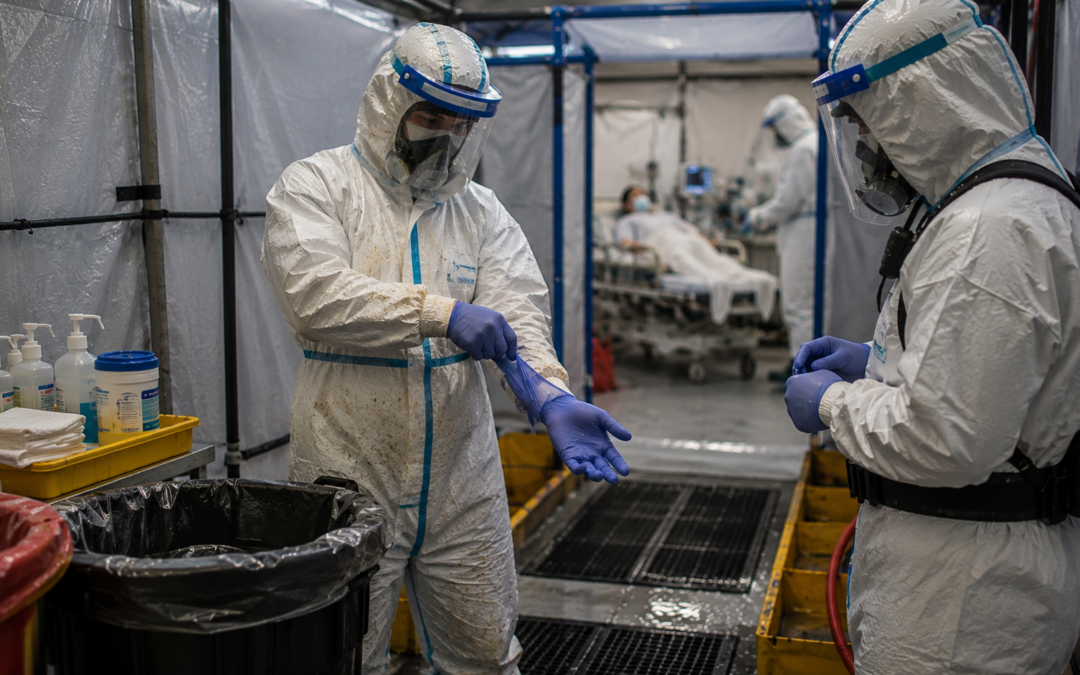
Putting on protective equipment is a deliberate, methodical process. Removing it can be surprisingly easy to rush. Fatigue sets in, the patient has been transferred, and the incident appears to be winding down. That is exactly when complacency can creep into the operation. Gloves contaminated with infectious material touch sleeves, hoods, respirators, or bare skin. A responder reaches for a zipper with contaminated hands or removes equipment in the wrong sequence. The protection that worked throughout the call suddenly becomes the source of exposure.
Lessons learned during previous Ebola outbreaks consistently pointed toward the same conclusion: disciplined doffing procedures prevented more exposures than stronger disinfectants ever could.
Decontamination Starts Before the Disinfectant
When most people think about decontamination, they immediately think about chemicals. Bleach solutions, hospital-grade disinfectants, and EPA-approved products all have an important role during biological incidents, but they are not the first step.
The first step is removing the contamination itself.
Visible blood, vomit, diarrhea, or other bodily fluids should be carefully absorbed or wiped away before disinfectants are applied. Gross contamination can physically block disinfectants from reaching the remaining microorganisms, reducing their effectiveness and unnecessarily spreading contamination during the decon process. By removing the bulk material first, responders allow the disinfectant to work on the smaller amount of contamination that remains.
This approach also reinforces an important hazmat principle. Decontamination is not simply about killing a hazard. It is about controlling where that hazard goes throughout the entire process.
Why Supervision Matters
One of the more valuable lessons to emerge from previous Ebola responses was the importance of assigning someone whose only responsibility is to supervise PPE removal.
A dedicated doffing officer is not there because responders lack experience. They are there because nobody is immune to making small mistakes after a physically demanding incident. A missed glove change, an out-of-sequence step, or an unnoticed contaminated surface may seem insignificant in the moment, but those small errors can become the exposure that matters most.
Having another trained responder carefully observe each step slows the process down just enough to catch those mistakes before they become injuries or illnesses. It is a simple concept, but one that repeatedly proved its value during large-scale biological responses.
The Incident Doesn’t End at the Hospital
For many hazardous materials incidents, the transfer of the patient marks the end of the operational challenge. Biological incidents rarely work that way.
Ambulances, stretchers, radios, medical equipment, monitoring devices, and reusable PPE all become potential sources of contamination if they are not properly cleaned and disinfected. Human remains require careful handling, leak-resistant body bags, and strict control over transportation and personnel access. Even waste generated during the response must be managed appropriately because the hazard does not disappear simply because the patient has left the scene.
Thinking beyond patient care is one of the defining characteristics of an effective biological response. Every object that contacted the patient deserves the same level of attention as the patient themselves.
Discipline Is the Best Protection
Ebola remains one of the most serious infectious diseases responders may encounter, but its danger is often misunderstood. The virus does not spread indiscriminately through the air, nor does every patient present the same level of risk. Successful responses begin with understanding how transmission actually occurs and recognizing the situations where responders are most vulnerable.
History has shown that many exposures were not caused by dramatic rescues or difficult medical procedures. They occurred during routine tasks that felt safe because the incident seemed to be ending. A contaminated glove. A rushed doffing sequence. A missed decontamination step. Small mistakes made after the hardest work was already finished.
That may be the most valuable lesson Ebola continues to teach the hazmat community. Protective suits, disinfectants, and equipment all play important roles, but none of them replace discipline. Responders who understand the hazard, remove contamination methodically, and treat every step of the doffing process with the same care as patient treatment give themselves the best chance of going home safely.
Because during an Ebola response, the most dangerous moment is often the one when you believe the danger has already passed.