There Is No Such Thing as “Nerve Gas”
The most useful part of my conversation with Mike and Bobby was also the part that stripped away the movie version of hazmat response. In their discussion about chemical and WMD response for first responders, they kept dragging the topic back to chemistry because chemistry is where the fantasy dies. The phrase people love to throw around -“nerve gas” -is one of those fantasies. What they were really talking about were liquids, often colorless, often hard to detect, that become a mass-casualty problem when they are dispersed as droplets, aerosols, or contamination on surfaces. That distinction matters because it changes everything about the way we think about exposure, spread, persistence, decon, and responder risk.
What stayed with me was how bluntly they framed it: many ordinary chemicals can hurt people, but chemical warfare agents are engineered for efficiency. They do the same ugly work at far lower doses. Mike and Bobby kept returning to routes of exposure -inhalation, absorption through the skin, mucous membranes, even secondary transfer by touch -because that is where complacency gets first responders in trouble. If the liquid gets misted, if it lands on a railing, if it sits on a doorknob, if it rides in on a patient’s clothing, the problem is no longer theoretical. It is now moving through a system of people.
That is why the old responder habit of relying on senses can get you killed. The conversation was full of dark humor about agents that supposedly smell “fruity,” “garlicky,” or like “geraniums,” but the point underneath the joking was serious. Odor is not a field instrument. At best, it is something a victim might report while a trained responder stays back, interviews, observes, and builds a picture from symptoms, environment, and contamination behavior. That cautious approach lines up with the broader responder doctrine in OSHA’s HAZWOPER rule, which requires emergency response programs to identify, evaluate, and control hazards, and with NFPA 470, which frames chemical and WMD response for first responders around competencies rather than guesswork.
The Real Fight Is Persistence in Chemical and WMD Response
The most important chemical lesson Mike and Bobby circled was the one most responders struggle to explain cleanly under stress: persistence. In conversation, they treated it the way good street instructors usually do -not as a textbook definition to be memorized, but as a behavior to be anticipated. How long does this material want to stay where it landed? How easily does it leave the liquid phase? How much can wind, ventilation, time, and temperature change the danger? That is the practical question.
In hazmat and WMD training, this is where military and civilian hazmat language sometimes gets mixed up. An agent may be described as “volatile” or “non-persistent” in a military comparison against other warfare agents, while still behaving, from a firefighter’s point of view, like a stubborn oily contaminant that is absolutely not going to vanish before the first-due company gets there. Bobby’s analogy of spilled cooking oil was crude, but effective. A persistent agent is not just a vapor problem. It is a contamination problem, a transfer problem, a hospital problem, and a chain-of-custody problem.
That idea also explains why the conversation kept shifting from release to contact. Aerosol is one pathway. Surface contamination is another. The dangerous moment is not always the dramatic release; sometimes it is the quiet handoff. The victim touches the rail. The medic touches the victim. The nurse touches the stretcher. A technical topic suddenly becomes a human-factors topic, because every link in the chain is a person making a rushed decision under uncertainty -a key focus in chemical and WMD response for first responders.
What the Body Tells You
When Mike and Bobby moved into signs and symptoms, the tone changed. The joking dropped away, and the responder’s brain took over. They talked through the classic cholinergic picture most of us learned by acronym -SLUDGEM or one of its many cousins, but they also made an instructor’s point that lands harder than the mnemonic itself: half the room can repeat the letters, and only a fraction can still define them under pressure. Salivation. Lacrimation. Urination. Defecation. Gastrointestinal distress. Emesis. Miosis. Muscle twitching. Bronchospasm. The words are easy in a classroom. They are harder in bunker gear, in a hallway, with vomiting patients, and bad radio traffic.
That matters because symptom clusters are often the first responders have. Not lab confirmation. Not a perfect instrument hit. Not a tidy scene. Just patients. Just behavior. Just clues.
The distinction they drew between nerve-agent-style presentations and blood-agent presentations was especially useful. A nerve agent overwhelms normal nervous-system shutoff mechanisms; a blood agent interferes with the body’s ability to use oxygen at the cellular level. On scene, both may look catastrophic, but they do not behave the same way. Cyanide-based blood agents can produce respiratory distress, collapse, and seizures, yet they do not present with the full cholinergic package that responders associate with nerve exposure. That is not trivia. That is differential diagnosis in turnout gear.
When they got to vesicants, the point was equally unforgiving. Blister agents do not just hurt now; many also carry long-term carcinogenic consequences. Mustard agents, in particular, complicate scene reading because symptoms can be delayed for hours. That delay is operationally vicious. It tempts responders and victims alike to downgrade the event before the chemistry has finished announcing itself.
The School Scenario That Explains Everything
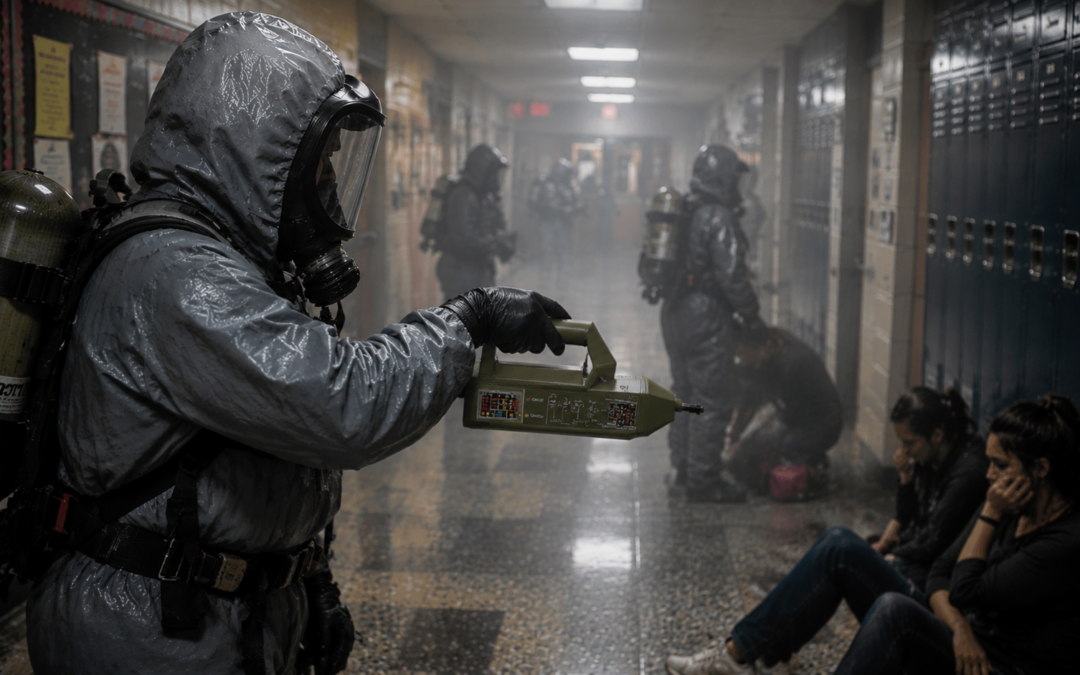
The sharpest part of the whole discussion was a simple scenario: you arrive at a school, patients are crying, vomiting, and tearing up, and everyone starts yelling, “chemical weapon.” Mike and Bobby immediately drove the conversation toward the uncomfortable alternative -what if it is mace, pepper spray, or another irritant, not a warfare agent?
That is where hazmat judgment lives. Not in the heroic answer, but in the disciplined one.
They talked through ventilation, fresh air, scene interviews, protective posture, and contamination persistence. An irritant dispersed from a locker prank or accidental discharge often behaves very differently from a persistent nerve-agent contamination problem. Pull people into the fresh air, irrigate, and control panic; many of those symptoms begin to subside. A true nerve exposure does not simply “wear off” because the patient walked outside. The body keeps telling the story.
There was a deeper psychological lesson in that scenario. In a school, in front of children, with anxious staff, you are not just reading chemistry. You are reading fear. Fear compresses time. Fear fills in blanks. Fear makes a common irritant feel like a weapon of mass destruction. The responders who do best are usually the ones who can slow the scene down just enough to think.
Sampling, Secondary Devices, and the Temptation to Rush In
I liked the way Bobby described hot-zone sampling because it was practical without sounding theatrical. Bring the sample to an organized work point within the hot zone. Get off the floor. Use clean comparison media for colorimetric papers or strips. Keep your process deliberate. In other words: stop acting like chaos is a badge of competence. That advice reflects the same discipline HAZWOPER emphasizes in training -workers should be prepared for the duties they are actually expected to perform, not the movie version of those duties.
Then the conversation widened into a terrorism response, and the hazard picture got bigger. Secondary devices. Radio-trigger concerns. Apparatus placement. Searching victims before transport. Working in pairs. Back-up teams in the warm zone. That part of the transcript was a reminder that a WMD response is never just about toxicology. It is also about strategy, denial, deception, and psychological warfare. The bomb that goes off after the bomb is designed to punish the reflex to help.
That is why I kept coming back to one line of thought from the interview: the most dangerous responder on these calls is the one who mistakes courage for immunity. Mike and Bobby took direct aim at the old firehouse mythology -the hoodless bravado, the “I can take a little more” mindset, the Superman complex that turns PPE into a suggestion. They were right to do it. PPE selection is not a chest-thumping exercise. It is a chemistry decision, a mission decision, and sometimes a test of humility.
The Part Too Many Departments Skip
Near the end, the conversation landed on two details that deserve more attention than they get. First, confined spaces and enclosed buildings make these incidents worse. Concentrations hold. Materials do not disperse. Warning: assumptions change. The room itself becomes part of the hazard. Second, the Emergency Response Guidebook is not just for highway tankers and overturned drums. The 2024 ERG is explicitly intended for the initial phase of hazardous materials incidents, and these agent categories do appear in guidebook references -exactly the kind of thing a first-arriving crew needs when it does not yet have the luxury of a full federal response package.
And that may be the most honest takeaway from talking with Mike and Bobby: most departments are not going to meter, sample, identify, isolate, decon, medically manage, and investigate a true nerve-agent event with their own organic resources. They are not supposed to. The first job is to recognize the problem, protect people, control the scene, read the symptoms, avoid becoming part of the body count, and call early for the state and federal assets that actually own the deeper capability.
That is not a weakness. That is professionalism.
If you lead a hazmat team, a truck company, an EMS unit, or a volunteer house that thinks WMD is somebody else’s problem, take this conversation back to your people and drill it until the language gets plain: stop saying “nerve gas,” stop trusting your nose, stop confusing irritants with persistent contamination, stop treating PPE like a dare, and start building responses around chemistry, symptoms, and disciplined scene management. Then run the school scenario again, because on the day it isn’t a drill, the room won’t care what acronym you forgot.
Well said, chemistry knowledge keeps responders alive!