
The Barrel That Looks Calm Until It Doesn’t
I’ve had this conversation with Mike Monaco and Bobby Salvesen enough times to know when a topic is making even seasoned responders uncomfortable. Polymerization does that. It lands in class like a bad joke with a long setup. Everybody recognizes the word. Almost nobody loves explaining it. And yet the reason it matters in the field is brutally simple: sometimes a container is not just holding product. Sometimes it is holding a reaction that is trying very hard to become something else.
That is the part Mike kept dragging back into the light. A monomer, stripped of the textbook polish, is just a small building block with a tendency to join up under the wrong conditions. Bobby reached for the kind of image responders actually remember: little magnets, little Lego pieces, unstable enough on their own that, given the chance, they start linking into something larger. In industry, that tendency is harnessed to make the things we touch every day-PVC, polyethylene, resins, rubbers, foams, coatings. In an emergency, that same tendency is the beginning of a pressure problem, a heat problem, and very quickly a life-safety problem.
That is why inhibited monomers matter so much in transportation and storage. They are not shipped on good intentions. They are shipped with stabilizers, temperature control, or other conditions meant to keep that urge to link up from running away. Federal hazmat rules treat unstable materials seriously; the Hazardous Materials Table can designate materials as forbidden in transportation, and the ERG flags some materials with a “P” to warn that violent polymerization is possible. OSHA’s HAZWOPER framework, meanwhile, is built around the same ugly truth Mike and Bobby kept circling: identify the hazard, control the scene, and do not confuse movement with control.
What makes polymerization such a cruel field hazard is that it often starts where confidence lives. The vessel is intact. The leak may be minor or nonexistent. The product might still be in spec, or close enough that somebody says, “We’ve got time.” That is the moment responders are seduced into thinking they are dealing with a storage problem rather than a chemistry problem. Mike put it in the language responders understand best: once this thing is really going, you are not in control in any meaningful way.
Heat, Pressure, and the Lie of “A Little More Time”
The science underneath that warning is not mysterious, but it is easy to underestimate. Most polymerization reactions of concern to responders are exothermic. They give off heat. That heat accelerates the reaction, which can generate more heat, which can raise pressure inside a closed container, which can push the system toward catastrophic failure. That feedback loop is what makes the event feel so unfair on scene. It may look quiet right up to the moment it stops being quiet at all.
Bobby made a point I wish more people sat with longer: responders usually arrive after control has already failed. We do not get invited to the lab when the inhibitors are fresh, the temperatures are steady, and the process engineer has all the variables pinned to the wall. We get called when contamination is possible, when heat has been added, when time in storage is uncertain, when somebody has overcooked the product, or when the material has been left to age, stratify, or react in ways the shipping paper does not fully capture. That means the field problem is not “How do I manage a polymerization reaction?” The field problem is “How do I recognize I may already be losing one?”
That is where their discussion about triggers becomes more than chemistry trivia. Temperature matters. Contamination matters. Inhibitor depletion matters. Pressure history matters. Container condition matters. Even molecular crowding-the steric effects Bobby mentioned-can alter reactivity in ways most responders are never going to calculate from a structural formula standing in turnout gear on wet pavement. And that is exactly the point. On scene, the winning move is not to become an organic chemist in three minutes. It is important to respect that the reaction space is larger than your certainty.
What the Camera Sees Before the Vessel Fails
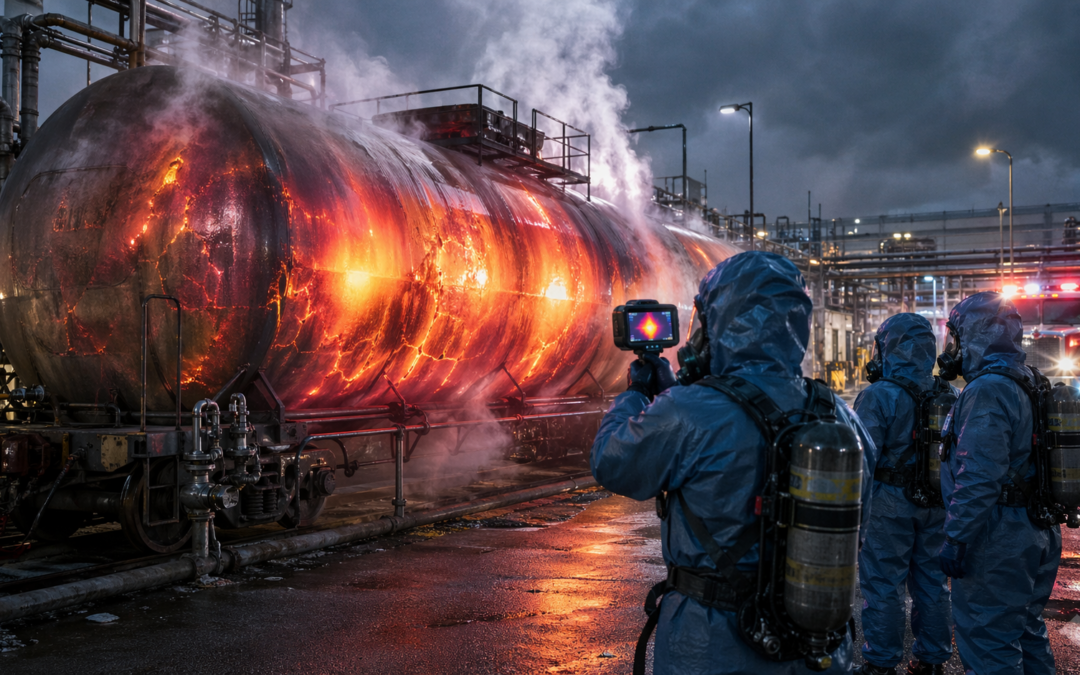
When Mike and Bobby shifted from chemistry to tactics, the conversation sharpened. This is where polymerization stops being a classroom abstraction and becomes a field recognition problem. If it is a reaction, then it will often announce itself thermally before it announces itself mechanically. That makes the thermal imaging camera one of the most valuable tools on the rig, not because it solves the event, but because it can tell you the event is changing.
I liked that neither of them oversold the gadget. A TIC is not magic. It is context. A hot vessel in a hot environment is not the same as a hot vessel against cooler surroundings. A changing thermal profile, a hot band, a warming shell, a spot that does not fit the rest of the container-those are clues, not verdicts. But in a suspected polymerization, even a few clues are enough to warrant distance, isolation, and a defensive posture.
That defensive mindset is not cowardice. It is doctrine. OSHA requires emergency response planning and hazard control under HAZWOPER, and NFPA 470 frames hazmat response around operational modes, strategy, and tactics chosen from the incident analysis, not from ego. When the product may be self-reacting, when pressure is building, and when the reaction cannot be reliably stopped in the field, “do less” is not a failure of nerve. It is often the highest form of competence on the scene.
Mike said it in plainer language: sometimes the best action is inaction. That line gets tossed around so often in hazmat circles that people stop hearing it. Polymerization forces you to hear it again. Because if the reaction has overpowered the inhibitor and the vessel is becoming a chemical bomb instead of fuel, there may be no clever technician move left to perform. There is only space, time, protection from exposures, and keeping other people from wandering into the kill zone.
The Incidents We Still Owe Our Attention
The history backs them up, and it does so without gentleness. In Freeport, Texas, on September 13, 2002, a 24,000-gallon railroad tank car containing hazardous waste catastrophically ruptured after steam-heating during transfer. The waste included cyclohexanone oxime, water, and cyclohexanone. Twenty-eight people were injured, nearby residents sheltered in place for five and a half hours, and the blast threw a 300-pound dome housing roughly a third of a mile. NTSB found that the tank car was overpressurized by a runaway exothermic decomposition reaction initiated by excessive heating, with failure to monitor temperature and pressure contributing to the disaster. That is the nightmare polymerization-adjacent lesson in a single frame: add heat to a reactive system you do not fully understand, and the vessel may decide the rest for you.
And then there is Bhopal, the name every hazmat student hears early and never forgets. In December 1984, methyl isocyanate was released from the Union Carbide plant in Bhopal, India, causing one of the worst industrial disasters in history. The exact chain of failures around the tank remains debated in parts, but the broad lessons are not: water contamination, reactivity, pressure, toxic release, failed safeguards, and catastrophic human consequences. Methyl isocyanate is acutely toxic by inhalation; Bhopal turned that chemistry into a mass casualty reality.
Those incidents matter because they strip away the fantasy that polymerization is just an exam word or a quirky “P” in the ERG. It is not. It is a warning that the material may be on a clock you cannot read.
What Mike and Bobby Were Really Teaching
By the end of the conversation, I realized Mike and Bobby were teaching two lessons at once. On the surface, they were explaining monomers, polymers, inhibitors, catalysts, exothermic reactions, chain initiation, chain propagation, and the rest of the vocabulary responders need to recognize when the SDS or reference material starts speaking in chemistry. The 2024 ERG still uses that simple operational shorthand: if the guide number carries a “P,” polymerization potential belongs in your size-up.
But underneath the terminology, they were teaching something harder and more useful: humility. Not passive humility. Operational humility. The kind that makes a crew slow down, verify, read the shipping papers carefully, check the SDS reactivity section, use the TIC intelligently, spell the product name clearly over the radio, and resist the fantasy that every problem yields to a more aggressive approach.
That matters because polymerization punishes impatience. It punishes assumption. It punishes sloppy communication, casual heat application, and vague estimates of container condition. It punishes the responder who sees a barrel, a railcar, or a tote and forgets that the real hazard may be invisible, internal, and accelerating.
So the next time that “P” shows up in the book, don’t treat it like folklore. Treat it like a countdown you haven’t been given permission to hear. Pull the references. Read the reactivity. Trust the thermal clues. Build distance early. Go defensive faster than your pride wants to. And then teach it the same way Mike and Bobby did-plainly, honestly, and before someone learns it from the side of a failing vessel.