
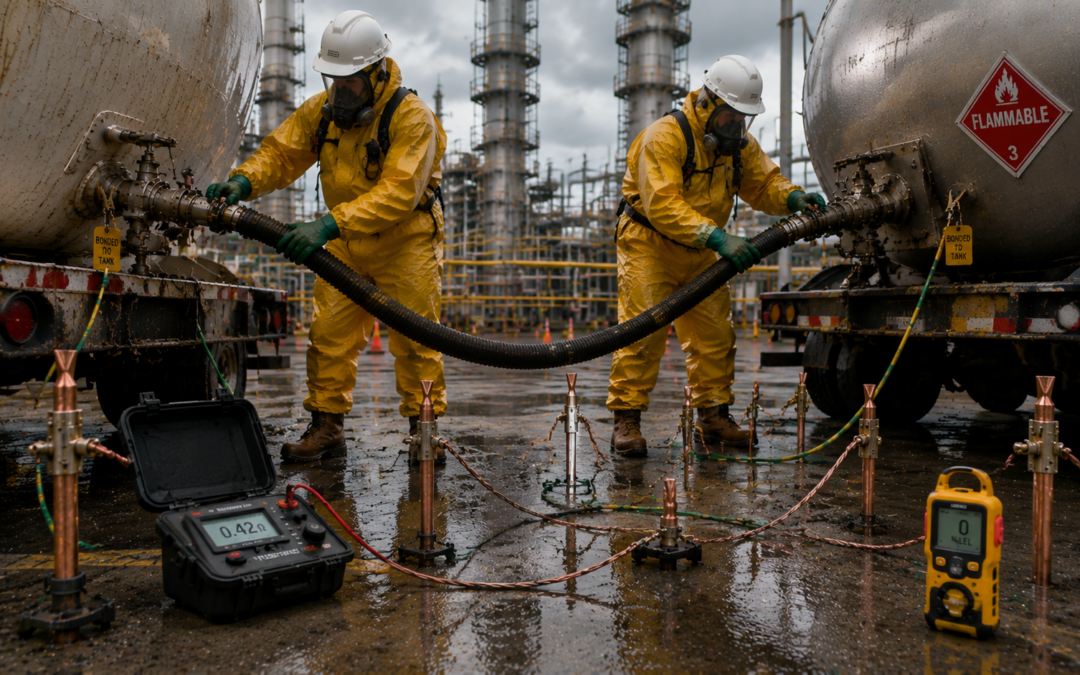
Where the Standard Stops and the Scene Begins
I came into this second part expecting more procedure. More clips, more clamps, more step-by-step grounding doctrine. What actually emerged was something more uncomfortable: how fragile those procedures become once they leave paper and hit a live incident.
Bobby and Mike were not arguing with the standards. They were pointing out where the standards assume conditions that the field rarely gives you. On paper, NFPA 30 from the National Fire Protection Association is clear enough. Chapter 18 sets out the expectation that facilities and operations must provide means to minimize static generation during the transfer of flammable and combustible liquids. That is clean language. Controlled language.
OSHA sits in a different space entirely under 29 CFR 1910.106. Once flammable vapors and transfer operations are involved, bonding and grounding are not theoretical. They are enforceable requirements tied directly to ignition prevention. That shift matters. It moves grounding and bonding out of “best practice” territory and into “legal expectation under hazard conditions.”
Still, none of those frameworks answer the real field question: what happens when the environment refuses to behave like the model?
The Problem With “One Number”
One of the biggest sources of confusion in grounding work is resistance values, particularly the way a few numbers get repeated without context.
In many training environments, a practical emergency benchmark is often cited around 1,000 ohms for temporary grounding systems in hazmat operations. That value is not about perfection or engineering-grade infrastructure. It is about achieving a functional path for charge dissipation in uncontrolled environments where soil conditions, equipment, and time are all variable.
That is routinely confused with the 25-ohm figure in the National Electrical Code. But that standard was developed for fixed electrical installations designed to handle fault current and lightning dissipation in buildings. It belongs to infrastructure grounding, not emergency product transfer.
The problem is not either number. The problem is applying infrastructure logic to incident response conditions. Lightning protection and static control are not the same energy problem. They are not the same scale, and they do not fail in the same way.
Once that distinction is clear, the goal stops being “hit a perfect resistance value” and becomes “ensure a reliable path exists under current conditions.”
That is a much more operational definition of success.
What Actually Breaks in the Field
Grounding and bonding failures rarely look dramatic. They do not usually fail with obvious sparks or obvious warnings. They fail through assumptions.
The most common assumption is that the system is grounded because the steps were followed. A rod was driven. A clamp was attached. A cable was connected. The ritual is complete, so the hazard must be controlled.
But electrical continuity does not care about procedural completion. It cares about metal-to-metal contact, surface condition, and actual resistance across the system.
Paint, corrosion, oxidation, and even thin surface films can interrupt that continuity. Aluminum, for example, forms an oxide layer almost instantly when exposed to air. Visually, it still looks like metal. Electrically, it behaves very differently.
That gap between appearance and function is where a lot of field confidence gets misplaced.
From an operational standpoint, this is also where cognitive load begins to matter. As equipment is connected and the operation progresses, responders often feel a greater sense of control. That sense of control can reduce attention to small details like contact quality or sequence integrity. It is not negligence. It is human performance under pressure.
And pressure is always part of the environment.
Sequence Is Not a Preference
The order in which connections are made is one of the most overlooked risk controls in grounding and bonding.
The logic behind the sequence is simple. The system is managing differences in electrical potential. If those differences are allowed to equalize at the wrong moment, the discharge path can become the responder or the wrong interface instead of the intended grounding system.
That is why connection order matters. The intent is to establish controlled equalization paths rather than allowing uncontrolled discharge during the act of connecting.
But sequence is also one of the first things to degrade under stress. Not because responders do not know it, but because real scenes compress attention. Vapor concerns, product movement, terrain, equipment layout, and command direction all compete for cognitive space.
When that happens, procedures get shortened. Not intentionally, but functionally. And shortened procedures tend to remove the very control mechanisms that prevent static discharge.
This is where grounding and bonding stops being a checklist and becomes a thinking process. If the only retained knowledge is “clip here, then there,” the system breaks when the environment changes. If the underlying principle is understood, adaptation becomes possible without losing control of the hazard.
When the Ground Is Not Reliable
The assumption that “ground is ground” is one of the more dangerous simplifications in field operations.
Soil conditions vary widely. Moisture content, mineral composition, compaction, and temperature all influence conductivity. Dry soil can behave almost like an insulator. Rocky or paved surfaces can eliminate natural grounding paths entirely.
That is why responders build grounding fields. Multiple rods increase surface area. Moisture improves conductivity. Salts increase ionic mobility in soil water, reducing resistance. The goal is not aesthetic. It is electrical connectivity across as much usable earth interface as possible.
In urban environments, responders often rely on existing conductive infrastructure. Fire hydrants, buried metal systems, guardrails, fencing, and other grounded municipal structures can all function as part of an unintended but effective conductivity network.
But that only works if continuity is verified rather than assumed.
Testing tools like ground resistance meters become the reality check. They remove interpretation from the equation and replace it with measurement. That shift is critical because it prevents visual confidence from overriding electrical reality.
If the system is not measured, it is guessed. And guessing is not a control strategy.
The Gap That Actually Matters
Across the entire discussion, one theme kept resurfacing: the real hazard is not just static electricity. It is the gap between what responders believe is connected and what is actually connected.
That gap exists in multiple forms. It exists in unremoved oxidation on a connection point. It exists in insufficient soil contact. It exists in a rushed sequence. It exists in environmental conditions that change conductivity without visible warning. It even exists in the assumption that low humidity or past success guarantees current safety.
Static only needs one of those gaps to become a problem.
And that is what makes grounding and bonding fundamentally different from many other hazmat tasks. It is not about performing steps correctly in isolation. It is about maintaining system integrity across an entire chain of connections under changing conditions.
The physics are stable. The environment is not.
So the standard is not just compliance. It is understanding. Understanding what creates charge, what allows it to accumulate, what controls its movement, and what finally gives it a path to discharge safely instead of unpredictably.
Because in hazmat operations, the spark is never the beginning of the incident.
It is the moment the invisible system finally reveals itself.