
The Top 10 Chemicals Moving on America’s Highways
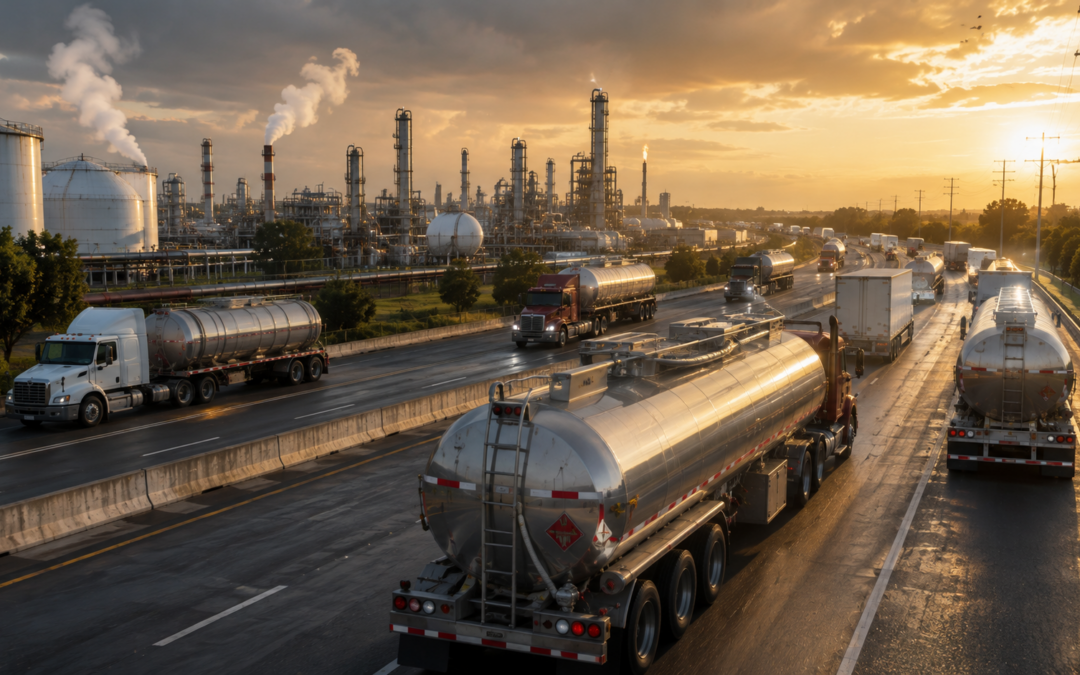
Every day, millions of people drive alongside hazardous materials without ever giving them much thought. Tank trucks move through cities, down interstates, and into industrial areas carrying the chemicals that keep everything from farms and factories to gas stations and water treatment plants running.
For hazmat responders, that means many of the chemicals we spend our careers training around aren’t hiding inside industrial facilities. They’re sharing the highway with us every day.
So, let’s count down ten of the chemicals moving in massive quantities over American highways and look at what makes each one worth knowing.
10. Hydrogen Peroxide
Hydrogen peroxide probably doesn’t sound particularly intimidating if your reference point is the little brown bottle in the medicine cabinet. Industrial hydrogen peroxide is a different animal.
Higher concentrations can present significant oxidizing and corrosive hazards. Hydrogen peroxide is used in chemical manufacturing, pulp and paper processing, water treatment, electronics manufacturing, and numerous other industrial processes.
One of the major concerns is what happens when concentrated peroxide contacts incompatible or combustible materials. An oxidizer doesn’t necessarily need to burn itself to dramatically accelerate combustion. During a transportation incident, damaged containers, wood, debris, fuels, and other materials can suddenly become part of that equation.
The lesson for responders is simple: don’t let the drugstore bottle define how you think about industrial peroxide.
9. Chlorine
Few chemicals receive as much attention during hazmat technician training as chlorine.
Chlorine, UN 1017, is a toxic inhalation hazard transported as a liquefied compressed gas. It’s heavily used in water treatment, chemical manufacturing, pulp and paper operations, and production of materials such as PVC.
Responders are also familiar with the different chlorine emergency kits associated with cylinders, ton containers, and transportation containers.
What makes chlorine interesting in the context of highway transportation isn’t simply its toxicity. It’s how much infrastructure depends on it. A chemical we train to treat with tremendous respect is also essential to processes happening around us every day.
Hazardous doesn’t mean rare.
8. Anhydrous Ammonia
If you’re operating anywhere near agricultural areas, anhydrous ammonia should already be on your radar.
UN 1005 ammonia is commonly transported as a liquefied compressed gas and presents significant inhalation, eye, and skin hazards. Agriculture represents a major application because ammonia provides nitrogen for fertilizers.
Industrial refrigeration is another major use, which means ammonia hazards aren’t limited to farms. Food-processing facilities, cold-storage warehouses, ice facilities, and other large refrigeration systems may also use it.
Ammonia represents a useful reminder that chemicals capable of creating serious emergencies are often the same chemicals modern society depends upon.
7. Hydrochloric Acid
Hydrochloric acid, commonly shipped as UN 1789, takes us into the corrosives.
HCl is a strong acid used throughout chemical manufacturing, steel processing, industrial cleaning, pH control, and oil and gas operations. Contact with the skin or eyes can cause serious injuries, while acid mist and hydrogen chloride vapor can create respiratory hazards depending on concentration and conditions.
Interestingly, hydrochloric acid is also a component of gastric acid in the human stomach. That certainly doesn’t make a bulk transportation release any friendlier.
Transportation incidents involving corrosives can introduce additional problems involving containment, runoff, materials of construction, and reactions with whatever the product encounters after being released.
6. Sodium Hydroxide
On the other side of the pH scale is sodium hydroxide, commonly called caustic soda or lye.
Sodium hydroxide solution is commonly transported as UN 1824 and is widely used in chemical manufacturing, pulp and paper production, soaps and detergents, aluminum processing, water treatment, and countless other industrial applications.
One mistake responders can make is mentally associating “acid” with dangerous while treating strong bases as somehow less aggressive. Sodium hydroxide should quickly eliminate that thinking. Strong bases can cause devastating chemical burns, particularly involving the eyes and tissue.
Variations of the same chemistry associated with drain cleaner and industrial processing also appear in food preparation, including processes used to produce the characteristic exterior of some pretzels and bagels.
Concentration, quantity, application, and route of exposure change everything.
5. Sulfuric Acid
Sulfuric acid is one of the workhorses of industrial chemistry.
It’s used in fertilizer production, petroleum refining, chemical manufacturing, metal processing, lead-acid batteries, and many other industrial processes. Its consumption has historically even been used as a rough indicator of industrial activity because so many manufacturing processes depend upon it.
For responders, sulfuric acid presents the expected corrosive hazards, but concentration matters tremendously. Its interactions with water and other materials can generate substantial heat, while spills can create secondary hazards depending on what the acid contacts.
This isn’t an obscure laboratory chemical. It’s deeply embedded in industrial production, which means enormous quantities have to move between manufacturers, processors, distributors, and end users.
4. Ethanol
At number four, the hazard class changes.
Ethanol, commonly transported as UN 1170 depending on concentration and formulation, is a flammable liquid. Large quantities move between ethanol producers, fuel terminals, blending facilities, and other parts of the transportation fuel network.
The ethanol we’re concerned with on the highway isn’t a truckload of beer. We’re talking about bulk ethanol and ethanol solutions that can generate ignitable vapor-air mixtures.
Ethanol also illustrates why correctly identifying the product matters during fire operations. Alcohol fuels don’t necessarily behave exactly like conventional hydrocarbon fuels, particularly when water miscibility and foam selection enter the equation.
Responders shouldn’t assume every flammable-liquid tanker fire is simply another gasoline incident.
3. Propane
Now we’re getting into materials almost everyone encounters.
Propane, commonly shipped under UN 1075 in bulk transportation, is a liquefied petroleum gas stored and transported under pressure. We use it for home heating, cooking, industrial processes, forklifts, agriculture, and the backyard grill.
The transportation container applies the same fundamental storage concept as that barbecue cylinder, but on a vastly larger scale: keep propane under sufficient pressure so much of it remains liquid.
That’s where one of propane’s important properties comes into play. Liquid propane expands enormously when converted to vapor, roughly 270 times its liquid volume under typical reference conditions.
Add flammability, pressure, heat exposure, and the potential for catastrophic container failure, and it’s easy to understand why propane transportation emergencies get firefighters’ attention.
2. Diesel Fuel
Diesel is so familiar that it’s easy to stop thinking about it as a hazardous material.
It’s everywhere: trucking fleets, construction equipment, generators, rail operations, industrial facilities, farms, emergency power systems, and fuel stations. That enormous demand means an equally enormous transportation network keeps those users supplied.
Diesel generally presents a lower vapor hazard than gasoline under ordinary ambient conditions because of its lower volatility, but that doesn’t make a significant release harmless. In a fire, diesel can produce substantial heat and heavy smoke. Large spills also introduce environmental, runoff, and ignition concerns.
Familiarity can actually work against us. We immediately recognize an overturned fuel tanker, but familiarity can reduce the respect we’d give an unfamiliar chemical in the exact same quantity on the roadway.
1. Gasoline
Number one shouldn’t surprise anyone.
Gasoline is one of the most ubiquitous hazardous materials in American life. We manufacture it, distribute it through terminals, transport it by tanker, store it underground at service stations, pump it ourselves, and carry it around in the fuel tanks of hundreds of millions of vehicles.
Gasoline is commonly identified as UN 1203 and presents a significant flammable-liquid hazard because of its volatility and ability to produce ignitable vapors.
Unlike many chemicals on this list, almost everyone interacts with it routinely.
That’s what makes gasoline interesting from a risk-perception standpoint. If responders encountered an unfamiliar chemical with gasoline’s volatility, flammability, transportation volume, and widespread public exposure, we’d probably treat it very differently.
Instead, people stand next to it wearing shorts and flip-flops while pumping ten gallons into their cars.
The Hazard Is Already Around You
The real takeaway from this list isn’t memorizing whether sulfuric acid beats sodium hydroxide or exactly how many tankers of ethanol travel American highways each year.
It’s recognizing the scale of chemical transportation happening around us.
Hydrogen peroxide, chlorine, ammonia, hydrochloric acid, sodium hydroxide, sulfuric acid, ethanol, propane, diesel, and gasoline aren’t exotic substances locked away inside laboratories. They’re industrial commodities. Modern agriculture, manufacturing, energy, transportation, sanitation, and infrastructure depend upon them, so they have to move.
Transportation emergencies also remove some of the advantages responders may have at a fixed facility. At a plant, preplans, inventories, facility personnel, SDSs, fixed containment, and established processes may help us understand what we’re dealing with.
On the highway, our first introduction to the problem might be a placard on an overturned tanker at 2 a.m.
That’s why understanding what’s moving through your jurisdiction matters.
You don’t have to work next to a chemical plant to have a chemical plant’s worth of product show up on your highway.