Where Hazmat Ends and Intent Begins
The first thing that struck me, listening to Mike and Bobby work through weapons of mass destruction, was how hard they tried not to let the conversation slide into cable-news theater. They kept dragging it back to the curb line, back to the rig, back to the responder’s first ugly question: is this an accident, or did somebody mean for this to happen? Responders must understand WMD hazmat response before approaching any suspicious chemical or biological threat.
That distinction matters, but not in the way civilians think it does. On the street, the chemistry may be identical. The release may look identical. The casualties may stack up the same way. What changes is intent, and intent changes everything downstream: who owns the scene, who gets evidence, how aggressively you move, and how much of your job shifts from rescue to restraint. That is why hazmat people who hate the politics of terrorism still have to study it. You do not get to opt out of reality just because the topic is radioactive in more ways than one.
Bobby and Mike were blunt about another uncomfortable truth: very few responders will ever get meaningful real-world experience with a true WMD event. That leaves us with what Bobby called brute-force learning. You learn signs and symptoms. You learn scene indicators. You learn where your local lane ends. And then you train hard enough that when the impossible-looking call finally drops, you do not improvise yourself into a body bag.
That is not just good culture. It is a regulation. OSHA’s HAZWOPER rule requires emergency response organizations to operate within a compatible incident command system, and it specifically requires operations-level responders to know and implement their employer’s ICS and emergency response plan.
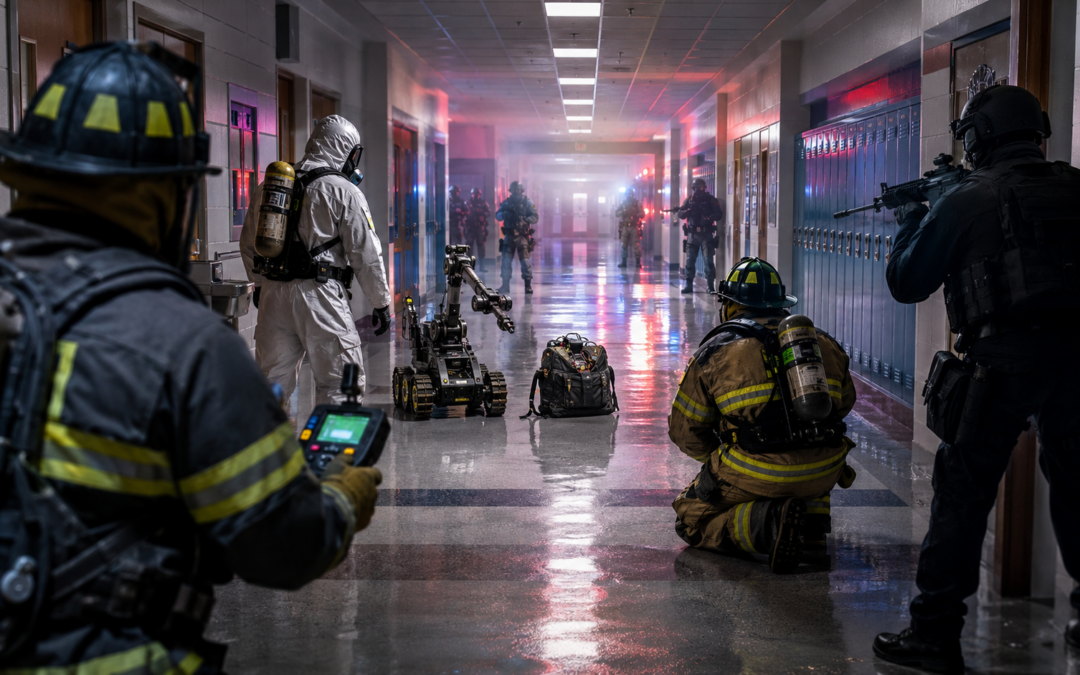
Mike kept coming back to jurisdiction, and he was right to do it. In some places, the fire department owns the first bite of the apple. In others, law enforcement will take anything involving suspicious powders, devices, or criminal indicators almost immediately. That sounds bureaucratic until you stand in front of a school hallway with an unexploded device report and realize that “knowing your role” is not administrative trivia. It is survival. The FBI’s own suspicious-package guidance is explicit: do not start handling or diagnosing a suspected device, and any render-safe work belongs to certified bomb technicians or military EOD, not the nearest eager responder with a meter and bad judgment.
The Scene Tells on Itself
The best part of the conversation was how little of it depended on cinematic clues. Mike and Bobby were not hunting movie villains. They were reading the scene the way experienced hazmat people do, one small irregularity at a time.
Sometimes the location is the warning. A symbolic site. A public building. A controversial business. A transportation hub. A place where fear travels faster than the plume. Sometimes it is timing: holidays, anniversaries, cultural events, anywhere the attack is meant to do psychological work beyond the immediate blast radius. And sometimes it is more subtle than that. An unusual cluster of illness. People down with no clear trauma. Odors where there should be none. A vapor cloud that does not belong. Fire behavior that feels chemically wrong. That is the discipline here: not guessing the entire plot, just noticing that the scene is lying about what it is.
That mindset is exactly where hazmat and WMD response overlap. The responder’s first job is not to be heroic. It is to stop misreading the environment. If thirty people are on the floor of a mall and nobody can explain why, the incident is already speaking. If a white powder shows up in a jurisdiction where the police own the evidence trail, then your discipline is to resist the technician’s urge to “just test it.” In that moment, patience is not passivity. It is command presence.
And command presence is not just posture at the front bumper. Under OSHA, emergency response plans must be built to identify hazards, control operations, and establish command. In modern standards language, responder competencies for hazardous materials and WMD incidents now appear in NFPA 470, which consolidated the older NFPA 472, 473, and 1072 tracks into a single standard. That matters because it reflects the real world Mike and Bobby were describing: these events are no longer neatly separated into old silos of hazmat, EMS, and law enforcement awareness.
B-NICE, Without the Training-Poster Nonsense
When the conversation turned to B-NICE, I appreciated that they kept it anchored to what an operations-level responder actually needs. The mnemonic is simple enough to sound almost childish, but that is the point. Under stress, the brain does not want elegance. It wants handles.
Biological threats are the first place where bad responder folklore can get people hurt. Bacteria, viruses, and toxins do not behave the same way, and collapsing them into a single mental category leads to overreacting to one hazard and underreacting to another. Anthrax is the classic example. Bacillus anthracis forms spores, and those spores can survive in the environment for decades under the right conditions. That persistence is what makes it such an enduring concern for preparedness.
But not every biologically derived threat is contagious. Ricin, which Mike and Bobby mentioned, is a toxin, not an infectious organism. The CDC is clear: ricin poisoning is not contagious, though secondary exposure can occur if the material is still on a victim’s body or clothing. That is a crucial operational distinction. “Not contagious” does not mean “safe to ignore.” It means your protective priorities and isolation strategy differ from those you would use for a communicable disease.
Then there is the nuclear and radiological side, where responder education too often gets trapped between mysticism and boredom. Mike did a solid job dragging it back to first principles. Ionizing radiation is the real concern because it carries enough energy to knock electrons out of atoms and damage tissue and DNA. EPA guidance identifies alpha particles, beta particles, gamma rays, and, in some situations, neutron radiation as the major operational categories responders need to understand. Alpha may be weak externally but dangerous if inhaled or ingested. Beta can burn skin. Gamma and neutron exposures change the game because distance, shielding, and time suddenly become life-saving math instead of classroom vocabulary.
That is what makes WMD training so psychologically difficult. Every one of these categories punishes a different kind of ignorance. Biological events punish sloppy assumptions about transmission. Radiological events punish invisible exposure. Explosives punish curiosity.
The Device in the School Hallway
The most useful stretch of the discussion came when Bobby put Mike on the spot with a scenario: unexploded device, school hallway, evacuation in progress, no obvious lab context, sunny June day, resources en route.
That is where you see the difference between a responder who wants to sound smart and a responder who wants to go home.
Mike did not race toward the package. He started widening the problem. Life hazard status. Evacuation completion. Collapse zones. Utility impacts. Line-of-sight to the blast area. Standoff distance. The possibility of secondary devices. The possibility that the package is not only an explosive problem, but also a radiological one. In other words, he built space before he built tactics.
That is mature command thinking. Secondary devices have haunted first-responder training for decades because they weaponize our own instincts. We move toward victims. We move toward uncertainty. We cluster near command posts, apparatus, and the easiest ingress points. A competent attacker knows that. So the scene has to be read not just for the first problem, but for the way the first problem is trying to position you for the second.
The FBI’s guidance on suspicious packages reinforces the same conservative approach: recognize indicators, isolate, notify, and let qualified bomb technicians do bomb-technician work.
That same discipline applies to explosives classification. The transcript wandered, as these conversations often do, into low-order versus high-order behavior, deflagration versus detonation, primaries and secondaries. All of that matters academically. But Bobby landed on the operations-level truth: from the wrong distance, the taxonomy stops mattering. The responder does not get extra credit for correctly naming the mechanism that sent fragments through the thorax.
What matters is that explosives are not just blast problems. They are glass, collapse, ignition, panic, and command problems. That is why the school scenario naturally led them to water supply, exposure protection, shielding, corner positions, and building collapse offsets. It is also why those old warning signs about secondary devices were never paranoia. They were memory aids for humility.
Mike and Bobby never tried to sell certainty where none exists. That may be the most valuable thing in the whole conversation. WMD response is not about pretending we can out-guess every actor or out-study every agent. It is about building responders who can recognize the scene, respect the lane, slow down when adrenaline says accelerate, and apply boring fundamentals before the incident punishes them for freelancing.
That is the work. Not theatrics. Not mythology. Not bumper-sticker counterterrorism.
Train your people to read intent without chasing it, to respect ICS before ego, to treat B-NICE as a field tool instead of a classroom slogan, and to rehearse the ugly scenario before it picks your school, your mall, or your downtown. Then run the drill again.