
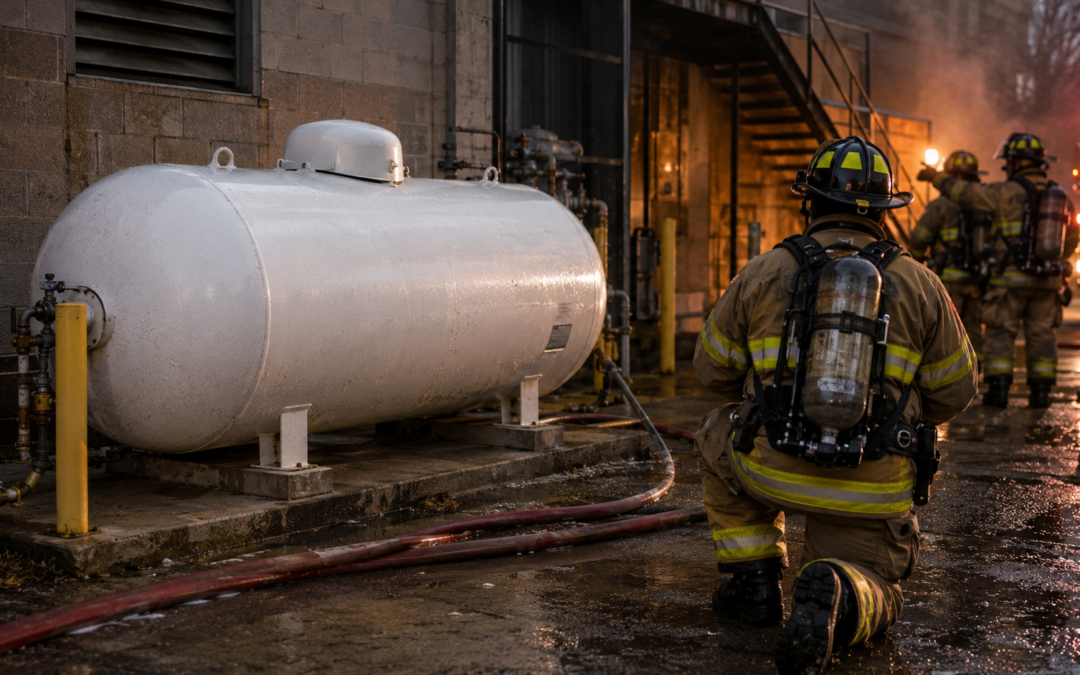
Where Propane Hides Until It Doesn’t
The easy mistake with propane is thinking small tanks mean small problems. Sitting with Mike and Bobby, I kept coming back to that point, because they were talking about hardware-store cylinders and camping bottles with the kind of casual familiarity that only comes from seeing how quickly “not much to them” becomes a working fire, a vapor cloud, or a bad rescue decision. A one-pound bottle on a shelf, a grill cylinder behind a duplex, a standby generator behind a McMansion, a bobtail in traffic, different scales, same lesson. Propane is still propane: a flammable hydrocarbon, stored as a liquid under pressure, waiting for pressure loss to turn it into vapor fast and in volume. The chemistry does not care whether it is feeding a pool heater, a food truck, or a home generator in the suburbs. Propane is commonly stored as a liquid under pressure, odorized for leak detection, and when released, it expands dramatically as it vaporizes.
That matters in the residential world more than most firefighters like to admit. We all know the backyard grill cylinder. What Mike and Bobby drove home is the second layer: generators. Some are the drag-it-out-of-the-shed variety, the kind that invites illegal backfeeding and a dozen electrical sins before breakfast. Others are permanently piped standby systems with a bulk tank sitting quietly in the yard until the lights fail and the homeowner finally discovers a regulator issue, a bad fitting, or a leak that had no reason to announce itself until the system actually flowed. That is what makes standby propane so treacherous. It can sit unused for long periods, and the defect does not become obvious until the exact moment the system is expected to perform. PHMSA guidance for LP-gas systems points operators back to NFPA 58 and related federal rules for materials, equipment, and system integrity, which is the bureaucratic version of the same warning Mike and Bobby were making on the street: dormant does not mean safe.
The Container Is Strong. The Weak Points Are Not.
The tanks themselves are not the part that usually lies to you. Bulk propane containers are robust by design, and OSHA’s LP-gas rules assume containers, valves, and relief devices are engineered for pressure, with hydrostatic relief and start-to-discharge settings that reflect that reality. What fails, as Bobby put it in plain language, are the common weak points: threaded connections, welded seams, valves, stems, and anything that has spent years outside trading moisture for corrosion.
That is why the abandoned-tank story hit so hard. A woman smells gas from an old propane tank that had been sitting on her property for years. The tank looks like junk, but it is still holding product. Somebody tries the old plug-the-pinhole move with a dowel, and the bottom gives way. Suddenly, the incident is no longer a nuisance leak. It is a liquid release, and liquid propane released to the atmosphere is where responders get into trouble. PERC’s own safety material notes that liquid propane released into the air quickly vaporizes and expands roughly 270 times its original liquid volume. That is not a minor leak with a little odor around it. That is a rapidly growing vapor problem with ignition consequences.
I liked Bobby’s blunt rule better than any polished classroom slogan: inspect the container before you get clever. That is more than technician swagger. It is a risk assessment. A corroded shell or a wasted thread engagement immediately changes the odds. Tightening a weakened valve into rusted threads is not “doing something.” It is applying force to the very place the metal has already told you it has had enough. The phrase “rocket valve” got laughs in the room, but the physics behind it are not funny.
Reading the Leak Before It Reads You
The conversation got even better once they moved from containers to leak detection, because this is where experience starts separating itself from gadget worship. Everybody loves a PID, and everybody loves saying “we metered it.” But Mike and Bobby were honest about the limits. A PID can be useful for quantifying low levels in the atmosphere, but it is not always the fastest or most practical tool for finding a tiny pinhole leak on a propane container. For that, they kept coming back to metal-oxide sensors-the old hot-or-cold style meters that respond quickly enough to let a tech hunt the leak in real time.
That tracks with the operational reality. When you are chasing a tiny seam leak or a corroded thread, response speed matters as much as sensitivity. A lagging instrument can tell you there is product in the area and still leave you guessing where the path actually is. That is why the oldest hazmat trick in the book still survives every technology cycle: soapy water. On paper, it sounds almost primitive. In practice, it is disciplined leak confirmation. If bubbles show at the thread, the stem, or the cap, that is not nostalgia. That is evidence.
The bigger point Mike and Bobby were circling is that metering should match the problem. Metal oxide for the hunt. LEL meter when the atmosphere is getting rich enough that your real concern is the distance between you and ignition. PID, where it actually helps quantify lower concentrations. The common error is taking one instrument and trying to make it the answer to every question. It never is.
Defensive Work Is Not Passive Work
When the discussion turned to tactics, I appreciated that they drew a clean line between defensive and offensive operations without turning it into a macho contest. Defensive work is not doing less. It is doing the right things first: isolating, metering, controlling access, eliminating or shielding ignition sources, and protecting the exposures that matter. If there is a rescue, that calculus changes. But absent that, the first job is still scene control.
With propane, scene control means thinking three dimensions and two directions at once: where the vapor is now, and where gravity will take it next. Propane vapor is heavier than air, so Bobby’s warning about basements, utility vaults, sewers, and low areas was not theoretical. That behavior is a core property of the gas and one reason vapor migration can outrun the casual assumptions of bystanders and even responders.
That is also why their New York manhole example worked so well. You can kill obvious ignition sources all day and still be staring at subterranean electric infrastructure that you cannot simply switch off. So what do you do? You redirect the hazard. The fog-stream discussion was useful here because they were careful not to oversell water as a magic cure-all. They were not talking about dissolving propane out of existence. They were talking about using fog for entrainment and hydraulic ventilation, pushing vapor away from the ignition source and shaping the atmosphere long enough to buy space and time. That is street-smart hazmat: understanding the mechanism, not just mimicking the move.
They also made an important point about the Emergency Response Guidebook. If you do not have perfect information, use the tools you do have. The ERG is not glamorous, but it gives isolation and protective-action guidance built for the exact moment when the incident is moving faster than certainty. PHMSA’s 2024 ERG remains the federal baseline for initial isolation and protective action on transportation-related hazmat incidents.
Offensive Operations Belong to People Who Actually Train for Them
Then the conversation crossed the line most departments flirt with, and too few truly prepare for: offensive propane work. Transfer, burnoff, water injection, freeze plugs, wraps, capping-this is the realm where confidence becomes dangerous if it is not backed by equipment, doctrine, and repetition.
Liquid transfer sounds simple until you remember what liquid propane really is: a pressurized liquid that wants to become a gas. Federal and industry references both emphasize that propane remains liquid under pressure, and its storage behavior varies with temperature and container conditions. So when Mike and Bobby talked about closed-system transfer, pressure-rated hoses and pumps, head-space equalization, and the need to actually monitor tank pressure and flow, they were describing an operation that punishes improvisation. This is not moving water between drums. This is managing phase change, container pressure, and mechanical limits simultaneously.
The same goes for burnoff operations. I have seen firefighters romanticize flare work because fire feels familiar. Mike and Bobby did the opposite. Yes, there are controlled ways to burn off product. Yes, seasoned teams use field methods. But under all the gallows humor was a serious truth: every one of those options depends on training, equipment compatibility, leak location, and the discipline to know when not to touch it. Their rejection of casually plugging a relief valve was one of the best moments in the whole exchange. Relief devices open for a reason. Disable the last-pressure-safety mechanism without solving the underlying cause, and you may transform a leak into a bomb. OSHA’s LP-gas rules and pressure-relief provisions exist precisely because overpressure is not an academic hazard.
Even the “simple” tricks came with caveats. Freeze plugs with wet rags can buy time on a vapor leak because evaporation pulls heat and creates the cold needed to build ice. But the fix is temporary and self-limiting. Slow the leak too much, and you lose the cooling that made the ice in the first place. That kind of practical chemistry-the sort you learn on asphalt, not PowerPoint- is what made this conversation worth preserving.
What stayed with me, though, was not one tactic. It was the mindset underneath all of them. Mike and Bobby kept returning to the same discipline in different languages: size up the container, understand the product, choose the right meter, respect the relief devices, and do not confuse action with progress. Propane incidents punish ego faster than ignorance. The firefighter who wants to “man up” with a wrench may be only seconds away from proving the tank right.
That is the call here. Please train on propane as if it is already in your district, because it is. It is in the grill cage, the camping aisle, the standby generator, the delivery truck, the fleet vehicle, the shed, the basement path, and the street vault you forgot was there. Pull your meters out. Read the code. Drill the size-up. Build your decision points before the leak starts talking